

By The Qualitative Magazine News Desk | July 26, 2025 | Abuja, Nigeria
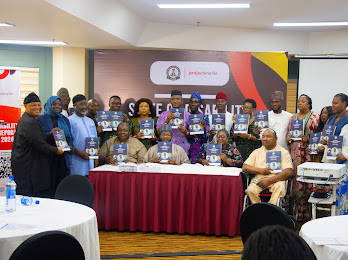
In a powerful show of commitment to inclusive governance, the Senior Special Assistant to the President on Special Needs and Equal Opportunities, Hon. Mohammed Abba Isa, on Friday officially unveiled the much-anticipated 2024 State of Disability Inclusion Report in Abuja. Produced by Project Enable Africa with support from the Nigeria Youth Futures Fund, the report offers a sweeping national assessment of the status of disability inclusion in Nigeria—six years after the enactment of the landmark Discrimination Against Persons with Disabilities (Prohibition) Act, 2018.
The launch, held in the Federal Capital Territory, attracted high-level stakeholders from the Federal Government, development agencies, civil society organizations, and representatives of Organizations of Persons with Disabilities (OPDs), all united in their resolve to close the gap between policy and practice for millions of Nigerians living with disabilities.
A Timely Wake-Up Call
In his keynote address, Hon. Mohammed Abba Isa commended Project Enable Africa and the Nigeria Youth Futures Fund for delivering a data-driven, evidence-based report that not only tracks progress but also exposes systemic failings in the nation’s journey toward disability inclusion.
“This report is timely and necessary. It is both a mirror and a map—a mirror reflecting the harsh reality of how far we’ve come, and a map guiding us on where we must go next,” Hon. Abba Isa said.
While acknowledging the strides made since the passage of the National Disability Act, he expressed deep concern over its slow, fragmented, and underwhelming implementation, noting that only 23 out of 36 states have passed corresponding disability laws, and just 15 of those have functional implementing agencies.
“The expiration of the five-year transition period mandated by the Act should have marked a turning point. Sadly, it has not. Infrastructure remains largely inaccessible, inclusive education is poorly supported, healthcare systems are not disability-friendly, and employment and social protection mechanisms continue to exclude persons with disabilities,” he lamented.
A Call for Unified Action
Hon. Abba Isa used the platform to announce a series of bold steps the Presidency is taking to rectify the situation. He revealed that, under the directive of President Bola Ahmed Tinubu, his office will commence strategic advocacy visits to the 13 states yet to domesticate the Act or set up implementation frameworks.
Additionally, he disclosed that his office is actively engaging with the Head of the Civil Service of the Federation to rally Ministries, Departments, and Agencies (MDAs) towards faster implementation, stronger accountability, and effective resource mobilization.
“Inclusion is a multifaceted journey that demands collective responsibility,” he said. “It is unfortunate that despite the presidential mandate for my office to work closely with the National Commission for Persons with Disabilities (NCPWD), collaboration has been lacking. We must correct this course together.”
The SSA also underscored the systemic barriers identified in the report—including inadequate funding, weak enforcement mechanisms, stigma, poor coordination, and lack of technical expertise—as critical bottlenecks that require urgent, united action.
“We cannot overcome these challenges through piecemeal efforts. What we need is a united front, policy reforms, and robust investment in capacity building,” he emphasized.
From Policy to Accountability
In a firm stance, Barrister Ikem Uchegbulam, who represented the Executive Secretary of the NCPWD at the event, emphasized the Commission’s resolve to begin holding event organizers accountable for choosing venues that are not accessible to persons with disabilities.
“Hotels and public venues that fail to meet accessibility standards will no longer be tolerated. The National Disability Act must come into full force—not just on paper, but in practice,” Barr. Uchegbulam asserted, drawing loud applause from attendees.
Championing Employment Equity
In his welcome address, Mr. Kola Olugbodi, Chairman of the Board of Trustees at Project Enable Africa, emphasized the importance of inclusion in employment, calling on both public and private sectors to increase their employment quotas for persons with disabilities to at least 10%.
“True inclusion cannot exist without economic empowerment. It’s time we go beyond tokenism and create real opportunities,” Mr. Olugbodi said.
The Report: Five Pillars of Inclusion
The 2024 State of Disability Inclusion Report focuses on five core thematic areas:
- Accessibility
- Education
- Health
- Employment
- Social Protection
It offers detailed evaluations of compliance levels with the National Disability Act and the United Nations Convention on the Rights of Persons with Disabilities (UNCRPD) across Nigeria’s 36 states and the FCT. The report aims to guide policymakers, development partners, and advocacy groups in identifying gaps, recommending reforms, and designing targeted programs to improve the lives of over 25 million Nigerians with disabilities.
Renewed Hope, Real Inclusion
Reaffirming the Federal Government’s commitment, Hon. Abba Isa concluded with a resounding pledge:
“The Renewed Hope Agenda of President Bola Ahmed Tinubu is a roadmap to inclusive development. My office stands ready to collaborate with every government institution, development partner, OPD, and civil society organization committed to making Nigeria a truly inclusive nation. We must ensure no one is left behind.”
The event was not just a policy dialogue—it was a rallying cry, a recommitment to a national promise, and a call to action that resonated with all in attendance.
As Nigeria inches toward the realization of its disability rights goals, the release of this report stands as a clarion call: Inclusion is not charity—it is justice. And justice delayed is justice denied.


