Monday, December 22, 2025
Home Blog Page 532

World Braille Day 2020: Why is Braille Important?

0

Braille is a tactile reading and writing system used by blind and visually impaired people who cannot access print materials. On this page you can read about what braille is, how its used, the history of braille and how it’s written.  What is braille?

Braille is a tactile reading and writing system used by blind and visually impaired people who cannot access print materials.  It uses raised dots to represent the letters of the print alphabet. It also includes symbols to represent punctuation, mathematics and scientific characters, music, computer notation and foreign languages.

Braille alphabet

Why is braille used?

Braille is not a language. It is a code by which all languages may be written and read. Through the use of braille, people who are blind are able to review and study the written word. It provides a vehicle for literacy and gives an individual the ability to become familiar with spelling, punctuation, paragraphing and other formatting considerations. 

Teacher and pupils sit behind desk with Braille in front of them

Who uses braille?

Braille is used mainly by people who are blind or deafblind. It is critically important to the lives of visually impaired people as the ability to read and write in braille opens the door to literacy, intellectual freedom, equal opportunity, and personal security. Teachers, parents and others who are not visually impaired tend to read Braille by sight rather than by touch.

Young boy reading Braille with teacher

What does braille look like?

Braille symbols are formed within units of space known as braille cells. A full braille cell consists of six raised dots arranged in two parallel vertical columns of three dots (like the number 6 on a dice). The dot positions are identified by numbers one through to six. 63 combinations are possible using one or more of these six dots. Cells can be used to represent a letter of the alphabet, number, punctuation, part of a word or even a whole word. 

Hands on Braille

How was braille invented?

A wide variety of methods were tried to enable blind people to read and write independently. Most were methods using raised print letters. The prevailing belief for why the braille system invented by Louis Braille was successful, when other methods failed, was because braille was based on a relational method of dots, specifically designed to be identified with the fingertip, rather than being based on symbols devised for visual recognition. The other advantage was that braille could be written by blind people completely independently. 

The braille code has undergone continuous modification over the years, particularly through the addition of contractions for words which appear frequently in English. The use of contractions allows for faster braille reading and helps to reduce the size of braille books. Since its development in France by Louis Braille in the early 19th Century, braille has become an effective means of communication and a proven avenue for achieving and enhancing literacy for people who are blind or visually impaired.

Louis Braille

How is braille written?

When every letter of every word is expressed in braille, it is referred to as uncontracted braille. Many newly blinded adults find uncontracted braille useful for labelling personal or kitchen items. Books or other reading materials can also be transcribed in uncontracted braille.

The system often used for reproducing textbooks and publications in English is known as contracted braille. In this system, cells are used individually or in combination with others to form a variety of contractions or whole words. For example, in uncontracted braille the phrase “you like him” requires twelve cell spaces. If it were written in contracted braille, this same phrase would use only six cell spaces. The letters Y and L are also used for the whole words “you” and “like” respectively. Similarly, the word “him” is formed by combining the letters h and m.

Pupil learning Braille with teacher

There are 180 different letter contractions and 75 short form words used in English contracted braille. These short cuts reduce the volume of paper needed for reproducing books in braille and make reading faster.

Just as printed materials can be produced with paper, pencil, typewriter or printer, braille can also be written in several ways. Embossed Braille is usually produced using a Perkins Brailler. Unlike a typewriter which has more than 50 keys, the Perkins Brailler has only six keys and a space bar. These keys are numbered to correspond with the six dots of a braille cell. Since most braille cells contain more than a single dot, all or any of the brailler keys can be pushed at the same time.

Computers provide and continue to expand additional avenues of literacy for braille users. Software programs and portable electronic braille note takers allow users to save and edit their writing, have it displayed back to them either audibly or tactually and produce a hard copy via a desktop computer-driven braille embosser.(royalblind.org)

World Braille Day is celebrated every year on January 4th because it is Louis Braille’s birthday, the inventor of braille! Louis was born in 1809 in France. He became blind after a childhood accident, and he quickly mastered his new way of living. When he was just 15 years old, he created the system we know today as braille, based on a system of writing developed by Charles Barbier. Over the years braille was tweaked to make it easier to read, and now it’s used the world over!

World Braille Day is a reminder of the importance of accessibility and independence for those who are blind or visually-impaired. The reality is that many everyday establishments — restaurants, banks, hospitals — aren’t equipped with braille menus, statements or bills. That means people with blindness or a vision impairment aren’t given the freedom to choose their own dinner … or to keep their finances private.

World Braille Day spreads awareness about braille and other accessible forms of communication. Everyone deserves (and is legally entitled to) the same accommodations

A blind farmer left devastated after fire gutted his 2-acre rice farm

0

A 52-year-old blind farmer, Mr Aduni Achana, has been left distraught and penniless after his two-acre worth of rice was reduced to ashes by fire recently.

Mr Achana who hails from Bonia, near Navrongo in the Upper East Region, Ghana, lost not only his rice but some farm resources such as a tarpaulin, a pair of Wellington boots and some basins to the fire.

Mr Achana was recognised as the 2018 Best Disabled Farmer in the Kassena Nankana Municipality. He has been a committed and inspirational farmer who relies mainly on his farming income to take care of his wife and children as well as support other relatives.

mynewsgh reports that the incident has left him grieving with his family and uncertain as to how to sustain his family and continue to work as a farmer.

The bush fire which spread from bushes nearby defied the fire belt created by Mr Aduni and burnt the rice he had harvested and gathered in heaps for processing in his presence.

A helpless Achana cried his lungs out for help but to no avail. His neighbours just couldn’t contain the furious bushfire that consumed everything in its way.

Mr Achana is therefore appealing for help to support his family as well as continue to do his farming business

DISABILITY RIGHTS ACT: Full implementation is the only panacea for the improvement of lives of persons with disabilities-Haruna Muhammad Tsafe

0

by Chris Agbo

Haruna Muhammad Tsafe is a deaf civil servant working with Federal Ministry of Interior. Haruna who have a master degree in International relations and diplomacy became deaf when he was 12 years as a result of a sickness. His parents tried their best to ensure that he regained his hearing but it wasn’t possible but his condition did not deter him from aspiring for greatness, he is the only graduate up to master’s degree level in his family. He is also married to a beautiful deaf lady whom he met in school and they are blessed with four beautiful children.

Haruna while answering question about his challenges in school, told the Qualitative Magazine that the major problem he faced in School was the communication barrier, during his bachelor degree, he was opportune to have a sign language interpreter made available by the school but during his master’s degree in University of Abuja, there was no such arrangement leaving him in state of exclusion but he was steadfast so he devised a way which was to buy all the text books since the courses were more of theory, he had to read on his own and graciously, he was able to pass all the courses. It wasn’t easy but he didn’t allow his disability to stand on his way of acquiring his master’s degree.

Speaking on his role as an advocate and a top member of Nigerian National Association of Deaf (NNAD), he called on the government to fully implement the disability rights act because it is the only panacea for improvement of the lives of the deaf persons and persons with disabilities in general.

As an advocate, in the next five years, he wants to see a situation whereby the disability act is being implemented and he has been helping deaf children to go to school, so he looks forward to see where a lot have been achieved in the area of education for the deaf children.

Sen. Al-Makura empowers 100 vulnerable persons

0

By Isaac Ukpoju

Sen. Umaru Al-Makura (APC-Nasarawa South), on Saturday empowered 100 vulnerable members of his constituency with grinding machines and power generating sets.

Distributing the items to the beneficiaries in Lafia, Al-Makura said it was aimed at improving their economic well-being.

He the items were part of his zonal intervention for his constituents, especially the most vulnerable.

Al-Makura maintained that the best form of empowerment was not doling out cash and food to people but providing them with items that would enable them make a living.

According to him, the grinding mills will go a long way to boost the economy of households of the women beneficiaries.

Al-Makura explained that he would roll-out various empowerment programmes with direct bearing on indigent members in his senatorial district to tackle poverty and restiveness.

“I have set up machinery to identify other priority needs of the people in my senatorial district with the view of addressing them.

“I assured my people that I will impact on their lives as much as a senator like I did during my tenure as a governor,” Al-Makura said.

Responding on behalf of the beneficiaries, Mr Isa Mahanga from Awe Local Government Area, said that the donation was a justification of their mandate to the senator.

He therefore assured the senator that they would use the items for the purpose they were meant to serve.

The News Agency of Nigeria (NAN) reports that the beneficiaries were drawn from Doma, Lafia, Awe, Keana and Obi Local Government Areas that make-up the senatorial zone. (NAN)

It’s 2020 and 90,000 Vietnam veterans will finally receive disability benefits

0
It's 2020 and 90,000 Vietnam veterans will finally receive disability benefits

Vietnam veteran Jim Caldwell
(Photo: KFMB)

SAN DIEGO (KFMB) — About 90,000 Vietnam veterans are finally getting the benefits they deserve.

Many of them suffer from cancers and other life-threatening diseases linked to Agent Orange. Agent Orange was used during the war to clear vegetation. Some veterans who were exposed to it now have serious diseases, like cancer.

Until recently, these veterans were denied compensation from the U.S. government. These Vietnam Navy vets were known as the blue water sailors, who served on ships off-shore during the war.

Earlier this year, a federal court ruled that disability benefits for presumptive diseases linked to Agent Orange should be extended to these veterans. 73-year-old Jim Caldwell of Mission Valley is one of the veterans that’s set to finally receive some of those benefits.

“It means that we were all vindicated,” said Caldwell. “We are actually all finally being welcomed home.”

He will finally begin receiving veterans disability benefits, as well as two years back pay, for his Type 2 diabetes, a condition which may be linked to Agent Orange.

“It just means a lot,” said Caldwell. “I love my country.”

Sailors like Caldwell say they were exposed to it even though they didn’t fight “in country.”

Caldwell says this is a big win for fellow veterans. He encourages other people in his situation to seek the disability benefits as soon as possible.

“They need to file a claim, now,” said Caldwell.

The Congressional Budget Office estimates these new benefits will cost over a billion dollars over the next ten years, while some VA officials say this will cost more than $5 billion.

ADVERTISEMENT


US ELECTIONS 2020: Elizabeth Warren Unveils Plan to Help People with Disabilities

0

BY ABIGAIL ABRAMS 

Democratic presidential candidate Sen. Elizabeth Warren speaks to guests during a campaign stop on Dec. 21, 2019 in Cedar Rapids, Iowa.

Democratic presidential candidate Sen. Elizabeth Warren speaks to guests during a campaign stop on Dec. 21, 2019 in Cedar Rapids, Iowa.

This year is an important one for Americans with disabilities: 2020 will mark the 30th anniversary of the Americans with Disabilities Act (ADA) and the 100th anniversary of the country’s vocational rehabilitation program, which helps people with disabilities find and keep jobs.

But even as these milestones pass, people with disabilities remain more than twice as likely to live in poverty as nondisabled people, less likely to graduate high school or hold a job, and are overrepresented in prisons and jails across the country.

Massachusetts Sen. Elizabeth Warren on Thursday became the latest Democratic presidential candidate to release a plan aimed at tackling many of these issues. In a 16-page policy, Warren outlined a series of proposals to reform Social Security benefits, boost employment for people with disabilities, increase funding for education and enhance protections for voting, housing and civil rights.

“Though we have made significant progress for the 61 million Americans living with disabilities, we have a lot of ground left to cover,” Warren’s plan says. “People with disabilities are still fighting for economic security, equal opportunity, and inclusion – and they are not fighting alone. As President, I will work in partnership with the disability community to combat ableism.”

Several other Democrats, including former South Bend, Indiana Mayor Pete Buttigieg, former HUD Secretary Julián Castro (who dropped out of the 2020 race Thursday morning) and Sen. Kamala Harris (who dropped out in December), released disability policies last year, while Warren had previously integrated disability issues into her other campaign proposals. But while disability rights have not historically been a hot-button topic, one in four Americans has a disability and Democrats this cycle are starting to pay more attention.

Warren says her administration would create a National Office of Disability Coordination to ensure federal programs work together to support people with disabilities. The plan would end the “shameful” sub-minimum wage that allows employers to pay disabled people below the minimum wage, and increase funding for civil rights enforcement at the EEOC and the Justice Department to combat workplace discrimination. It would also prioritize hiring people with disabilities for federal government jobs, as well as for federal contracts and internship programs.

Warren’s plan identifies systemic problems and proposes specific reforms aimed at changing those institutions. Disabled people often have limited incomes, for example, which means they can be at higher risk of identity theft, financial abuse and fraud. To fight against this, Warren proposes creating a new position at her signature Consumer Finance Protection Bureau that would expand the agency’s services for disabled people.

Warren has previously released a plan to expand Social Security benefits more broadly, but in this policy she also says she would implement other reforms to Social Security Disability Insurance (SSDI) such as getting rid of the “benefit cliff” that currently means recipients who earn more than a certain amount per month lose their entire benefit. She would also make changes to Supplemental Security Income, including getting rid of asset limits and eliminating penalties that make it difficult for some people with disabilities to get married and keep their benefits.

These changes are similar to what Castro proposed last year and have been priorities for many disability activists as they seek to get presidential candidates to prioritize disability issues on the campaign trail. When Castro dropped out of the 2020 presidential race on Thursday, Warren was quick to thank him for proposing “bold and progressive plans.” Warren’s staff consulted with a range of experts when putting her plan together, including former Sen. Tom Harkin, one of the original sponsors of the ADA, as well as the Center for American Progress’s Rebecca Cokley and founder of the Women’s March Disability Caucus Mia Ives-Rublee, who is now on Warren’s staff.

The Massachusetts Senator mentioned a number of disability rights activists in her plan and credited their work, emphasizing that she wanted to build on the significant victories they have achieved in the past, something she often does when introducing new policies or making big speeches.

ADVERTISEMENT

Warren’s plan also includes her version of Medicare for All, which will cover direct support and home health services that can be important to some people with disabilities. Warren also says she will improve Medicaid’s coverage of long-term supports and services to ensure people can live in their communities instead of prioritizing institutions.

When it comes to education, Warren, like many of her fellow Democratic candidates, wants to fully fund the federal government’s share of the Individuals with Disabilities Education (IDEA) Act. “As a former public school special education teacher, I understand how much those dollars matter in the classroom,” she says in the plan. She also highlights that she has already committed to expanding funding for early intervention services and promises to ensure that all participating child care centers in her universal child care plan are ADA accessible.

Warren also says she wants to make sure people with disabilities have access to quality higher education experiences and says she will enforce laws against discrimination and implement delayed Department of Education regulations to ensure that students of color with disabilities are treated fairly.

Criminal justice reform is another major focus of Warren’s policy, as people with disabilities face disproportionate rates of incarceration and are at higher risk of violence by law enforcement. Her plan states that she would establish a federal standard for use-of-force and increase funding for law enforcement training. Warren would also work to decriminalize homelessness, improve response to mental health crises and end policies like cash bail that can all impact people with disabilities. Warren’s plan also promises to protect the rights of people with disabilities in prison and mandate better data collection on how prisons treat disabled inmates.

Warren also says she would prioritize disabled people when it comes to affordable housing, making transportation more accessible and preparing for climate change-related disasters.

After a strong autumn, the Senator has recently dipped in the polls and slowed in fundraising in comparison to her top rivals, but disability voter turnout surged in 2018 and disabled voters could be an increasingly important bloc in 2020. culled from Time Magazine


THINGS YOU SHOULD NOTE ABOUT DISABILITY ACT 2018 (PART 2)

0

This is to create awareness about the Discrimination against persons with disabilities( Prohibition) Act 2018. We will be publishing it in episodes as it was summarized by Disability Rights Advocacy Centre (DRAC).

DO YOU KNOW THAT PART I :PART II – EASE OF MOVEMENT

  1. A Person with disability has the right to enter any place just like other persons, without anything blocking their movement.

2. Every public building shall ensure that lifts, ramps and any other thing that shall help persons with disabilities enter and move around freely  are p u t i n p l a c e w h e n building.

3. All road-sides, overhead bridges, and other special things as listed at the end

of the Disability Act shall be made easy for persons with disabilities to use.

4. There is a five-year period of grace from when this law was made, for all public buildings to correct their structures so as to make it easy for Persons with disabilities to enter and move around.

5. Before any structure is built, its plan must first pass through the office that will make sure it follows the building code.

a) Any building that does not include the easy movement of Persons with disabilities in its plan will not be approved by the government.

b) Any person that approves or asks someone to approve a building plan that is not in line with the building code has committed an offence  and  will pay a fine of N1,000,000 or go to prison for two years or both.

6. Based on Number 5 above, if a Person with disability goes to any public place he/she has a right to be in, and is unable to move freely because some things are blocking his/her movement, he/she may complain to the office in charge about the issue and they will make sure that such things are removed immediately. This does not stop the person with disability from taking the management of the place to court.

If the office in charge, receives a complaint from a Person with disability as mentioned in number 6 above, but fails to do anything about it, they have committed an offence.

a) If it is an organization, they will pay the affected person the sum of N10,000 for each day from when the complaint was made.

b) If it is an individual, they will pay the affected person the sum of N5,000 for each day from when the complaint was made or go to prison for 6 months or both.

Responsible Bodies: Federal Ministry of Works, Power and Housing, Federal Ministry of Land, Housing and Urban Development, Council for the Regulation of Engineering in Nigeria (COREN), Organizations of Persons with Disabilities, Civil Society Organizations, The Media and others

Main reasons for the Suspension of Alhaji Iliasu as Board Chairman of Federal Civil Service Staff With Disabilities Multipurpose Cooperative Society

0

On 30th of November, 2019, The Qualitative magazine published a breaking news on the suspension of Alhaji Abdulrauf Iliasu by the board members of Federal Civil Service Staff with Disabilities Multipurpose Cooperative Society as the Chairman of the board but the details were not published (https://qualitativemagazine.com/?p=2709) but there was a promise to publish the details of the resolution of the meeting where he was suspended on 2nd of December, 2019, we are sorry that it was not published on the said date because our correspondent couldn’t get hold of the document since then.

Going by our practice of ensuring that we publish the authentic and evidence-based news, we waited till we were able to get hold of the document of the resolution signed by all members of board present at the meeting.

Thank God, we are able to keep our promise, it is better late than never.

Our dear readers, below is the special resolution of the extraordinary emergency board meeting of the Federal Civil Service Staff with Disabilities Multi-purpose Cooperative Society LTD(FCSSWDMCS) suspending Alhaji Abdulrauf Iliasu as the chairman of board by the Board members in a meeting which took place in Abuja on 29th November, 2019.

Social security disability benefits: What Trump’s proposed cuts could mean for recipients

0

by Anita Wadhwani, Nashville Tennessean

The Trump Administration is proposing new rules for the nation’s safety net program for people with disabilities that could end benefits for tens of thousands of people.

The rules would require more frequent paperwork checks of people getting Social Security disability payments in a process known as a “continuing disability review.”

The proposed new rules have alarmed some advocates for people with disabilities, who call it a “backdoor way” to cut people from a program already under scrutiny for taking years to review disability claims and wrongly denying benefits.

Social Security Administration officials say the plan would “enhance program integrity and ensure that only those who continue to qualify for benefits will receive them.”

Whose disability benefits would be impacted:

More than 16 million adults and children currently receive disability benefits, but the Social Security Administration isn’t saying how many people the new rules would affect.

The agency has said it expects to conduct 4.4 million more continuing disability reviews over ten years if the rules take effect. The reviews would add $1.6 billion in administrative costs, but save $2.8 billion in benefits when people are cut from the program. 

Using those figures, national advocates for people with disabilities estimate tens of thousands of people stand to lose disability benefits each year. 

Alan Chrisman holds medical bills and records near the McDonald's where he worked at as a maintenance employee before being diagnosed with stage 4 colorectal cancer. This photo has been altered to blur the address on the envelope.

Alan Chrisman holds medical bills and records near the McDonald’s where he worked at as a maintenance employee before being diagnosed with stage 4 colorectal cancer. This photo has been altered to blur the address on the envelope. (Photo: Caitie McMekin/News Sentinel)

What is Social Security disability?

The Social Security Administration is best known for retirement benefits, but it also oversees two programs for people living with disabilities:

Supplemental Security Income, or SSI, is for low-income individuals without a work history. The maximum payment for an individual is $783 a month beginning in January.

Social Security Disability Insurance is for workers who become disabled. Payment amounts depend on past earning. In 2019, the average payment was $1,234 per month.

To qualify for either, individuals must show they have a long-term medical, psychological or intellectual impairment that prevent them for working. 

Children who are blind or have severe functional limitations expected to last at least a year or result in death also qualify. 

The fine print on disability reviews

Once on disability, adults and children are subject to “continuing disability reviews” by Social Security staff. 

The reviews require recipients to submit medical, income and asset records as well as documentation of living arrangements. Social Security staff then decide whether someone still qualifies for benefits.

How frequently anyone is required to go through a review depends on which of three categories Social Security has placed them in. Individuals whose conditions are expected to improve — babies born prematurely, for example — are in a category called “medical improvement expected” and reviewed every six to 18 months. 

People with debilitating or terminal conditions are in a “medical improvement not expected” category, reviewed every five to seven years.

Those in the “medical improvement possible” category are reviewed every three years.

Social Security officials are proposing fourth category, “medical improvement likely,” to be reviewed every two years.

Children would also be automatically reassessed at age 6 and 12. The Social Security Administration would also change some of the criteria for deciding in which category to place individuals.

You can read the rules here.

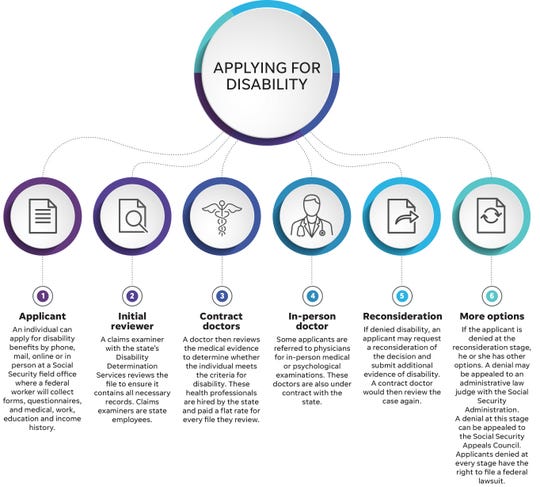
How applying for disabilities works in Tennessee

Why the social security plan is controversial

The reviews require recipients to submit large volumes of paperwork, a complicated and burdensome process for people living with a disability.

People go through a similar process when they first apply, which that can take two or more years to complete.

Advocates are concerned people would lose benefits because they are unable to navigate the process, even though they did not experience any medical improvement.

A Tennessean investigation earlier this year found some doctors hired to review disability claims raced through the paperwork at an implausible pace while billing six-figures annually.  Experts say it’s impossible to review disability claims at such a fast pace without wrongfully rejecting claims. The report prompted an investigation by the Government Accountability Office, which remains ongoing. 

Advocates have also questioned the Social Security Administration’s projected savings. 

The new reviews will save about $1.50 for every dollar spent, according to agency estimates. 

Those projected savings, however, are significantly lower than what the Social Security Administration says it saves on current disability reviews: about $19 for every dollar spent. ( culled from tennessean.com)

RedAid Nigeria partners with Enugu state government and others to provide free artificial limbs for 186 amputees in Enugu state

0

RedAid Nigeria in partnership with The Spiritan Self Awareness Initiative and Enugu State Government, supported by ISHK Limb Center provided One hundred and eighty six persons were fitted with different prosthetic devices.

This programmed titled Gift of Limbs saw amputees of different age brackets from Enugu State getting prosthetic devices free.

RedAid Nigeria is a Nigerian NGO, with headquarter in Enugu State, Nigeria. RedAid is affiliated with German Leprosy and TB Relief Association (GLRA), a German Charity who has been working in Nigeria for more than 50 years in the fight against Neglected Tropical Diseases (NTDs) and Tuberculosis (TB).

HERE ARE PICTURES OF THE EVENT:

Image may contain: one or more people, sky, cloud, outdoor and nature
Image may contain: 1 person, standing and shoes
Image may contain: 2 people, people smiling, people standing and beard
Image may contain: 1 person, standing and shoes
Image may contain: 6 people, people standing and indoor
Image may contain: 3 people, people smiling, people sitting
Image may contain: 2 people, people standing and indoor
Image may contain: 2 people, people sitting
Image may contain: 5 people, people smiling, people standing, beard and indoor
Image may contain: 2 people, people sitting
Image may contain: 3 people, shoes
Image may contain: 1 person, standing
Image may contain: 4 people, indoor
Image may contain: 2 people, shoes
Image may contain: 3 people, people standing and shoes
Image may contain: one or more people
Image may contain: one or more people, people sitting and indoor
Image may contain: 2 people
Image may contain: 1 person
Image may contain: 1 person, standing and shoes
Image may contain: 1 person
Image may contain: 5 people, people smiling, people standing