

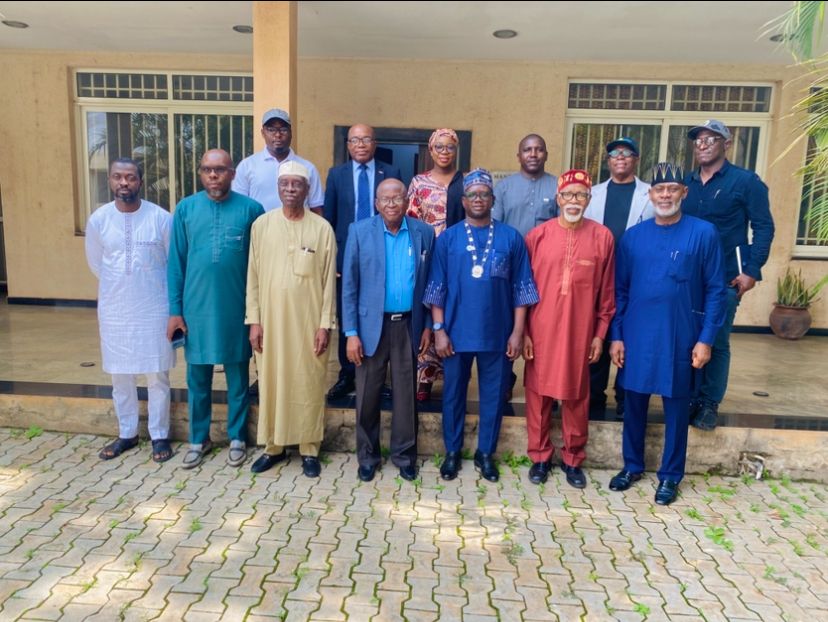
Abuja, Nigeria – July 24, 2025 — In a significant move to bolster collaboration between Nigeria’s engineering professionals and academia, the Executive Committee of the Nigerian Society of Engineers (NSE) paid a high-level courtesy visit to the African University of Science and Technology (AUST) in Abuja. The visit, which included a tour of strategic research centers, was marked by robust discussions around inclusive infrastructure, innovation, and the future of engineering in Nigeria.
Led by Engr. Ahmed Kutigi, FNSE, Chairman of the NSE, the delegation included prominent members such as Engr. Yusuf Manasseh, Engr. M.B. Guna, Engr. Paul B. Anyu, and Engr. Mrs. Mistura Aderike Rafiu. The team was warmly received by Professor Azikiwe Peter Onwualu, FAS, President of AUST, alongside other members of the university’s academic leadership.
Engineering Meets Academia: The Power of Synergy
During the visit, the NSE delegation toured key research hubs within the university, notably the Center for Urban Transportation Studies (CUTS) and the CPDI Center for Afrocentric Design Advancement (CADA). These centers reflect AUST’s forward-thinking approach to solving Africa’s unique infrastructural and developmental challenges.
At CUTS, the delegation was welcomed by the Center’s Chief Executive Officer, Engr. Christopher N. Chigboh, FNSE, P.E, who expressed deep appreciation for NSE’s interest in the Center’s pioneering work. In his address, Engr. Chigboh emphasized the necessity of inclusive infrastructure, pointing to global best practices where “developed countries build homes and public spaces with accessibility in mind, ensuring that even people with disabilities have unhindered access.”
He lauded the leadership of Professor Onwualu for his strategic vision and unwavering support, which he said were instrumental in the successful establishment and ongoing development of the center.
Driving Innovation and Accessibility Through Engineering
In his own remarks, Engr. Ahmed Kutigi expressed excitement about the visible progress at AUST, especially at CUTS. He commended the university’s commitment to fostering research and innovation aligned with national and continental development goals.
“The Nigerian Society of Engineers is actively pursuing initiatives that will nurture innovation, especially among young engineers,” Engr. Kutigi stated. “We believe that our partnership with academic institutions like AUST will spark creative thinking and sustainable problem-solving approaches among the next generation of professionals.”
He further revealed that NSE is planning a series of upcoming programs aimed at building capacity and promoting innovation culture among young and emerging engineers across the country.
AUST: A Hub for Afrocentric Engineering Excellence
While welcoming the NSE team, Professor Onwualu expressed profound appreciation for the visit, describing it as “timely and strategic.” He reiterated AUST’s commitment to bridging the long-standing gap between research and professional practice in engineering.
“Our goal is to develop a stronger synergy between academia and professional bodies like the NSE,” he noted. “It is only through deliberate partnerships that we can translate research into practical, impactful solutions that address the real challenges faced by our communities.”
The AUST President was joined by senior faculty members including Dr. Bello Abdulhakeem, DAP, Dr. Olusegun Toluhi from the Faculty of Civil Engineering, and Dr. Vitalis Anye, Acting Dean, School of Engineering. Together, they accompanied the visitors on a guided tour of university facilities, showcasing the institution’s state-of-the-art laboratories, design studios, and research centers.
A Future of Collaboration and Impact
In a show of mutual optimism, both parties expressed eagerness to formalize collaborative frameworks. Professor Onwualu extended an open invitation to NSE to submit proposals for joint initiatives, training, policy dialogues, and collaborative research projects that could enrich Nigeria’s engineering landscape and promote national development.
“We believe the future of engineering in Africa lies in localized solutions—grounded in our realities and propelled by strategic partnerships like this,” Professor Onwualu added.
The visit concluded with group photographs and informal networking, as both parties pledged to sustain momentum and turn ideas into impactful actions.


