

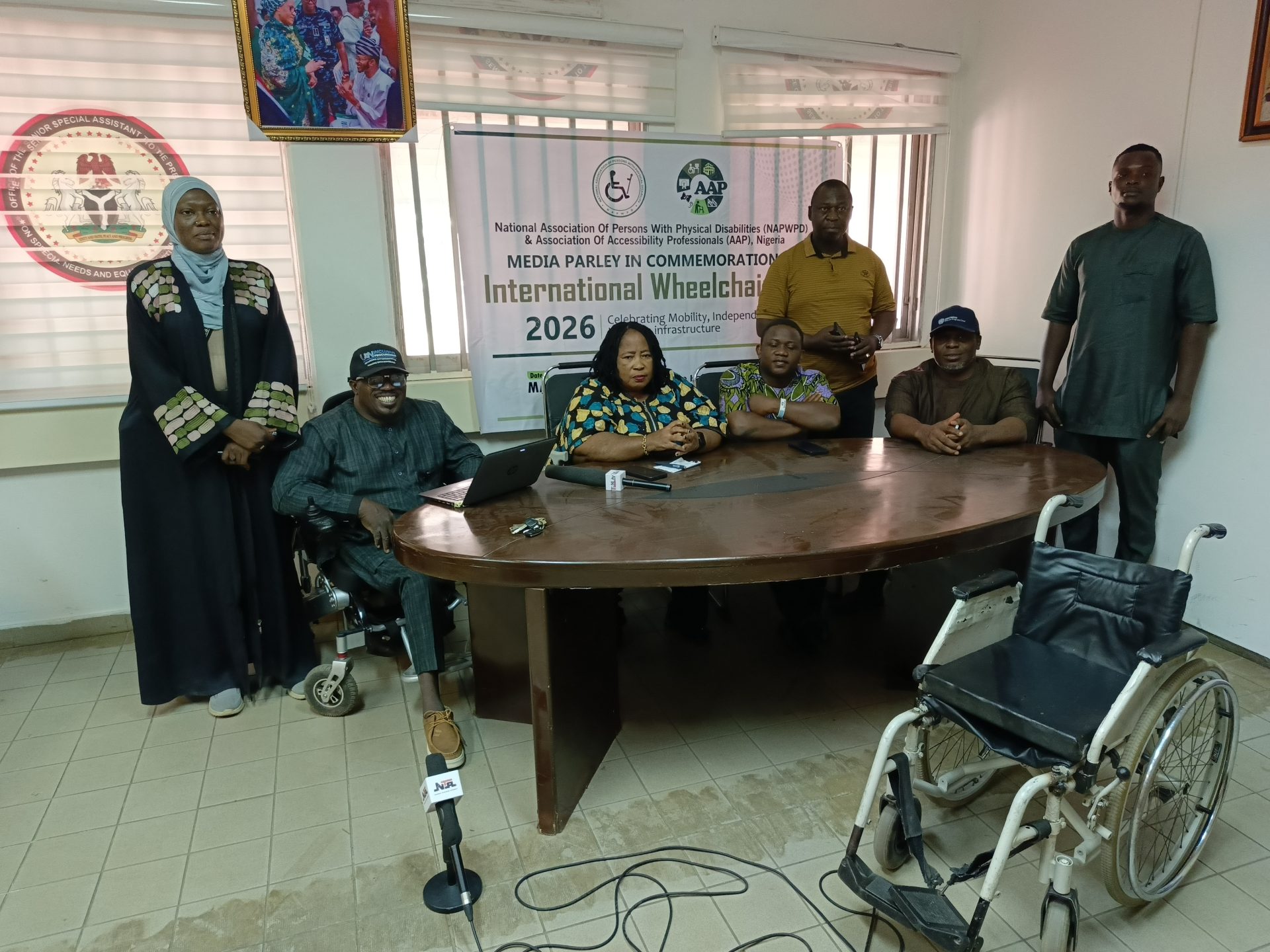
Abuja, Nigeria — Advocates, policymakers, and members of the disability community gathered in Abuja to commemorate International Wheelchair Day 2026, with a strong call for improved accessibility, inclusive infrastructure, and full enforcement of disability rights laws in Nigeria.
The National Association of Persons With Physical Disabilities (NAPWPD) marked the global observance with a press conference organized in collaboration with the Association of Accessibility Professionals (AAP) Nigeria and the Office of the Senior Special Assistant to the President on Special Needs and Equal Opportunities.
Observed annually on March 1, International Wheelchair Day celebrates mobility, independence, and the transformative impact of wheelchairs on the lives of millions of people worldwide. This year’s theme, “Celebrating Mobility, Independence and Inclusive Infrastructure,” focused on promoting accessibility and breaking down barriers that prevent wheelchair users from participating fully in society.
Wheelchair: A Symbol of Freedom and Opportunity
Speakers at the event emphasized that a wheelchair is far more than a mobility device. For many persons with physical disabilities, it represents independence, dignity, and access to opportunities.
Chairman of the Board of Trustees of the Association of Accessibility Professionals (AAP) Nigeria, Barrister Iyodo Yusuf, said the celebration is an opportunity to shift the conversation from limitations to possibilities.
“A wheelchair is not a symbol of limitation. It is a tool of mobility and independence. What truly limits people are inaccessible buildings, poorly designed infrastructure, and systems that fail to consider everyone,” he said.
He stressed that accessibility must not be treated as charity or an afterthought but as a fundamental component of national development.
“When our roads, schools, offices, transport systems, and digital platforms are accessible, society as a whole benefits. A Nigeria that works for wheelchair users works for everyone,” Yusuf added.
Highlighting the Daily Struggles of Wheelchair Users
While celebrating the achievements and resilience of wheelchair users, stakeholders also drew attention to the persistent barriers they face in Nigeria.
Chairman of the National Association of Persons With Physical Disabilities (NAPWPD), FCT Chapter, Comrade Agbo Christian Obiora, described the wheelchair as a bridge between isolation and participation in society.
“Today, we are not merely celebrating a device made of metal, rubber, and wheels. We are celebrating freedom, dignity, independence, and possibility,” he said.
“For millions of persons with physical disabilities, a wheelchair is access to education, employment, worship centers, markets, political spaces, and leadership tables.”
However, he noted that many wheelchair users still confront significant obstacles in their daily lives.
Across Nigeria, many public and private buildings remain inaccessible, often lacking ramps or elevators. Public transportation systems are largely non-inclusive, roads are poorly designed, and sidewalks are either broken or non-existent.
“In Nigeria, too many wheelchair users still face buildings without ramps, offices without elevators, polling units located upstairs, and public transport systems that exclude them,” he said.
“A wheelchair alone does not guarantee inclusion. Inclusion happens when policies are implemented, when infrastructure is designed with accessibility in mind, and when society recognizes persons with disabilities as contributors to national development.”
Government Commitment to Inclusive Infrastructure
In his remarks, the Senior Special Assistant to the President on Special Needs and Equal Opportunities, Hon. Mohammed Abba Isa, reaffirmed the Federal Government’s commitment to protecting the rights of persons with disabilities and promoting inclusive development.
Speaking on behalf of President Bola Ahmed Tinubu, he emphasized that the administration recognizes the importance of mobility and accessibility for national progress.
“As a wheelchair user myself, I understand that a wheelchair is far more than a mobility aid. It is a gateway to education, employment, leadership, and full participation in society,” he said.
“It represents independence and empowerment. It represents the fundamental right of every citizen to move freely and access opportunities without barriers.”
However, he acknowledged that many wheelchair users still struggle with the high cost of procuring quality wheelchairs, difficulty accessing repair services, and the lack of inclusive infrastructure.
He also condemned discriminatory practices by some transport operators who deny wheelchair users access to public transportation or impose extra charges.
“A wheelchair is not luggage. A wheelchair is not a load. It is part of a person’s mobility and identity. There is absolutely no justification for discrimination against wheelchair users,” he said.
Strengthening Disability Rights Implementation
Stakeholders at the event called for stronger implementation of the Discrimination Against Persons with Disabilities (Prohibition) Act, 2018 and the Persons with Disabilities Accessibility Regulations, 2023.
These legal frameworks were established to guarantee equal rights, accessibility standards, and protection from discrimination for persons with disabilities in Nigeria.
Nigeria has also taken several steps to advance disability inclusion, including signing the United Nations Convention on the Rights of Persons with Disabilities (UNCRPD) in 2007 and establishing the National Commission for Persons with Disabilities (NCPWD) to oversee the implementation of disability policies and programs.
The commission has developed guidelines to ensure that public facilities include accessibility features such as ramps, accessible toilets, and Braille signage.
Government initiatives have also focused on promoting the local production of assistive technologies, including wheelchairs and prosthetic limbs, as well as implementing a five percent employment quota for persons with disabilities in public institutions.
Despite these efforts, disability advocates argue that implementation remains slow and inconsistent.
Call for Collective Action
NAPWPD used the occasion to draw attention to the millions of Nigerians with physical disabilities who still lack access to appropriate wheelchairs and assistive technologies.
The association called on federal, state, and local governments to intensify efforts toward removing barriers that hinder the full participation of persons with disabilities in society.
Vice President of NAPWPD, Ambassador Mube Awala Beatrice, emphasized the need for collective action.
“We join our voices with over 35 million Nigerians with disabilities to call on all levels of government to strengthen the implementation of the Discrimination Against Persons with Disabilities Act and other relevant policies,” she said.
“Accessibility must move from policy documents to real-life implementation that improves the living conditions of persons with disabilities.”
Building an Inclusive Nigeria
Participants at the event agreed that creating inclusive infrastructure is not only beneficial for persons with disabilities but also for the broader population, including older persons, pregnant women, and individuals with temporary injuries.
Advocates urged policymakers, urban planners, transport unions, and private sector operators to prioritize accessibility in building design, road construction, and public services.
For wheelchair users across Nigeria, the message of International Wheelchair Day remains clear: mobility is a right, not a privilege.
As stakeholders concluded the event in Abuja, the call echoed strongly — a Nigeria where wheelchair users can move freely, access opportunities equally, and participate fully in national life is not merely an aspiration.
It is a responsibility.
And it begins with removing the barriers that stand in their ways.
Click the link below to join our WhatsApp channel


