

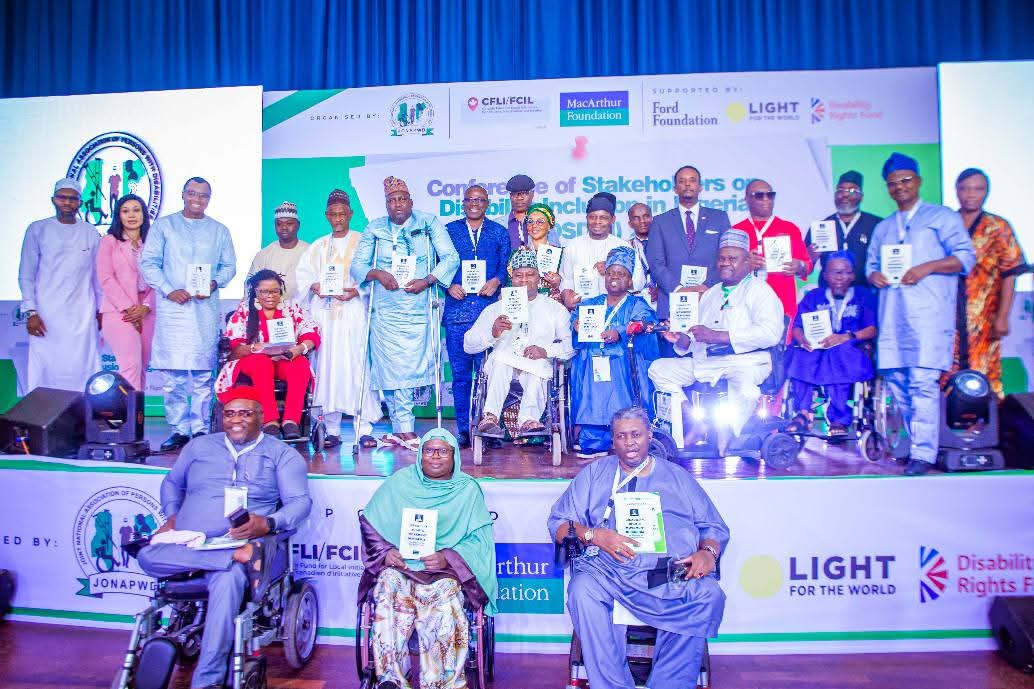
Abuja, Nigeria — November 27, 2025 — The Joint National Association of Persons With Disabilities (JONAPWD) has renewed its push for the Nigerian government and key institutions to move from promises to concrete action in implementing commitments made at the Global Disability Summit (GDS). This call came during the Conference of Stakeholders on Disability Inclusion in Nigeria (COSDIN) 2025, which convened in Abuja on Thursday with a powerful assembly of voices from across the 36 states and the FCT.
The two-day national conference, held in commemoration of the 2025 International Day of Persons With Disabilities (IDPD), brought together Ministries, Departments and Agencies (MDAs), private sector leaders, development partners, disability groups, innovators, and advocates to chart actionable pathways toward disability-inclusive development.
With the conference theme “From Commitment to Action: Advancing Disability-Inclusive Development in Nigeria,” the atmosphere was one of urgency, solidarity, and renewed hope.
“Move Beyond Berlin Commitments”—JONAPWD President Challenges Stakeholders
President of JONAPWD, Abdullahi Aliyu Usman, underscored the essence of COSDIN 2025: a strategic gathering designed to transform the commitments Nigeria made during the GDS in Berlin into real, measurable progress.
“We brought all relevant stakeholders together so we can collectively ensure that every commitment Nigeria made at the Global Disability Summit goes beyond paper and becomes active implementation,” Usman stated.
He urged PWDs, OPDs, government actors, and development partners to strengthen collaboration, emphasizing that only unity of purpose will translate years of advocacy into tangible results.
“We have struggled for long. It’s time those struggles produce real, positive fruits,” he added.
While acknowledging recent government strides on disability inclusion, the JONAPWD President called for intensified efforts, insisting that expectations from the disability community remain high.
FG: “Interventions Without PWDs Are Incomplete”
Speaking on behalf of the Minister of Humanitarian Affairs and Poverty Reduction, Daniel Dung Dalyop reaffirmed the ministry’s commitment to disability inclusion.
“It is within our mandate to engage with persons with disabilities. Any intervention without PWD involvement is incomplete,” he said.
Dalyop announced that the new national social register will include fully disaggregated disability data—an innovation expected to make interventions quicker, more accurate, and more responsive.
“Empower PWDs for Manufacturing and Business”—Former NCPWD ES Advocates
Immediate past Executive Secretary of the NCPWD, Dr. James Lalu, stressed that economic empowerment remains a major frontier for achieving full inclusion.
He said one of the strongest pathways to reducing discrimination is to build the entrepreneurial and manufacturing capacity of PWDs, especially in the production of assistive devices.
“The Renewed Hope Agenda Committee should prioritize entrepreneurship for persons with disabilities. That is how we reduce discrimination and open sustainable livelihood opportunities,” Lalu told journalists.
Inclusive Budgeting is Key — Dr. Chike Okogwu
Dr. Chike Okogwu, Executive Director of Centre for Ability, Rehabilitation and Empowerment (CARE), delivered a compelling message: Nigeria cannot achieve disability inclusion if budgets remain non-inclusive.
“If we rely solely on NCPWD to push disability inclusion, progress will be minimal. Every MDA must implement its mandate toward disability inclusion through a more inclusive budget structure,” he said.
He praised the government’s efforts so far but stressed that the achievements remain far from the expectations of the disability community.
“From Begging to Rights Movement”—Misbahu Didi Celebrates Progress
Former APC National Leader for Persons with Disabilities, Misbahu Lawan Didi, provided a historical perspective on the evolution of the disability movement in Nigeria.
“We have gone from a begging movement to a rights movement. PWDs are now fully participating in politics and represented across political party structures.”
He highlighted remarkable progress in sports, business, and civic participation, describing these as milestones worth celebrating.
A Packed Agenda: Keynotes, Data Unveiling, Innovations, and Panels
COSDIN 2025 featured a rich lineup of sessions and presentations, signalling a new era of disability-inclusive programming in Nigeria.
Key Highlights:
🔹 Keynote Address
Delivered by Dr. Tayo Aduloju, CEO of the Nigerian Economic Summit Group (NESG), titled:
“The Renewed Hope Agenda: Where Are We With Persons With Disabilities?”
His keynote challenged policymakers to embed disability inclusion as an economic, social, and governance priority.
🔹 JONAPWD Data Count Unveiling
A major highlight was the presentation of exploratory demographic data of persons with disabilities across Nigeria—an initiative expected to support evidence-based policymaking and targeted interventions.
🔹 Innovations in Inclusive Product Design
Sterling Bank, FCMB, DBBO Africa, NTA, and others showcased groundbreaking solutions aimed at improving accessibility and inclusive service delivery across sectors.
🔹 Thematic Sessions and Panel Discussions
Bridging the Response Divide: Digital Accessibility for GBV Survivors with Disabilities
Nigeria’s Commitments at GDS 2025: Turning Pledges into Policy and Practice
Cluster-Based Priority Actions for Disability Rights Implementation
These sessions provided a roadmap for multi-stakeholder collaboration in disability rights, policy development, and service innovation.
A Turning Point for Disability Inclusion in Nigeria
As the conference closed, one message echoed across the hall: Nigeria must now move boldly from commitment to action.
COSDIN 2025 not only brought together the most influential actors in the disability sector—it laid the foundation for strengthening accountability, leveraging innovation, and accelerating progress toward a truly disability-inclusive Nigeria.
With renewed energy from OPDs, MDAs, political actors, private organizations, and development partners, there is a collective resolve that disability inclusion will no longer be an afterthought, but a national priority guiding the country’s development agenda.
Follow the The Qualitative Magazine channel on WhatsApp: https://whatsapp.com/channel/0029VanfIB50wajpjGi3JJ1G


