

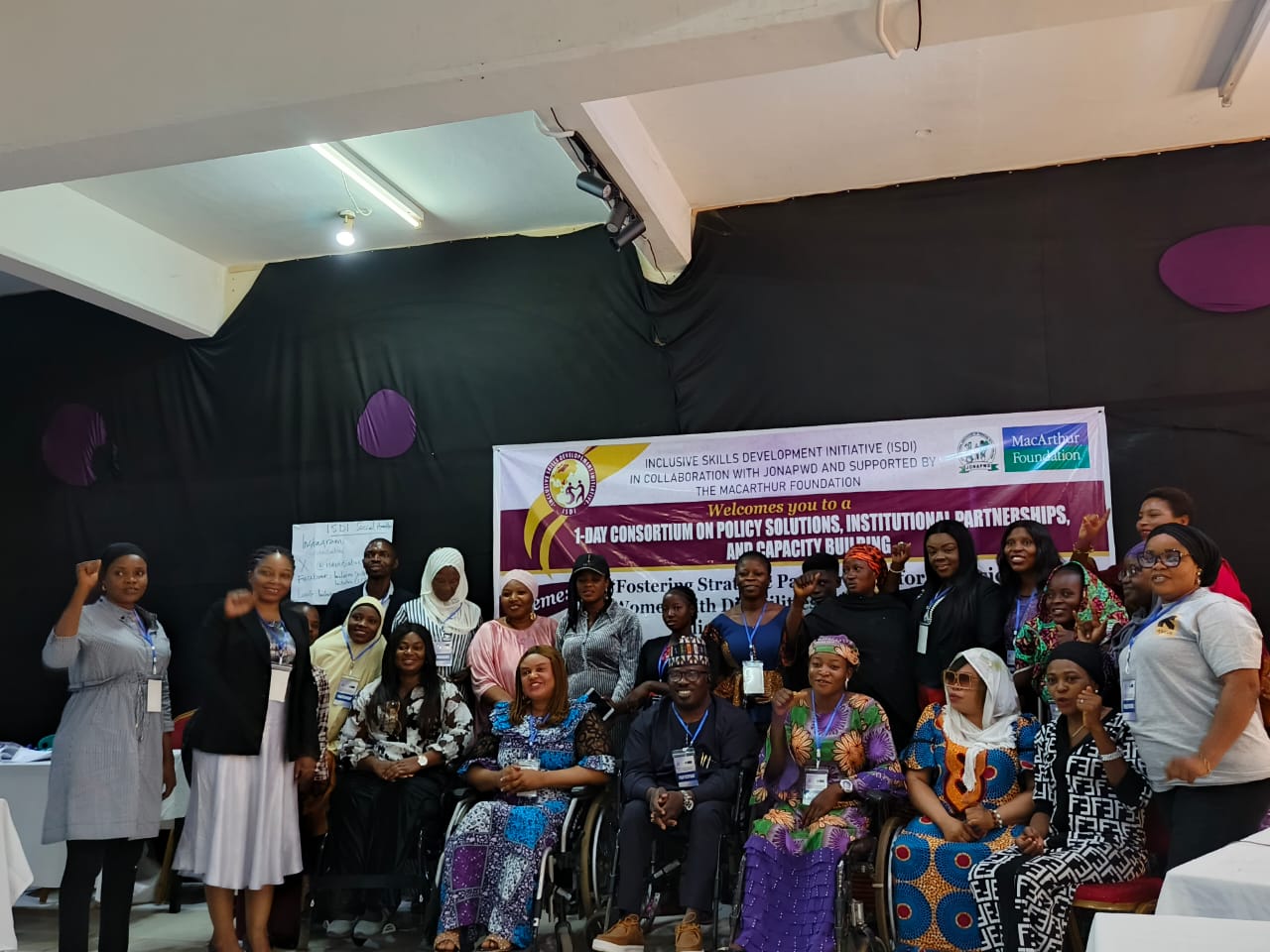
The Executive Director of the Inclusive Skills Development Initiative (ISDI), Angelina Ugben, has called on the government, corporate organizations, and individuals to support businesses owned by women and girls with disabilities. She made this passionate appeal during a one-day consortium held in Abuja on December 12, 2024, organized by ISDI in collaboration with the Joint National Association of Persons with Disabilities (JONAPWD) and funded by the MacArthur Foundation.
Themed “Fostering Strategic Partnerships for Inclusion of Women with Disabilities in Business and Trade: Policy and Practice of Inclusivity”, the event brought together women and girls with disabilities, policymakers, experts, financial institutions, civil society organizations (CSOs), and media practitioners to discuss actionable strategies for advancing inclusivity in Nigeria’s business and trade sectors.
Breaking Barriers for Women with Disabilities
In her opening remarks, Angelina Ugben described the consortium as a pivotal step under ISDI’s Breaking Barriers project. According to her, the project aims to tackle systemic barriers and promote inclusive opportunities for women with disabilities. She highlighted that the consortium’s purpose was to create a platform where stakeholders could share insights, identify challenges, and co-create solutions for the inclusion of women with disabilities in economic activities.
“The event seeks to bring together key stakeholders—policymakers, business leaders, financial institutions, civil society organizations, and women entrepreneurs—to develop actionable strategies for fostering inclusivity. Collaboration and strategic partnerships are key to unlocking the full potential of women with disabilities in trade and business,” she stated.
Ugben further expressed her gratitude to the MacArthur Foundation and JONAPWD for their support and reiterated her commitment to creating a more equitable and empowering environment for women with disabilities. “A lot of women and girls with disabilities are excelling in business and trade. What they need is support—through financial opportunities and patronage,” she said.
Funding Challenges and the Call for Government Intervention
One of the central issues highlighted at the event was the difficulty women with disabilities face in accessing funding. Ugben noted that financial inclusion remains a significant challenge, as existing structures in Nigeria often exclude women with disabilities from empowerment programs. “Government should specifically target women with disabilities in all women empowerment programs,” she emphasized. “These women are engaged in various trades, such as fashion, farming, and hairdressing, and they are doing exceedingly well. All they need is financial support to thrive.”
She urged government agencies like the National Directorate of Employment (NDE) and the Small and Medium Enterprises Development Agency of Nigeria (SMEDAN) to prioritize the economic empowerment of women with disabilities and implement a quota system for their inclusion in social intervention programs.
JONAPWD Calls for Inclusive Policies
Comrade Chris Agbo, Secretary General of JONAPWD FCT Chapter, echoed Ugben’s call for action. He encouraged women with disabilities to leverage opportunities provided by ISDI’s initiatives to enhance their economic participation. “It is through active economic engagement that women with disabilities can improve their lives,” Agbo remarked.
He also advocated for the adoption of an inclusive procurement policy by the government, which would open contract opportunities for persons with disabilities. “This will ensure that women with disabilities are not left out of the economic equation. Inclusion must be intentional, and policies must reflect this commitment,” he added.
Agbo further encouraged women with disabilities to take on leadership roles within JONAPWD, stressing that active involvement in organizational activities would better position them for opportunities and advocacy.
Data-Driven Advocacy for Systemic Change
Addressing systemic and institutional barriers, Evelyn Ugbe, a consultant leading research under ISDI, revealed that the ongoing study funded by the MacArthur Foundation is designed to generate evidence-based data to inform advocacy. “Our research aims to highlight the challenges faced by women with disabilities, such as the lack of access to business skills and exclusion from empowerment programs,” she explained.
Ugbe emphasized that while Nigeria’s Disability Act provides for a 5% employment quota for persons with disabilities, women with disabilities often remain excluded from these opportunities. “The data we gather will support our advocacy efforts and push for inclusion in both public and private sector opportunities,” she said.
WIMBIZ Lends Support to the Cause
In a goodwill message, Gloria Osafemie Idiahi, representing Omowunmi Akingbohungbe, Executive Director of WIMBIZ, lauded the initiative as a significant step toward achieving equity. She described the consortium as more than a gathering but a clarion call for all stakeholders to work collaboratively toward dismantling systemic barriers.
“Inclusion is not a privilege; it is a right,” Idiahi declared. “The focus on policies, partnerships, and capacity building underscores the holistic approach needed to empower women with disabilities. Let us champion their inclusion in education, employment, entrepreneurship, and leadership. Together, we can ensure that no woman is left behind.”
She concluded with the inspirational words of Dr. Ngozi Okonjo-Iweala: “If you want to go fast, go alone. If you want to go far, go together.”
Insights from Panel Discussions
The consortium featured panel discussions and breakout sessions where stakeholders shared insights on the challenges and opportunities for women with disabilities in business and trade. Participants emphasized the need for capacity-building programs, financial literacy training, and mentorship to help women with disabilities thrive in their entrepreneurial pursuits.
The event ended with a renewed commitment from all stakeholders to collaborate in fostering an inclusive environment where women and girls with disabilities can reach their full potential. The consensus was clear: strategic partnerships and intentional actions are vital for driving meaningful change.
A Call to Action
The Inclusive Skills Development Initiative (ISDI), supported by JONAPWD and the MacArthur Foundation, has set the stage for a transformative approach to inclusivity. The call for support from the government, private sector, and individuals is not just a plea; it is a mandate to ensure that women with disabilities are given the tools and opportunities they need to succeed in business and trade.
As Angelina Ugben aptly put it, “Collaboration and strategic partnerships hold the key to unlocking the potential of women with disabilities. It is time to move beyond rhetoric and take concrete steps toward building a truly inclusive society.”


