

LAGOS, Nigeria – June 3, 2025
In a powerful display of compassion beyond commerce, two foreign investors are winning hearts in Nigeria — not just for their business acumen, but for their deepening humanitarian commitments to some of the country’s most overlooked citizens: persons with disabilities.
Sudeep Ramnani and Jai Mahtani, two internationally renowned businessmen with footprints in Africa and beyond, have extended their ongoing humanitarian programme to the disability community in Lagos State, bringing food relief and renewed hope to dozens of persons with disabilities under the care of the Centre for Citizens with Disabilities (CCD).
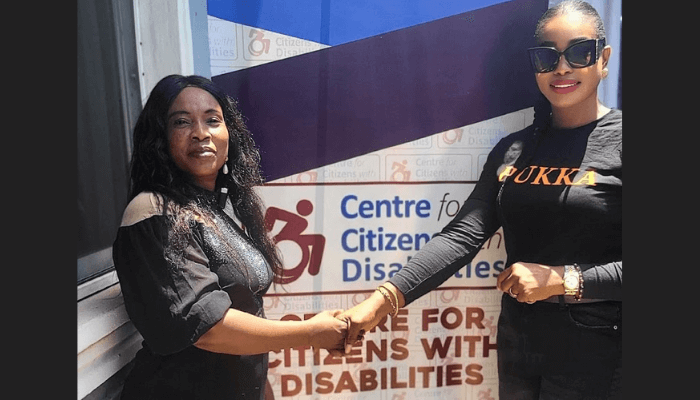
The latest intervention, which took place on Friday, May 30, 2025, at CCD’s headquarters in Opebi, Ikeja, saw a delegation led by their Nigerian representative, Beulah Akingbelu-Banjo, distribute food items and offer words of solidarity, encouragement, and inclusion to the disabled community.
“This outreach reflects our commitment not only to doing business in Nigeria but also to contributing meaningfully to the lives of its people — especially the underserved,” said Akingbelu-Banjo, while addressing attendees at the CCD compound.
The initiative, implemented in partnership with Pukka Logistics and Support Services Ltd, a Nigerian firm, is part of a broader outreach that kicked off in March 2024, with the ambitious goal of reaching every one of Nigeria’s 774 local government areas — one LGA at a time.
Since its launch, the programme has delivered life-saving food packs and essentials to thousands across states, touching internally displaced persons, widows, orphans, low-income households, and now, persons with disabilities — a demographic often left behind in development planning.
A Visit That Sparked Joy and Renewed Hope
The atmosphere at the CCD office was charged with joy and emotion as the food items were handed out. For many recipients, it wasn’t just about the food; it was the validation that their lives mattered — that they had not been forgotten.
Receiving the items on behalf of the Centre, Florence Chima Austin, a prominent disability rights advocate and representative of the CCD, offered heartfelt gratitude to the visiting team.
“This kind of support gives hope and shows that people with disabilities are not forgotten,” she said. “We need more stakeholders — both local and foreign — to adopt this kind of humanitarian mindset. Together, we can build a more inclusive and compassionate Nigeria.”
She further noted that with the current economic challenges in the country, including surging inflation, food insecurity, and social exclusion, persons with disabilities have been hit the hardest — facing not just hunger, but deeply rooted barriers to access, mobility, education, and healthcare.
Disability, Poverty, and the Nigerian Reality
Data from the National Bureau of Statistics (NBS) reveals that a staggering 63% of Nigerians are multidimensionally poor, with millions of persons with disabilities grappling with compounded challenges, including systemic discrimination, inaccessible infrastructure, and inadequate social protection.
These harsh realities make philanthropic gestures like the one from Ramnani and Mahtani all the more significant — offering not just food, but dignity and visibility to a group often unseen by the mainstream.
“For every community we reach, we learn something new about resilience and the human spirit,” Akingbelu-Banjo said. “Today was no different. The disability community has shown us that strength comes in all forms.”
Private Sector Rising to the Challenge
As Nigeria continues to navigate a fragile economic climate, worsened by rising food costs and unemployment, public-private collaborations are proving essential in plugging the welfare gaps.
While governments at federal and state levels continue to develop social investment programmes, they often lack the speed or scale to meet the growing needs of vulnerable populations. In this context, private-sector-led humanitarian efforts like this are not just welcome — they are necessary.
By stepping into spaces typically dominated by government or international aid agencies, investors like Ramnani and Mahtani are redefining what it means to be socially responsible in business, proving that profit and purpose can co-exist.
A Call to Action: More Can Be Done
Florence Chima Austin urged other corporate entities and philanthropists to follow the example being set, stating that “true impact lies in consistent, inclusive engagement that recognizes every Nigerian — able or disabled — as equally deserving of care, opportunity, and protection.”
With more than 25 million persons with disabilities in Nigeria, the task ahead is enormous. But with support from the private sector and sustained public awareness, advocates say progress is not just possible — it is inevitable.
For now, the story of Friday’s outreach at the Centre for Citizens with Disabilities stands as a shining example of how global empathy can meet local need, creating a ripple effect of change one community at a time.


