

Urge Authorities to Prioritize Accessibility and Dignity in Education
Abuja, Nigeria – August 7, 2025
In a powerful call to action, the Original Inhabitants with Disabilities in the Federal Capital Territory (FCT) have urged the government to provide truly inclusive educational facilities and public structures that reflect the needs and rights of persons with disabilities (PWDs).
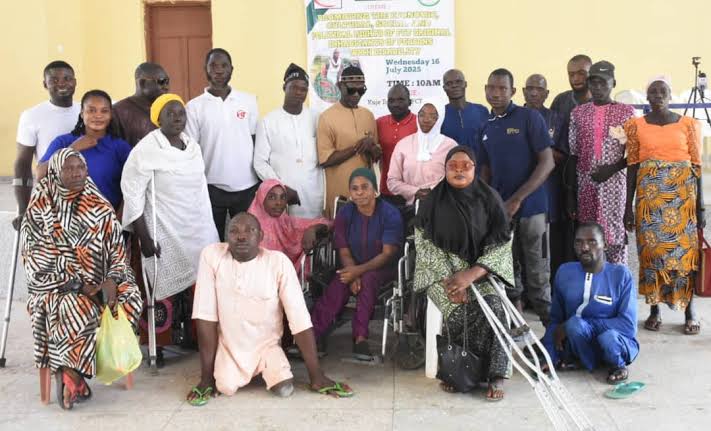
This appeal was made during a sensitization and enlightenment campaign organized in Abuja on Thursday by the MacArthur Foundation, under the theme: “Promoting the Economic, Political and Social Rights of FCT Original Inhabitants with Disabilities.”
The campaign brought together disability rights advocates, education stakeholders, and representatives of local authorities, amplifying the voices of one of the most underrepresented and marginalized groups in the Nigerian capital—the indigenous persons with disabilities.
Education is the Foundation of Social Rights
At the forefront of the campaign was Mr. Festus Yakubu, President of the Original Inhabitants with Disabilities in the FCT, who passionately argued that inclusion must begin with the education sector.
“The rightful society for us to start with is the primary school. Schooling is the foundation of social rights. It is where dignity, inclusion, and development start,” Yakubu said.
He emphasized that many government schools in the FCT remain structurally inaccessible to children with disabilities. With classrooms located upstairs, no ramps, no accessible toilets, and a lack of inclusive teaching aids, many PWDs are either forced to stay at home or abandon education altogether.
“We are not asking for favors; we are demanding our rights as equal citizens. The original inhabitants with disabilities in this territory feel invisible, overlooked, and pushed to the margins of society,” he added.
Yakubu also called for the inclusion of persons with disabilities in the ongoing planning and implementation processes of the proposed FCT Commission for Persons with Disabilities, asserting that “nothing about us should be done without us.”
Exclusion Limits Our Contributions to National Development
Also speaking at the event, Mr. Abubakar Abduljaleel, former Chairman of the Joint National Association of Persons with Disabilities (JONAPWD), FCT chapter, strongly condemned the widespread exclusion of PWDs from key socio-economic sectors.
“Imagine being in a classroom without a sign language interpreter. Imagine being turned away from a hospital because the entrance is too narrow for your wheelchair. Imagine constantly being treated like a burden, instead of a human being with potential and dignity,” Abduljaleel lamented.
He stressed that the continuous sidelining of PWDs denies Nigeria the contributions, innovations, and talents that this demographic holds.
“Exclusion is not only a denial of rights; it is a loss to the nation. We can’t achieve true development without inclusivity,” he added.
Stakeholders Advocate for Early Sensitization in Schools
Representing the Local Education Authority (LEA) Karu Central, Mr. Ochida Sunday, who stood in for the Headmistress, stated that there is a need to instill the values of inclusion, empathy, and respect for persons with disabilities at the elementary level.
“There is ability in disability, and this must be taught early. Children must grow up seeing their peers with disabilities as friends, classmates, and equal contributors to society,” Sunday said.
He further emphasized the importance of incorporating inclusive education practices in public schools and urged parents and teachers to encourage interaction between children with and without disabilities as a way of combating stigma.
Pushing Beyond Ramps: The Broader Demand for Inclusion
While physical infrastructure such as ramps and accessible classrooms is crucial, participants at the campaign stressed that inclusion must go beyond buildings.
They called for the deployment of trained special education teachers, availability of teaching and learning materials in accessible formats (Braille, audio books, sign language), and the integration of disability rights education into the curriculum.
The campaign also spotlighted the urgent need for data collection and disaggregated statistics on indigenous PWDs in the FCT, to ensure targeted policy-making and effective service delivery.
A Message to Policy Makers: “Inclusion is not Charity, It is Justice”
As the campaign drew to a close, one message rang loud and clear: Inclusion is not an act of charity; it is a matter of justice, equity, and national development.
Stakeholders urged the FCT Administration, the Universal Basic Education Board, and other relevant agencies to take swift action in upgrading existing schools, developing inclusive educational policies, and implementing the provisions of the Discrimination Against Persons with Disabilities (Prohibition) Act, 2018, which mandates inclusive education and accessible infrastructure across Nigeria.
The campaign marks another milestone in the long journey towards equal rights, dignity, and opportunity for all persons with disabilities in Nigeria, especially the often-forgotten original inhabitants of the Federal Capital Territory.


