

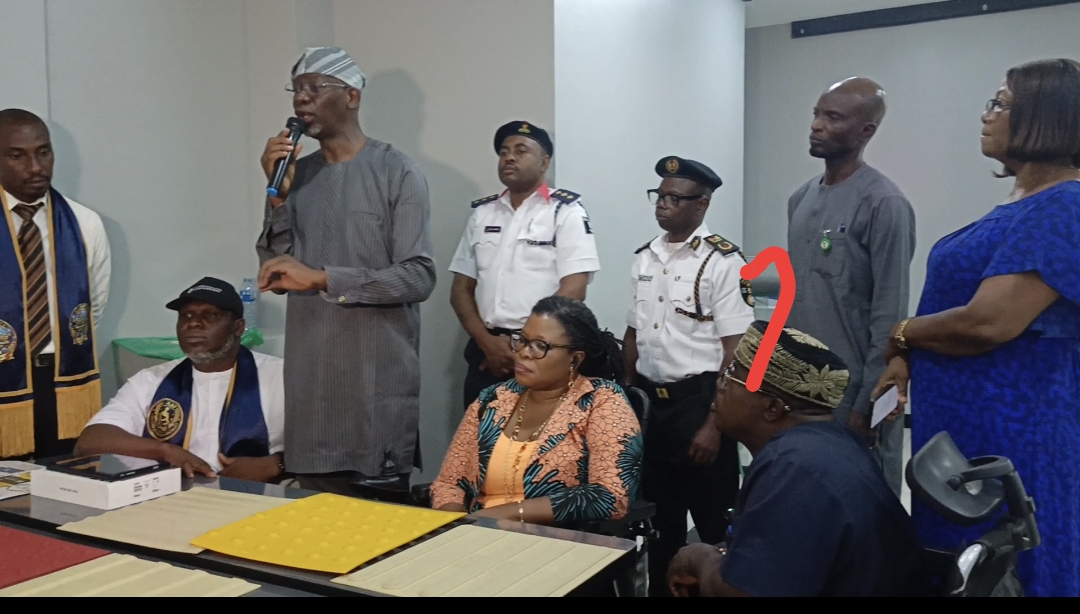
Abuja, Nigeria — In a bold and transformative move set to redefine accessibility standards across Nigeria, the Association of Accessibility Professionals (AAP), Nigeria, has launched two cutting-edge solutions—AAP-AMAS (Accessibility Mobility Announcement System) and the Tactile Building Map—signaling a major leap from policy discussions to real, practical implementation of disability inclusion.
The unveiling marks a critical turning point in Nigeria’s accessibility journey, as stakeholders increasingly demand tangible action to enforce the provisions of the Discrimination Against Persons with Disabilities (Prohibition) Act, 2018.
From Policy to Practice: AAP Takes the Lead
For years, Nigeria has grappled with the gap between disability laws and their real-life application. While the legal framework exists, implementation—especially in transportation and infrastructure—has remained inconsistent.
Speaking at the launch, Barrister Yusuf Iyodo, Chairman of the AAP Board, described the initiative as a decisive intervention to close this gap.
“Nigeria has made commendable progress with the Disability Act, but laws alone do not change lives—implementation does. What AAP is doing today is moving accessibility from paper to practice, from intention to impact,” Iyodo stated.
AAP-AMAS: Revolutionizing Public Transport for All
At the center of the launch is AAP-AMAS, a purpose-built system designed to make public transportation inclusive and accessible for everyone.
In a country where persons with disabilities often struggle to navigate public transit due to lack of information, AAP-AMAS introduces a seamless, real-time communication system within transport vehicles.
The system delivers:
- Audio announcements for persons who are blind or visually impaired
- Visual and digital displays for persons who are deaf or hard of hearing
Passengers can now receive vital travel updates such as bus stops, route progress, and destination alerts—information that many previously had to depend on others to access.
This innovation directly aligns with Section 10(2) of the Disability Act, which mandates accessible transportation systems, including the use of appropriate communication formats.
Reacting to the innovation, Mr. Dapo Taiwo, President of AAP, emphasized its practical relevance to everyday mobility.
“Accessibility in transport is not optional—it is a right. With AAP-AMAS, we are ensuring that no passenger is left guessing or excluded simply because of a disability. This system guarantees equal access to information, which is the foundation of independent travel,” Taiwo said.
Industry observers describe AAP-AMAS as a potential game-changer, capable of dismantling one of the most persistent barriers in Nigeria’s mobility ecosystem—information exclusion.
Tactile Building Map: Redefining Navigation and Independence
Complementing the transport solution is the Tactile Building Map, a thoughtfully designed tool that enhances independent navigation within public and private buildings.
Designed primarily for persons with visual impairments, the tactile map provides:
- Touch-readable layouts of facilities
- Clear identification of entrances, exits, restrooms, and service areas
- Improved spatial awareness and confidence in navigating complex environments
Beyond convenience, the innovation addresses a deeper issue—autonomy. For many persons with disabilities, navigating buildings often requires assistance, limiting independence and dignity.
Iyodo further noted that true accessibility goes beyond structural compliance.
“Accessibility is not just about ramps and entrances; it is about usability. A building is only accessible when people can move within it independently and safely. The tactile map is a critical step in achieving that reality,” he added.
Closing the Implementation Gap
Nigeria’s disability law has long been praised for its comprehensiveness, yet its impact has been weakened by poor enforcement.
AAP’s dual innovations—AAP-AMAS and the Tactile Building Map—offer practical, scalable solutions that directly respond to this challenge. They provide a clear blueprint for:
- Standardized accessibility systems
- Easy deployment across sectors
- Nationwide scalability
Taiwo stressed that the solutions are designed for immediate adoption.
“We have moved beyond conversations. These are ready-to-deploy solutions that government agencies, transport operators, and developers can adopt today. The goal is simple—make accessibility visible, measurable, and enforceable,” he said.
A Strong Call to Action
AAP is not stopping at innovation—it is pushing for immediate adoption.
The association has called on:
- Transport regulators to mandate accessible announcement systems in all public vehicles
- Fleet operators to integrate AAP-AMAS as a standard feature
- Urban planners and developers to incorporate tactile maps in building designs
- Government agencies to enforce compliance with existing accessibility laws
According to AAP leadership, accessibility in transport and infrastructure is not a privilege—it is a legal obligation and a matter of human dignity.
A New Era for Accessibility in Nigeria
The launch of these innovations signals more than just technological advancement—it represents a shift in mindset.
With AAP leading the charge, accessibility is being repositioned from charity-driven narratives to rights-based, system-driven solutions.
As Nigeria continues to urbanize and modernize, initiatives like AAP-AMAS and the Tactile Building Map offer a clear pathway toward a society where no one is left behind.
The message from AAP is clear: accessibility is no longer theoretical—it is practical, achievable, and long overdue.
Click the link below to join our WhatsApp channel


