

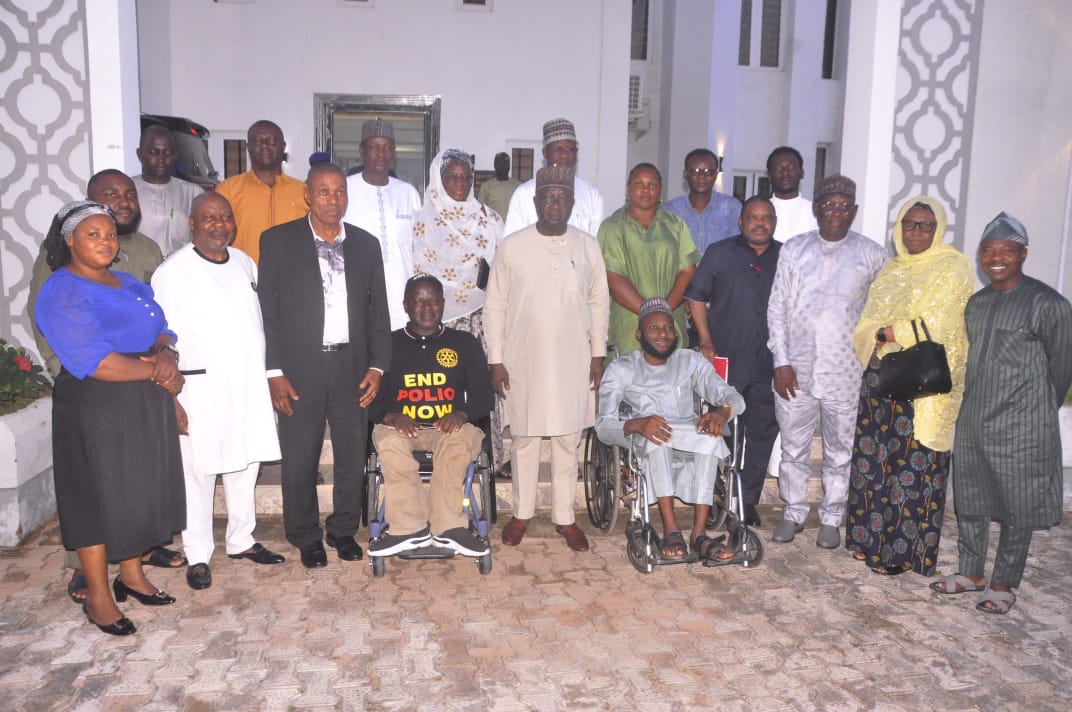
LAFIA, NASARAWA STATE – In a major step towards advancing disability inclusion, economic empowerment, and food security in Nigeria, the Nasarawa State Government has thrown its weight behind the proposed Farm City Project of the National Commission for Persons with Disabilities (NCPWD), describing the initiative as a transformative intervention capable of changing the lives of thousands of Persons with Disabilities (PWDs).
The endorsement came as the Deputy Governor of Nasarawa State, Dr. Emmanuel Agbadu Akabe, received a joint delegation from the National Commission for Persons with Disabilities and Peace for Humanity Foundation at the Government House in Lafia on Wednesday.
The Farm City Project, which is being proposed as a pilot initiative for the North Central geopolitical zone, is designed to serve as a disability-inclusive social and economic development hub where Persons with Disabilities can acquire practical skills, engage in agriculture and agro-processing, build sustainable businesses, and achieve economic independence.
Speaking during the meeting, Dr. Akabe described the project as both timely and impactful, noting that it aligns perfectly with the state government’s commitment to agricultural development, economic growth, peace, and social inclusion.
According to him, the project has the potential to address one of the most pressing challenges confronting Persons with Disabilities in Nigeria—economic exclusion.
“This is a project that every responsible government should embrace. It is a noble initiative that seeks to empower a segment of society that has often been marginalized despite possessing enormous potential. Opportunities such as this should not only be embraced but replicated across the country,” he stated.
The Deputy Governor emphasized that the project comes at a critical time when governments at all levels are prioritizing food production and economic diversification as solutions to rising poverty and unemployment.
He explained that Nasarawa State’s reputation as one of the most peaceful states in the country makes it an ideal destination for developmental and investment-driven projects.
“Nasarawa is a peaceful state, and investors thrive where there is peace and stability. I strongly believe this Farm City Project will not only improve the welfare of Persons with Disabilities but will also attract additional investments and development opportunities to our state,” Dr. Akabe said.
He further commended the National Commission for Persons with Disabilities and Peace for Humanity Foundation for choosing Nasarawa State as the pilot location for the North Central zone, expressing confidence that the project would flourish in the state.
“Any development project established in Nasarawa has every opportunity to grow and succeed. We are ready to support this initiative, and the government will identify suitable land for its implementation,” he assured.
The endorsement is being viewed by disability rights advocates as a significant boost to ongoing efforts to create sustainable economic opportunities for Persons with Disabilities, many of whom continue to face barriers to employment, entrepreneurship, and access to productive resources.
Earlier in his remarks, the Executive Secretary of the National Commission for Persons with Disabilities, Hon. Ayuba Gufwan, explained that the purpose of the visit was to formally introduce the Farm City concept to the Nasarawa State Government and seek strategic partnership for its implementation.
Hon. Gufwan clarified that contrary to possible misconceptions, the Farm City is neither a settlement camp nor a residential institution for Persons with Disabilities.
Rather, he described it as a modern empowerment and entrepreneurship ecosystem designed to equip PWDs with practical skills, employment opportunities, and pathways to economic self-reliance.
“This is not an Internally Displaced Persons camp, nor is it a residential facility. It is a community of opportunity where Persons with Disabilities can learn, work, innovate, and build sustainable livelihoods with dignity and independence,” he explained.
According to him, the initiative is structured to integrate various sectors of the agricultural value chain, including farming, livestock production, agro-processing, vocational training, healthcare services, entrepreneurship development, and accessible infrastructure.
He stressed that the overarching goal of the project is to move millions of Persons with Disabilities from poverty and dependency to productivity and self-sufficiency.
“The vision behind the Farm City Project was inspired by the urgent need to create meaningful opportunities for over 35 million Persons with Disabilities in Nigeria. Many of them are trapped in cycles of poverty and unemployment, not because they lack ability, but because they lack access to opportunities,” Hon. Gufwan stated.
He added that the project will create thousands of direct and indirect jobs for Persons with Disabilities and their caregivers, particularly in agriculture, livestock management, agro-processing, and related enterprises.
Beyond employment creation, he noted that the initiative will contribute significantly to national food security by increasing agricultural production, supporting value addition, and promoting inclusive economic participation.
The NCPWD boss highlighted three major reasons for selecting Nasarawa State as the pilot location for the North Central region.
First, he cited the relative peace and stability of the state, which provides a conducive environment for investment and sustainable development. Secondly, he pointed to the alignment between the priorities of the Nasarawa State Disability Commission and the Federal Government’s disability inclusion agenda. Finally, he emphasized the strong prospects for collaboration between the state government, development partners, and disability stakeholders.
Stakeholders believe that if successfully implemented, the Farm City Project could become a model for disability-inclusive economic development across Nigeria, demonstrating how strategic investments in agriculture and entrepreneurship can unlock the potential of millions of Persons with Disabilities while contributing to national development.
As Nigeria continues to seek innovative solutions to poverty, unemployment, and food insecurity, the proposed Farm City Project represents a bold vision—one that places Persons with Disabilities at the center of economic growth rather than on its margins.
For many disability advocates, the initiative signals a future where empowerment replaces dependency, inclusion replaces exclusion, and opportunity becomes accessible to all, regardless of disability.
Click the link below to join our WhatsApp channel


