

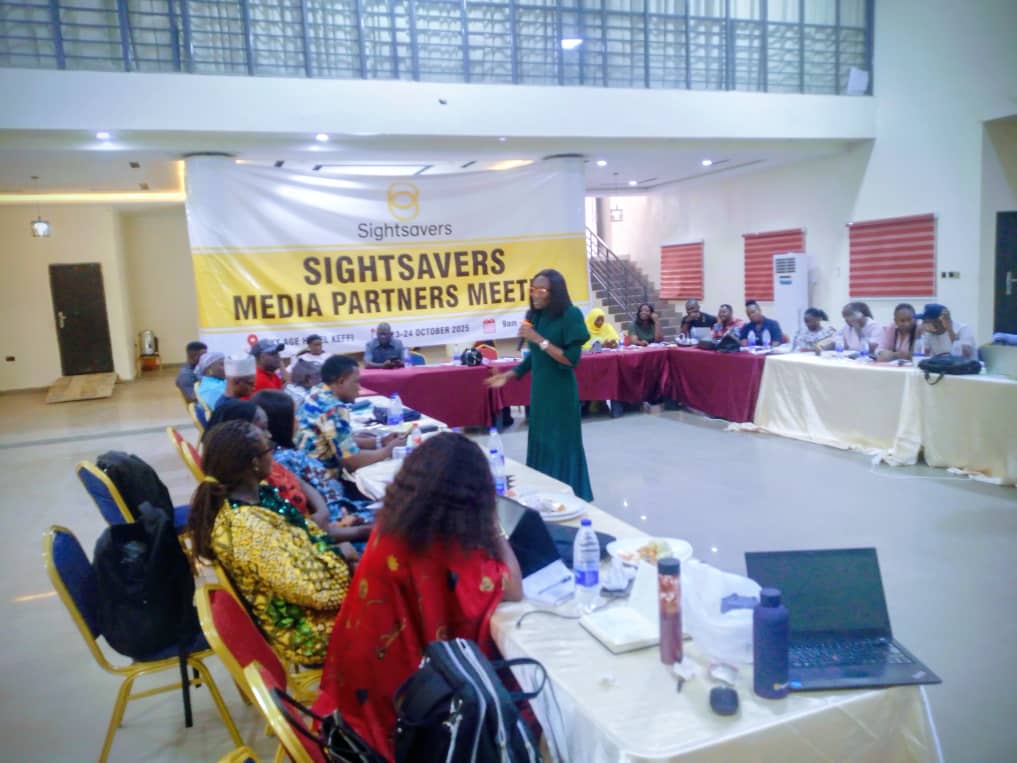
— Calls for urgent investment in eye health and inclusion of persons with disabilities
By Agbo Christian Obiora
Keffi, Nasarawa State | October 25, 2025
A disturbing revelation has emerged as Sightsavers Nigeria, an international non-governmental organisation dedicated to preventing avoidable blindness and promoting disability rights, disclosed that more than 4.2 million Nigerians are currently blind or visually impaired, with many of these cases arising from preventable or treatable conditions such as cataracts, glaucoma, and uncorrected refractive errors.
The alarming statistics were made known by Ms. Barbara Marok, Eye Health Programme Officer, during a two-day Media Partners Meeting organised by Sightsavers in Keffi, Nasarawa State, which brought together journalists from Kogi, Federal Capital Territory (FCT), Benue, Kwara, Niger, Nasarawa, and Plateau States.
Ms. Marok, while addressing the gathering, painted a worrisome picture of the state of eye health in Nigeria, emphasizing that despite the scale of visual impairment, only 4.4% of Nigerians have access to eye care services, compared to 38% in middle-income countries.
“Over 4.25 million Nigerians are blind or visually impaired, and the sad reality is that most of these conditions are preventable or treatable,” Marok lamented.
“Nigeria continues to lose billions of naira annually due to poor vision — losses that manifest in reduced productivity, lower income levels, and educational setbacks,” she added.
She called for increased awareness, improved funding, and equitable investment in eye health, particularly targeting rural and underserved communities, where lack of access to medical services continues to deepen the crisis.
Nigeria Bears 25% of Africa’s NTD Burden
In her presentation, Ms. Folake Aliu, Senior Monitoring, Evaluation and Learning Manager, NTDs/Safeguarding Lead, Sightsavers Nigeria, further highlighted the nation’s heavy burden in the fight against Neglected Tropical Diseases (NTDs).
According to her, Nigeria currently bears 25% of Africa’s NTD burden, a situation that has compounded the country’s public health challenges.
“Many causes of blindness in Nigeria are preventable — from cataracts to glaucoma and refractive errors,” Aliu said.
“Through our interventions, Sightsavers has tackled the five most prevalent NTDs: lymphatic filariasis (elephantiasis), river blindness (onchocerciasis), trachoma, intestinal worms, and schistosomiasis.”
She disclosed that as of 2024, Sightsavers’ global and national interventions have ensured treatment for over 653,130,744 million NTD Treatments to people, supported 74 local government areas to reach trachoma elimination thresholds, and provided 80% of the required technical and financial support towards trachoma elimination in Nigeria.
However, she noted that insecurity, poor government ownership, funding gaps, and ineffective implementation of health programmes remain significant barriers to the total elimination of NTDs across the country.
“Media is a Key Partner in Driving Change” — Prof. Joy Shuaibu
Earlier in her opening remarks, Prof. Joy Shuaibu, Country Director of Sightsavers Nigeria, represented by Mrs. Anita Gwong, Project Director, NTDs, described the media as a critical ally in championing the fight against avoidable blindness and disability exclusion.
She explained that the essence of the meeting was to equip journalists with accurate data, insights, and strategies to amplify issues surrounding NTDs, eye health, and disability inclusion.
“Sightsavers has impacted about 60% of Nigeria’s population through various health and inclusion interventions,” Shuaibu revealed.
“We need the media to continue to shed light on these issues, drive accountability, encourage government ownership of projects, and close funding gaps in the health sector.”
She emphasized that sustained collaboration with the media would help shape public discourse, influence policymaking, and ensure that no one is left behind in accessing healthcare and education, particularly persons with disabilities (PWDs).
Tackling Discrimination Through Inclusive Programming
Speaking on the intersection between disability inclusion and access to healthcare, Mrs. Esther Bature, Sightsavers’ Advocacy Coordinator, called attention to the persistent discrimination faced by Persons with Disabilities, which often deprives them of access to healthcare facilities, quality education, and other social amenities.
According to her, Sightsavers has been actively addressing these barriers through inclusive projects such as the Support Mainstreaming Inclusion to All Learn Equally (SMILE) initiative, Inclusive Family Planning Project, Inclusion Works II, and GESP-SABI Woman programme — all of which are designed to promote equality, inclusion, and empowerment for PWDs, especially women and girls.
“True inclusion means giving persons with disabilities the space to thrive — to learn, work, and live with dignity,” Bature said. “Through our advocacy and inclusive programmes, we are changing attitudes, policies, and systems to make that a reality.”
A Call for Collective Action
The two-day engagement is part of Sightsavers’ periodic capacity-building initiative for media professionals — an effort to strengthen media reportage on issues of eye health, disability inclusion, and NTD elimination in Nigeria.
By bringing journalists together from across North-Central Nigeria, Sightsavers aims to build a network of informed advocates who will keep the spotlight on avoidable blindness, disability rights, and inclusive health systems.
As the curtains fell on the meeting, one message resonated strongly among participants — that blindness and disability should no longer be barriers to living a full and productive life, especially in a nation with the resources and human capacity to change the narrative.
“Together, we can eliminate avoidable blindness, tackle NTDs, and create a more inclusive Nigeria,” one participant declared. “But it starts with awareness — and the will to act.”
Follow the The Qualitative Magazine channel on WhatsApp: https://whatsapp.com/channel/0029VanfIB50wajpjGi3JJ1G


