

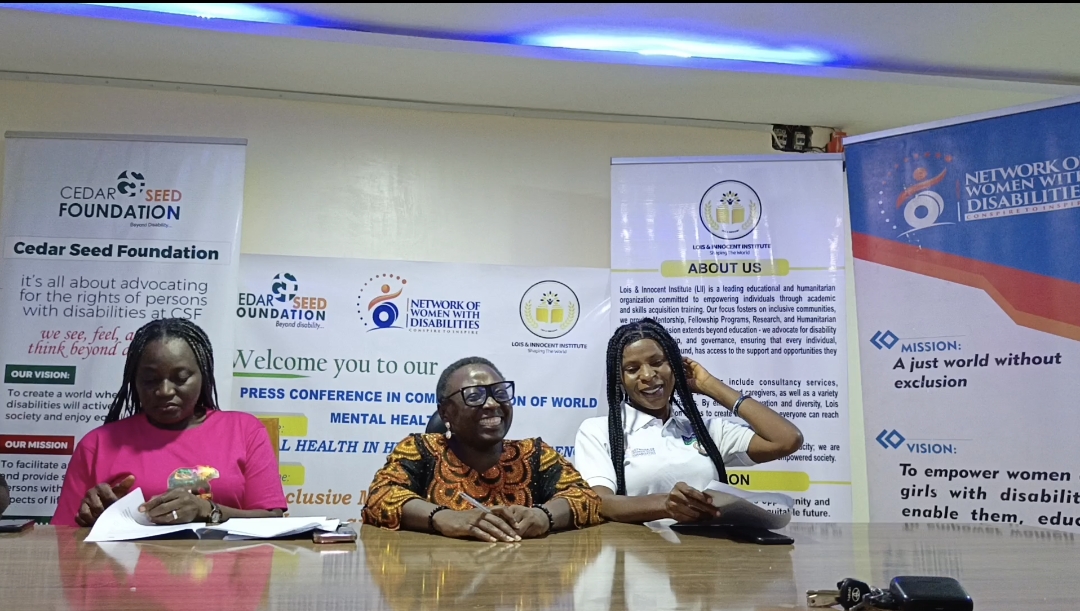
In commemoration of World Mental Health Day 2025, the Lois and Innocent Institute (LII), in collaboration with the Network of Women with Disabilities (NWD) and the Cedar Seed Foundation (CSF), convened a powerful press conference on Friday, October 10, 2025, at the Lungi Barracks Shopping Complex, Asokoro–Maitama, Abuja. The event brought together disability advocates, humanitarian actors, mental health experts, and members of the media to push for an inclusive mental health agenda that recognizes the unique struggles of women and girls with disabilities in humanitarian emergencies.
With the theme “Mental Health in Humanitarian Emergencies” and sub-theme “Inclusive Mental Health Agenda for Women and Girls with Disabilities”, the gathering was not just another routine commemoration. It was a call to conscience—a rallying cry to policymakers, development partners, and society at large to ensure that mental health care reaches everyone, especially the most marginalized.
Mental Health Is Not a Luxury—It’s a Necessity
Opening the event, Lois Auta, Co-Founder and Co-CEO of the Lois and Innocent Institute, welcomed participants with heartfelt gratitude and a clear message: “Mental health is not a luxury, but a necessity.” She emphasized that millions of Nigerians, especially those displaced by conflicts, disasters, and insecurity, continue to live in the shadows of trauma and neglect.
“Among them, women and girls with disabilities remain some of the most invisible, unheard, and unsupported. That is why we are here—to confront silence, raise awareness, and remind both government and society that the fight for inclusion must extend to the mind, not just the body,” Auta declared.
She lauded the media for their crucial role in amplifying advocacy, stating that journalists are “not just reporters of stories but amplifiers of truth and accountability.”
When Trauma Meets Exclusion: A Double Burden
The press conference shed light on a growing but often ignored crisis—the intersection of mental health, disability, and humanitarian emergencies. Nigeria’s recurring humanitarian challenges, from insurgency in the North-East to floods and displacement in the Middle Belt and South, have left behind more than physical destruction; they’ve also inflicted deep psychological wounds.
“While visible injuries may heal, the emotional and psychological scars remain,” Auta noted. “Now imagine being a woman or girl with a disability in that same humanitarian setting—facing physical barriers, discrimination, and sometimes sexual or gender-based violence—all while battling trauma.”
She lamented that mental health is frequently treated as a secondary concern in humanitarian response efforts, and when it is addressed, disability inclusion is rarely part of the design. The result is double exclusion—being marginalized both as a woman and as a person with a disability.
A Call for an Inclusive Mental Health Agenda
The coalition of organizations made a passionate call for the government and humanitarian actors to adopt an Inclusive Mental Health Agenda. This, they said, must recognize that disability, gender, and humanitarian experience intersect and must be addressed together.
Their key recommendations include:
- Inclusive Policy Frameworks: Mental health policies in Nigeria must explicitly include persons with disabilities, with measurable strategies for implementation.
- Accessible Service Delivery: Health centers, IDP camps, and psychosocial support facilities should be physically accessible, with provisions for sign language interpreters and materials in Braille.
- Capacity Building: More disability-aware mental health professionals—counselors, psychologists, and social workers—must be trained to provide accessible and empathetic care.
- Public Awareness: The persistent stigma surrounding mental health and disability must be tackled through continuous sensitization using radio, social media, and community platforms.
- Data and Research: Comprehensive data on the mental health experiences of women and girls with disabilities is essential for evidence-based policy and budgeting.
“Inclusion should not be an afterthought—it must be built into mental health interventions from the very beginning,” Auta emphasized.
Humanitarian Crises and the Mental Health Gap
Over the years, Nigeria has faced overlapping humanitarian crises—conflicts, floods, and displacement—that have led to widespread trauma. Yet, mental health services in camps and emergency shelters remain grossly inadequate.
Research shows that women and girls with disabilities are at higher risk of depression, anxiety, and post-traumatic stress disorder (PTSD) after crises. However, few mental health programs in Nigeria are designed with accessibility in mind. In many IDP camps, psychosocial support is scarce or non-existent, and where available, it is often inaccessible to persons with hearing or visual impairments.
“We rebuild houses and roads, but we often forget to rebuild minds,” Auta lamented. “Healing cannot be complete until we address the emotional wounds of survivors—especially those left behind because of disability.”
Partnerships Driving Change
The collaboration between LII, NWD, and CSF exemplifies the power of partnership in advocacy. These organizations have long been at the forefront of campaigns promoting the inclusion of women with disabilities in national policy dialogues, healthcare systems, and humanitarian responses.
Through community sensitization, mental health awareness campaigns, and peer support programs, they have reached hundreds of women across the country. Yet, as Auta noted, “there is still much more to be done.”
“We want women and girls with disabilities not just to benefit from mental health programs but to be part of designing and implementing them,” she said. “Inclusion without participation is just another form of exclusion.”
Healing, Hope, and Humanity
In her closing remarks, Lois Auta expressed deep appreciation to all partners, media representatives, and government stakeholders for their continued support of inclusive advocacy. She urged them to remain steadfast in ensuring that no one is left behind in Nigeria’s mental health response.
“Mental health is not a special issue—it is a universal one,” she stated. “Everywhere around us, people silently battle anxiety, trauma, and despair. Our humanity demands that we respond not with pity, but with systems that work, policies that protect, and care that includes.”
Auta’s final words resonated deeply across the hall:
“Healing begins when we feel seen. Inclusion begins when we are heard. And progress begins when society learns to care for both the body and the mind.”
The Way Forward
As Nigeria continues to grapple with humanitarian challenges, the message from the 2025 World Mental Health Day commemoration is clear: mental health must be part of every emergency response plan, and inclusion must be non-negotiable.
The Lois and Innocent Institute, the Network of Women with Disabilities, and the Cedar Seed Foundation have set the tone for a national conversation that goes beyond commemoration—one that demands accountability, inclusiveness, and compassion.
Their advocacy underscores a powerful truth: when the most marginalized are cared for, the entire society heals.
Follow the The Qualitative Magazine channel on WhatsApp: https://whatsapp.com/channel/0029VanfIB50wajpjGi3JJ1G


