

Abuja, Nigeria – September 23, 2025
Nigeria has taken another giant stride toward building an inclusive society as the National Commission for Persons with Disabilities (NCPWD) officially unveiled a set of groundbreaking National Accessibility Compliance Certificates in Abuja. The historic initiative is designed to accelerate the enforcement of the Discrimination Against Persons with Disabilities (Prohibition) Act, 2023, as well as the Persons with Disabilities (Accessibility) Regulations, 2023, offering a clear compliance framework for public and private institutions nationwide.
The three certificates—the National Accessibility Compliance Certificate, the National Disability Compliance Certificate, and the Provisional Accessibility Compliance Certificate—represent a bold new mechanism for ensuring that Nigeria’s estimated 35.5 million persons with disabilities enjoy full access to buildings, services, transportation, and technology.
“Accessibility Is a Right, Not a Privilege”
Speaking at the unveiling ceremony, the Executive Secretary of NCPWD, Hon. Ayuba Burki Gufwan, described the initiative as a concrete step toward dismantling barriers that have excluded millions of Nigerians from meaningful participation in society.
“Accessibility is essential for persons with disabilities to participate fully in every aspect of life,” he declared. “These certificates will encourage compliance with standards, promote accountability, and celebrate organizations that prioritize inclusion. Together, we are building a Nigeria where no one is left behind.”
The certificates, he explained, are more than symbolic—they are practical tools designed to promote compliance with accessibility laws, enhance accountability by recognizing organizations that meet benchmarks, and foster a culture of inclusion across Nigeria.
Guidelines, Enforcement, and Sustainability
The NCPWD has already developed detailed guidelines for implementing the certificates, which include training, monitoring, and active participation of stakeholders. These guidelines are currently awaiting gazette publication and codification by the Office of the Accountant-General of the Federation.
In addition to serving as recognition for compliance, the certificates are expected to generate Internally Generated Revenue (IGR) for both the Commission and the Federal Government. This innovative funding stream will ensure sustainability for disability inclusion initiatives nationwide while reducing over-reliance on traditional funding models.
A Call to Action for National Transformation
Echoing the Executive Secretary’s message, Barr. Ikem Uchegbulam, Director of Compliance and Enforcement at NCPWD, emphasized that the unveiling was not just a celebration, but a challenge to all stakeholders.
“Today, we reaffirm our collective dedication to breaking down the physical, social, and systemic barriers that have hindered the progress of persons with disabilities,” he said. “It is imperative that we cultivate an environment where everyone, regardless of ability, can thrive and contribute to Nigeria’s development.”
Government’s Renewed Commitment
The event also featured strong messages of support from key government officials. The Head of the Civil Service of the Federation, Dr. Didi Walson-Jack, represented by Mrs. Patience Oyekwale, Permanent Secretary, Office of the Head of Service, underscored the importance of enforcement within Ministries, Departments, and Agencies (MDAs).
“Disability inclusion is a right that must be complied with across all sectors,” she insisted, calling for immediate and robust implementation of the compliance framework.
Similarly, the Senior Special Assistant to the President on Special Needs and Equal Opportunities, Hon. Mohammed Abba Isah, commended the Executive Secretary of NCPWD for what he termed a “milestone achievement,” adding that the certificates would usher in a new era of practical enforcement of the Disability Act.
A Symbol of Hope for an Inclusive Nigeria
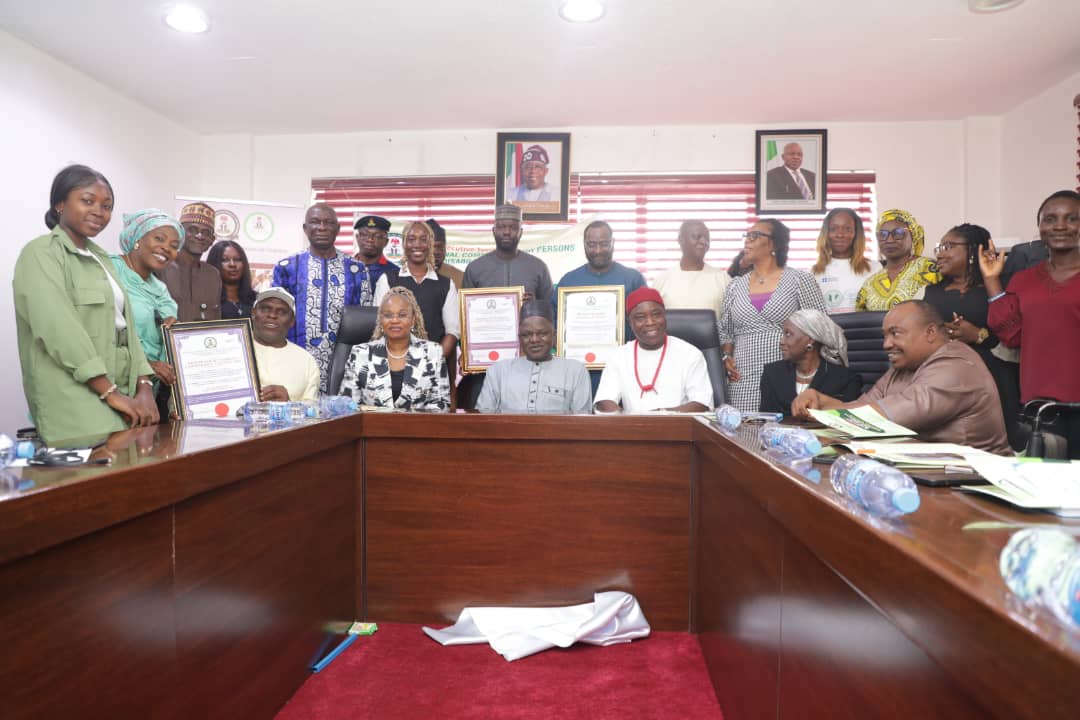
The highlight of the event came with the formal unveiling of the certificates by Mrs. Patience Oyekwale, representing the Office of the Head of Service of the Federation. Applause and optimism filled the room as stakeholders—from government officials to disability advocates—praised the Commission for its bold steps toward making Nigeria more inclusive.
For many participants, the ceremony was more than a policy milestone; it was a symbol of hope. By institutionalizing accessibility through official certification, Nigeria is charting a path toward a future where persons with disabilities are no longer excluded from opportunities that others take for granted.
Looking Ahead
The NCPWD’s Accessibility Compliance Certificates are expected to set a new national standard. Advocates believe they will not only encourage public and private institutions to comply with the law but will also shift attitudes, reinforcing the principle that accessibility is a shared responsibility.
As Hon. Gufwan concluded in his rallying call:
“Let us ensure that awareness about this compliance framework reaches every corner of our nation. By doing so, we create a society where accessibility is not an aspiration but a reality for all.”
With this unveiling, the Commission has sent a powerful message: Nigeria’s journey toward full disability inclusion is no longer on paper—it is becoming a lived reality.
Follow the The Qualitative Magazine channel on WhatsApp: https://whatsapp.com/channel/0029VanfIB50wajpjGi3JJ1G


