

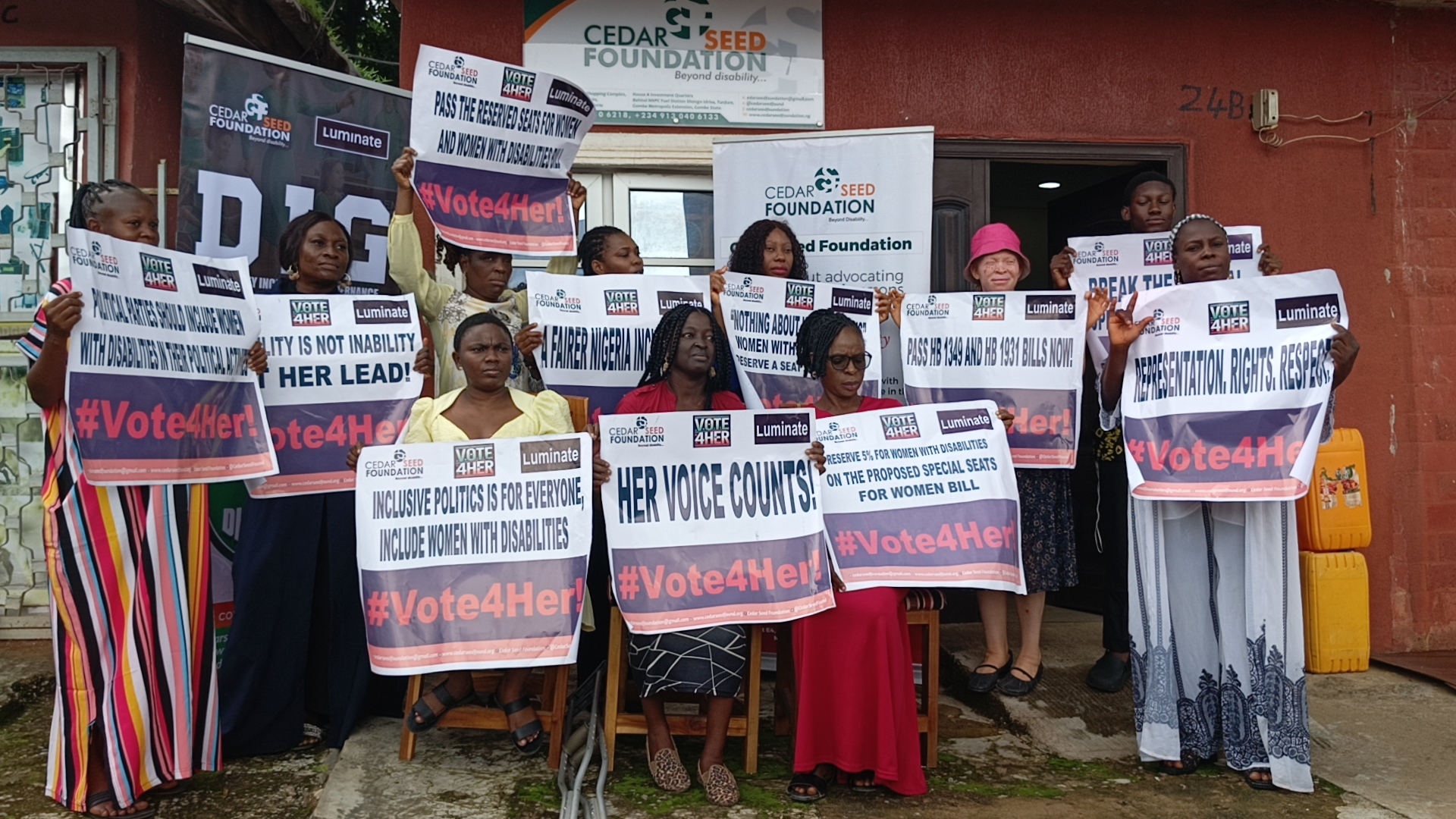
Abuja, Nigeria — August 4, 2025
In a bold and urgent move to reshape Nigeria’s political landscape, Cedar Seed Foundation(CSF) , with support from global philanthropic organization Luminate, has launched a powerful civic advocacy campaign titled “Vote for Her” — a rallying cry for the full political inclusion of women and girls with disabilities in Nigeria’s democratic processes.
The campaign, unveiled during a press conference in Abuja, brought together a cross-section of civil society leaders, government representatives, disability rights activists, media professionals, development partners, and advocates for gender equity. The launch was not just a ceremonial event, but a stirring declaration that the political marginalization of women with disabilities can no longer be tolerated.
“It is with great pride and a deep sense of urgency that we welcome you to the official launch of the ‘Vote for Her’ campaign,” said Lois Auta, Executive Director of Cedar Seed Foundation. “We are here to say: enough is enough. No democracy can thrive when millions of women are left behind.”
The Heart of the Campaign
“Vote for Her” is more than a slogan — it’s a movement. A national and international call to dismantle the systemic barriers that have long prevented women and girls with disabilities from fully participating in Nigeria’s political life.
Despite representing a significant portion of Nigeria’s population, women and girls with disabilities continue to face multiple layers of exclusion — as women, as persons with disabilities, and as citizens within a political environment that remains largely inaccessible both physically and institutionally.
“We must challenge the structures that silence women with disabilities,” said Auta. “This campaign is about creating space, amplifying voice, and changing the narrative — from exclusion to inclusion, from tokenism to transformation.”
Campaign Goals and Strategy
Over the next 15 days, Cedar Seed Foundation will roll out a robust civic engagement strategy that combines grassroots mobilization with high-level advocacy, using both digital platforms and in-person stakeholder engagements. The campaign will focus on five key areas:
1. Social Media Advocacy
A nationwide digital campaign will use powerful storytelling to highlight the experiences, leadership, and potential of women and girls with disabilities. These narratives will humanize the statistics and confront the prejudices that often lead to exclusion.
2. Stakeholder Engagement
Cedar Seed will hold high-level meetings with political party leaders, the Independent National Electoral Commission (INEC), civil society groups, and media houses. These dialogues aim to push for inclusive reforms in party constitutions, candidate selection, and electoral practices.
3. Community Mobilization
Grassroots efforts will focus on raising public awareness about the importance of inclusive governance. The campaign will host forums and town halls to educate citizens about the rights of women with disabilities to participate fully in the political process.
4. Policy Advocacy
One of the campaign’s most urgent demands is the implementation of the 5% quota for persons with disabilities, as guaranteed by Nigeria’s Discrimination Against Persons with Disabilities (Prohibition) Act, 2018. The campaign also calls for political parties to revise their manifestos to reflect and uphold the rights of women with disabilities.
5. Accessible Electoral Processes
The campaign is urging INEC and all electoral stakeholders to ensure accessibility throughout the electoral cycle — from registration to polling units — so that no woman is left behind due to disability.
The Bigger Picture: Democracy Must Be Inclusive
“Inclusive governance is not a luxury,” said Auta. “It is a necessity. If democracy is truly about representation, then every woman — including those with disabilities — must have a seat at the table.”
The exclusion of women with disabilities from leadership positions has long been normalized in Nigeria. They are rarely nominated as party candidates, seldom appointed to public office, and often ignored in electoral processes. Even basic accessibility to political spaces remains a challenge, as many polling units lack ramps, sign language interpreters, or ballot materials in accessible formats.
Cedar Seed Foundation’s “Vote for Her” campaign is determined to change that reality.
A Call to Action for Political Actors and Citizens
The campaign issued a strong appeal to political stakeholders, development partners, and citizens, calling on them to act decisively:
- Political Parties: Must revise their constitutions and manifestos to include women and persons with disabilities. The Inter-Party Advisory Council (IPAC) is urged to make this a mandate.
- INEC: Must guarantee inclusive voter registration, voting materials, and polling accessibility.
- Citizens: Are encouraged to amplify this movement, demand reforms, and support women with disabilities in their leadership journeys.
- Media and Civil Society: Are urged to be active partners in shifting the public narrative from pity and exclusion to empowerment and rights.
“This campaign is not about sympathy. It is about rights. It is about justice. It is about voice and visibility,” Auta emphasized. “We say it loud and clear: She has a voice. She has a right. She matters. Let us VOTE FOR HER.”
A Movement That Can’t Be Ignored
With the 2027 general elections already on the horizon, the “Vote for Her” campaign sets the stage for a more inclusive political future. It calls on Nigeria to live up to its democratic ideals by ensuring that the voices of all women — including those with disabilities — are heard, respected, and represented.
Cedar Seed Foundation and its partners are ready to lead this charge — but they are clear: they cannot do it alone.
“Let us build a Nigeria where every woman counts,” concluded Auta. “Let’s make it possible for the next generation of girls with disabilities to dream of the presidency, the Senate, the governorship — and actually reach it. It starts now. It starts with us. Let us VOTE FOR HER?.


