

By Agbo Christian Obiora
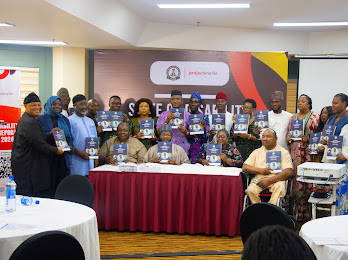
Abuja, Nigeria – In a groundbreaking move to accelerate disability rights and inclusive governance, Project Enable Africa, in partnership with the National Commission for Persons with Disabilities (NCPWD) and the Federal Ministry of Humanitarian Affairs and Poverty Reduction, on Friday, July 26, 2024, unveiled Nigeria’s first-ever State of Disability Inclusion Report (SDIR) 2024 — a comprehensive national assessment spotlighting the state of disability inclusion across the country.*
The historic report, unveiled at a high-level event in Abuja, marks a critical milestone in Nigeria’s journey towards full implementation of the Discrimination Against Persons with Disabilities (Prohibition) Act 2019, as the nation arrives at the end of the five-year transitional compliance window.
The State of Disability Inclusion Report 2024 serves as Nigeria’s first empirical document capturing how inclusive the nation truly is across critical sectors — education, health, employment, social protection, policy frameworks, and accessibility standards.
🔍 A National First: Measuring Inclusion with Data
Presenting the landmark report, Mr. Olalekan Owonikoko, Executive Director of Project Enable Africa, described it as “a defining moment for disability rights in Nigeria.” According to him, the report was developed through nationwide stakeholder consultations, policy reviews, and in-depth interviews with Persons With Disabilities (PWDs) from all 36 states and the Federal Capital Territory (FCT).
“This report is not just a publication; it is a mirror held up to the Nigerian government, institutions, and society at large — showing both how far we’ve come and how far we still need to go,” Owonikoko declared.
🧭 Enforcement Tools and Political Will
The Executive Secretary of the NCPWD, Mr. Ayuba Gufwan, represented at the launch by Barr. Nkem Uchegbulam, emphasized the commission’s readiness to back the report with concrete action. He announced the deployment of enforcement guidelines and the issuance of accessibility compliance certificates to ensure infrastructure and services meet disability standards.
“We now have effective and efficient modalities to enforce compliance under my leadership. The rights and liberties of PWDs will be protected — not only on paper but through action,” he affirmed.
He also revealed that the Commission will forward a memo and the SDIR findings to relevant Ministries, Departments, Agencies, and state governments, clarifying how their mandates intersect with the report’s recommendations.
📊 The Findings: Gaps, Warnings, and Hope
The report, presented in full by disability policy expert Dr. Bukola Adebayo, reveals both progress and glaring gaps. As of 2024, only 23 out of Nigeria’s 36 states have domesticated the National Disability Act, and just 15 states have operational disability agencies. The findings, he said, make the case for urgent mainstreaming of disability concerns in national and subnational development strategies.
Adebayo outlined key recommendations, including:
- Resource allocation for both disability-specific programs and mainstream inclusion
- Nationwide accessibility audits of public infrastructure
- Domestication of disability laws in all states
- Inclusive health insurance schemes tailored to the unique needs of PWDs
“The report challenges us to be honest: Are public spaces truly accessible? Do our policies reflect inclusive values? Inclusion must move from intention to implementation,” he said.
👩🦽 Gender and Disability: Double Discrimination
Mrs. Maryam Keshinro, Permanent Secretary of the Federal Ministry of Women Affairs, represented by Mr. Ayuba Richard, emphasized the unique plight of women and girls with disabilities, who often face multiple layers of marginalization in health, education, employment, and political representation.
“They have been sidelined for too long. Their voices, experiences, and aspirations are often erased from national conversations,” she lamented.
“As a ministry tasked with protecting the rights of women and vulnerable groups, we insist — no one must be left behind.”
She emphasized that the SDIR will serve as a catalyst for intersectional policymaking, urging all stakeholders to address the compounded vulnerabilities of disability and gender inequality.
🔔 A Call to Wake Up
Speaking on behalf of the Project Enable Africa board, Dr. Kola Olugbodi reminded participants that the Disability Act provided a five-year grace period for compliance, which ends in 2024. The launch of the SDIR, he said, is both a diagnostic and a directive.
“This report is a wake-up call. It’s time for all sectors — public and private — to put action behind their commitments to disability inclusion,” he said.
🧭 Towards a More Inclusive Nigeria
The State of Disability Inclusion Report 2024 is part of the Disability Inclusion Metric Project, funded by the Nigerian Youth Futures Fund, and designed to provide empirical data for advocacy, policy reform, and program development in line with global standards.
For many disability rights advocates, the SDIR represents a long-awaited instrument that can shift the conversation from charity and tokenism to rights-based development. It provides the necessary blueprint for measuring impact, enforcing accountability, and ensuring that PWDs are not treated as afterthoughts in national development.
As Nigeria moves beyond the five-year transitional phase of the Disability Act, the question now is no longer “When will we act?” but rather: “How boldly will we implement the report’s findings — and who will lead the change?”
#DisabilityInclusion #StateOfDisabilityReport2024 #ProjectEnableAfrica #NCPWD #NYFF #DisabilityRights #AccessibilityNow #NoOneLeftBehind #InclusiveGovernance #DisabilityActNigeria #GenderAndDisability #PWDsMatter


