

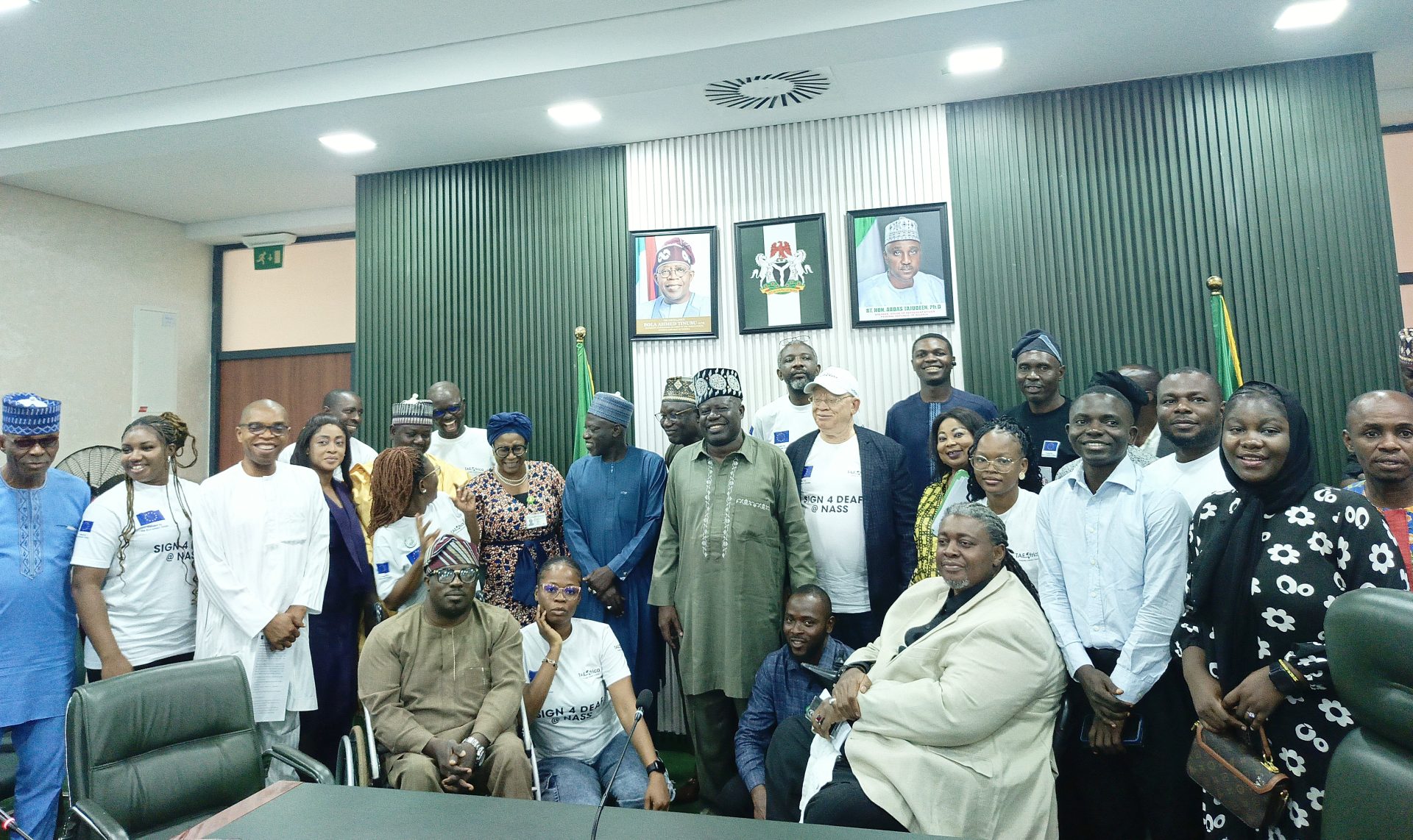
…As TAF Africa, NCPWD, and Deaf Community Leaders Call for Full Implementation of Disability Act and Inclusive Legislative Broadcasting
In a powerful high-level advocacy engagement held at the National Assembly on Thursday, stakeholders in the disability community, led by TAF Africa and the National Commission for Persons with Disabilities (NCPWD), called on Nigeria’s federal lawmakers to urgently address the lack of visibility of sign language interpreters during official plenary broadcasts.
The event, convened under the theme of promoting inclusive media representation for Deaf Persons, brought together a wide range of advocates, development partners, and government representatives, all united by a single goal — to ensure that legislative proceedings are fully accessible to Deaf Nigerians.
The delegation, which included leaders of the Nigerian National Association of the Deaf (NNAD), the Centre for Ability, Rehabilitation and Empowerment (CARE), the Association of Sign Language Interpreters of Nigeria (ASLIN), and other stakeholders, submitted a unified demand: make sign language interpreters visible, professional, and central to all official legislative broadcasts.
“Invisibility Defeats the Purpose” – Amb. Jake Epelle
Speaking at the engagement, Ambassador Jake Epelle, the Founder and Chief Executive Officer of TAF Africa, expressed deep concern over the tokenistic inclusion of sign language interpreters in National Assembly coverage, despite the recent deployment of interpreters to both chambers — a historic first in Nigeria’s legislative history.
“The major challenge, from our findings, is that there is no designated position for sign language interpreters that allows cameras to focus on them during plenary sessions. What then is the purpose of deploying interpreters if the Deaf community cannot see them?” he asked.
Epelle explained that although interns and professionals have been deployed to provide sign language interpretation, their services are rendered ineffective when camera angles and production setups fail to prioritize them. He passionately appealed to the leadership of the National Assembly to mandate the ICT and media teams to focus a dedicated camera on the interpreters during live sessions.
“We are not asking for favors; we are demanding equal access. The Deaf must be able to follow proceedings in real-time just like every other Nigerian,” Epelle added.
NCPWD Commends Effort, Demands More
Representing the Executive Secretary of NCPWD, Hon. Ayuba Gufwan, the Director of Social Integration, Mr. Lawrence Idemudia, commended the National Assembly for adopting sign language interpretation at plenary sessions, but he noted several critical gaps that risk undermining this commendable step.
“Some National Assembly staff are yet to understand the significance of having sign language interpreters. Worse still, there are reports of subtle discrimination against interpreters. These attitudes must be addressed,” Idemudia warned.
He listed several recommendations to remedy the situation:
- Procurement and deployment of dedicated cameras for interpreters in both chambers.
- Deployment of two trained staff to manage the cameras.
- Inclusion of sign language interpreters as part of the National Assembly’s official media crew.
He further called on the legislature to implement the Accessibility Audit conducted by CARE, which highlighted structural gaps, including the lack of designated parking lots for persons with disabilities, the absence of a disability desk, and other infrastructural barriers within the complex.
Calls for Legal Recognition and Sustainable Funding
John Bamidele, Chairman of ASLIN FCT, used the platform to advocate for the legal recognition of sign language as an official language in Nigeria. According to him, until sign language is recognized by law, access for the Deaf community will continue to be at the mercy of tokenistic goodwill.
“We propose the establishment of a National Sign Language Certification Body to ensure continuous training and quality assurance for interpreters. Deaf persons deserve professional, consistent, and accessible services — whether in health, education, or employment,” Bamidele emphasized.
He also urged the government to gazette a budget line for sign language interpretation services, moving away from the current practice of paying stipends to interpreters — a model he described as unsustainable and exploitative.
More Stakeholders Join the Call
Dr. Chike Okogwu, CEO, CARE and Haruna Tsafe, National President, NNAD echoed the sentiments of earlier speakers, stressing the urgent need for more inclusive practices across all arms of government, especially in the legislative process.
They stressed that any legislative process that does not accommodate Deaf persons and other PWDs violates both the spirit and letter of the Discrimination Against Persons With Disabilities (Prohibition) Act, 2018.
National Assembly Promises Bold Reforms
Responding to the stakeholders’ passionate appeals, Hon. Dr. Bashiru Ayinla Dawodu, Chairman, House Committee on Disability Matters, who represented the Speaker, Rt. Hon. Tajudeen Abass, and Deputy Speaker, Hon. Benjamin Kalu, expressed appreciation for the partnership between TAF Africa, NCPWD, and the National Assembly.
He reassured the disability community that the 10th Assembly remains fully committed to disability inclusion. “We are proud that for the first time in Nigeria’s history, sign language interpreters are now deployed in both chambers. But we acknowledge that more must be done.”
To address the issue of visibility, Dr. Dawodu promised that the ICT Department would be directed to integrate a screen-in-screen feature during broadcasts, allowing viewers to clearly see sign language interpreters.
He also proposed:
- A disability inclusion budget line in key ministries, departments, and agencies (MDAs).
- The introduction of a Disability Infrastructure Fund to finance access projects.
- A joint oversight hearing by relevant committees to fast-track the implementation of the Disability Act.
- The introduction of a Disability Compliance Scorecard to publicly track how MDAs are meeting their obligations.
- Legislative action to prioritize inclusive education and ensure swift passage of pending disability-related bills.
Furthermore, the Speaker’s representative pledged to:
- Encourage lawmakers to hold consultative forums in their constituencies to engage PWDs.
- Host a national dialogue on disability inclusion before the end of 2025.
- Partner with TAF Africa to develop a Disability Inclusion Handbook for National Assembly staff.
- Train frontline protocol officers and legislative aides on sign language and disability etiquette.
A Renewed Commitment to Full Inclusion
The meeting ended on a high note, with stakeholders and government representatives reaffirming their commitment to building a National Assembly that is not just accessible in words, but in action. With passionate advocacy, clear policy asks, and strong political will, Nigeria moves one step closer to ensuring no citizen is left behind—not even in the hallowed chambers of its Parliament.
#DisabilityInclusion #SignLanguageMatters #DeafRightsNow #InclusiveLegislation #TAFAfrica #NCPWD #NNAD #CARENigeria #ASLIN #NationalAssembly #PWDRepresentation #AccessibilityForAll #RightToCommunicate #NigeriaDisabilityAct #10thAssemblyForInclusion #TQMReports


