

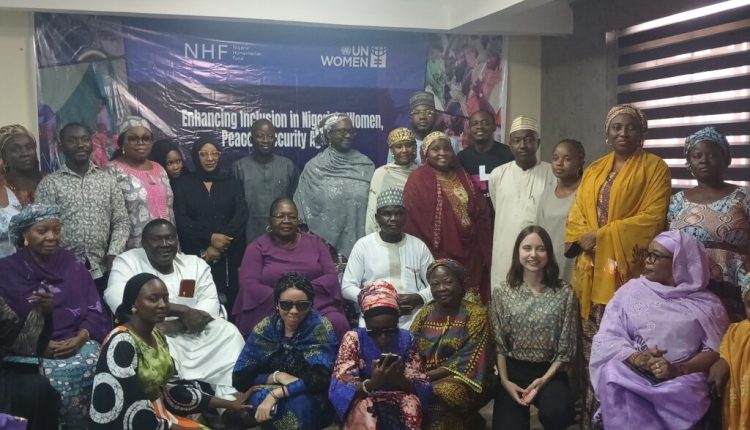
Stakeholders Unite to Amplify Voices of Women With Disabilities in Peace and Governance
Yola, Adamawa State – May 2025 — The call for inclusive governance in Adamawa State reached a crescendo on Monday as the United Nations Women and a coalition of civil society organizations, disability rights advocates, and government representatives urged Governor Ahmadu Umaru Fintiri to sign into law a landmark bill promoting the rights and inclusion of Persons With Disabilities (PWDs).
The passionate appeal was made during a high-level policy dialogue held in Yola, themed “Enhancing Inclusion of Women With Disabilities in Peace and Security Decision-Making.” The event, supported by the Nigeria Humanitarian Fund (NHF), brought together a cross-section of stakeholders committed to transforming the lived realities of persons with disabilities—especially women and girls—in conflict-prone and post-crisis communities.
The dialogue, according to organizers, aimed not only to amplify the voices of women with disabilities (WWDs) in peacebuilding efforts but also to push for a comprehensive legal framework that would institutionalize their rights and ensure full societal integration.
Waiting for the Governor’s Pen: A Historic Bill in Limbo
Addressing participants at the event, Ms. Patience Bello, National Programme Officer of UN Women, emphasized that disability rights are not charity-based but human rights that deserve robust legal protection. She revealed that Adamawa State had already crossed a major legislative hurdle, with the House of Assembly passing a bill to re-enact the PWD Commission into law—yet the final step remains: Governor Fintiri’s assent.
“We commend the Adamawa State House of Assembly for passing this progressive bill. What remains is the Governor’s signature, which will activate a legal framework that protects the dignity, rights, and opportunities of PWDs in the state,” Bello stated.
The bill, sponsored by Hon. Yohanna Jauro of Mubi South Constituency, aims to repeal the existing Disability Rights Commission Law No. 14 of 2016 and enact a stronger, more inclusive law known as the Adamawa State Persons with Disability Commission Law. Its objective is to create a sustainable structure that guarantees the rights of persons with disabilities and eliminates all forms of discrimination.
A Platform for Action, Not Just Dialogue
Participants at the policy dialogue moved beyond rhetoric, developing a Joint Action Plan that identified core barriers faced by WWDs in peace and security processes and offered practical solutions. The plan also recommended the formal integration of WWDs into strategic, women-led peace networks such as the Mixed Observation Team and the Women Mediation Network.
“This meeting is not just about talking—it’s about creating a roadmap for action,” Bello affirmed. “Women with disabilities must be seen and heard as peacebuilders, not just victims of conflict.”
Government and Legal Stakeholders Speak Up
The Ministry of Women Affairs and Social Development, represented by Principal Welfare Officer Mrs. Rukaiyatu Tahir, reiterated the ministry’s commitment to rehabilitating and empowering women with disabilities. Tahir explained that the rehabilitation department focuses on preventing discrimination, fostering independence, and reducing street begging by creating economic opportunities for WWDs.
“We are dedicated to ensuring that women with disabilities are active participants in peacebuilding processes, not afterthoughts,” she said.
Also lending a strong legal voice was Mrs. Jamila Babuba, Chairperson of the International Federation of Women Lawyers (FIDA) in Adamawa State. She highlighted FIDA’s pro bono legal aid services for WWDs, especially those with mobility or communication barriers, and its advocacy for disability-inclusive legal reform.
“Our justice system must recognize the specific challenges faced by women with disabilities. From mobility to access to fair hearing, these issues require thoughtful legislation and judicial empathy,” Babuba declared.
Bill Reflects Global, National Disability Priorities
The proposed Adamawa State Persons With Disability Law aligns with Nigeria’s national legislation—the Discrimination Against Persons With Disabilities (Prohibition) Act, 2018—as well as the United Nations Convention on the Rights of Persons With Disabilities (UNCRPD), to which Nigeria is a signatory.
If signed into law, Adamawa will join other progressive states in implementing a comprehensive disability legal framework, creating new opportunities for inclusive development, and ensuring that no one is left behind in the state’s journey toward peace and prosperity.
Voices from the Movement: A Demand for Dignity and Equality
Disability rights advocates across the country have hailed the policy dialogue and legislative progress as critical milestones in a broader fight for equality and inclusion. However, they stress that the delay in gubernatorial assent continues to leave thousands of PWDs in Adamawa in a state of legal limbo.
“This bill is not just paper; it’s a shield for our rights, a voice for the voiceless,” said Aisha Salihu, a disability rights activist and participant in the dialogue. “We need Governor Fintiri to listen to our voices and act swiftly.”
A Call to Action
As the Adamawa disability community and its allies await the governor’s action, the stakes remain high. Without the legal framework in place, PWDs—especially women and girls—remain vulnerable to systemic exclusion, discrimination, and neglect.
Stakeholders at the dialogue concluded with a unified message: it is time to turn promises into policies and advocacy into action. Signing the bill into law would be a historic move, not just for Adamawa, but as a beacon of hope for disability-inclusive governance across Nigeria.

Follow Us On WhatsApp Channel For More


