The Anambra state Office of the Governor on Disability
matters in collaboration with the Anambra State joint national association of
persons with Disabilities (Jonapwd) organized a one day capacity building
workshop for Entrepreneurs with Disabilities on Tuesday 6th August 2019 at
Prof. Dora Akunyili women Development Centre,Awka.
Prof. Hyacinth Ezeka, a USA based onye Anambra,Tax
Administrator as well as a lecturer at the college of Business,Copping State
University Baltimore, Maryland, USA facilitated the training sessions which was
based on rudiments of Business record keeping.
The workshop was well attended by the various clusters of
entrepreneurs with Disabilities including the Deaf,the Blind and the Physically
Challenged as well as the SSA on power and utility Hon. Engr. Victor Meju and
the Special assistant to the Governor on sign language communication Mr Collins
Joseph
Inaugurating the entrepreneurs with Disabilities group, the
SSA on Disability matters, Barr. Chuks Ezewuzie encouraged them to always put
into practice what they have learnt from the seminar,as that would boost their
businesses as well as enable them access micro credit facilities from Anambra
state small business Agency (ASBA).
Delivering the vote of thanks,Mr Uche Nnadi former chairman, national association of the Blind, Anambra state, appreciated the resource person for finding time to train members of the Association without cost,while the chairman of Jonapwd Anambra state Comr. Ugochukwu Okeke charged the the participants to live up to expectations.
Gombe is among twelve other states to benefit from a 3.4
billion naira World Bank loan intervention to address the problem of
malnutrition and stunting for the next five years.
Dr Kamil Shoretire, the National Projects Manager of
Accelerated Nutrition Results in Nigeria (ANRIN), started this while briefing
newsmen in Gombe during the orientation meeting of stakeholders of the
programme in Gombe.
He said Gombe was among the benefiting States for the
project because of the high level of malnutrition and stunting in the states.
Dr Kamil also said that the target of the Anrin projects is
pregnant women and lactating Mothers in twelve’s state selected.
He said the money came through the support of Primary health
care development agency that makes sure this intervention will meet the needs
of the children.
According to him, all new born babies should be exclusively
breast fed except when there is medical indication that will prevent it. “The
results are so glaring, exclusively breast fed baby will have well developed
brain in school and in many things”, Dr. Kamil stressed.
He then advised to all pregnant women to use iron and folic
acid during pregnancy so as to help the baby as well as those having anemia to
remain strong.
The total amount of the loan which the twelve states are to
benefit from is $232m which Gombe is part of.
The other states
include Abia, Akwa-Ibom, Nasarawa, Kwara, Kaduna, Katsina, Kano, Kogi, Niger,
Oyo, and plateau states.
Strengthening Citizens Resistance against Prevalence of Corruption (SCRAP-C): The Centre for Citizens with Disabilities (CCD) held Stakeholders’ meetings on corruption and the Nigeria Disability Act simultaneously in two states; Kano and Enugu state on the 6th of August 2019.
The Stakeholders’ meetings on corruption and the Nigeria Disability Act enlightened participants on the negative effects of corruption on persons with disabilities (PWDs) and the society at large. Establishing the fact that there is a direct line connecting Corruption and Poverty to Disability. Corruption as a tool takes all the resources at the disposal of a nation and puts in the hands of few citizens, thereby leaving the larger populace in abject poverty that in the long run leads to increase in the population of persons with disabilities.
CCD through the SCRAP-C programme aims to fight corruption among PWDs and Nigerians at large and as well as highlighting the benefits of implementing the Nigeria Disability Act to all stakeholders involved. The full implementation of the Nigerian Disability Act will protect the rights of PWDs in Nigeria and create more opportunities for all Nigerians
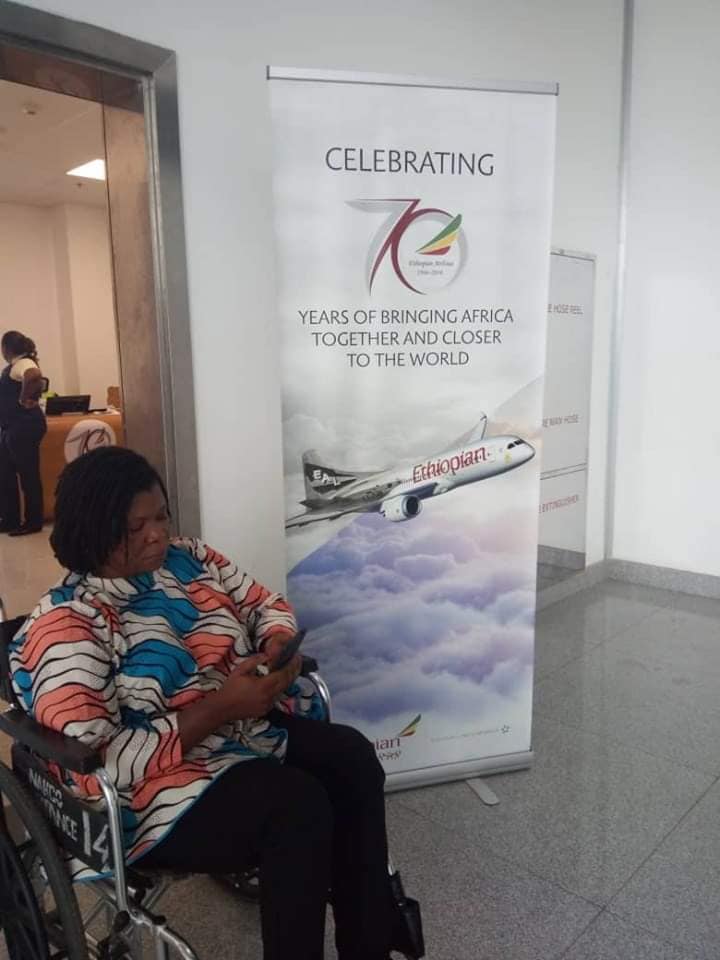
The Ethiopian airline has caused serious outrage among Nigerians with disabilities after it grounded popular disability advocator and Executive Director of Inclusive Friends Association, Grace Jerry, for more than 3 hours as they misplaced her wheelchair’s footrest.
Grace who was returning from a programme held in Johannesburg, South Africa took to her facebook page to share her harrowing ordeals.
Information gathered by INN revealed that Grace was grounded at Abuja international airport for over three hours after the airline officials misplaced her checked in wheelchair’s foot rest.
The damaged wheelchair
Grace noted that the airline officials were lackadaisical in their approach to solving her wheelchair issue and were also reluctant to providing her a mean to get home.
Expressing her displeasure over the ordeal, she wrote, “This is Grace Jerry, I need your help, I’m still at the airport since 12noon.”
“@flyethiopian has grounded me at Abuja airport for over 2hrs as my checked in wheelchair from Johannesburg to Abuja arrived with missing foot rest, they don’t want to provide means for me to get home. My only means of mobility is damaged”. Grace added
Grace Jerry being grounded for hours
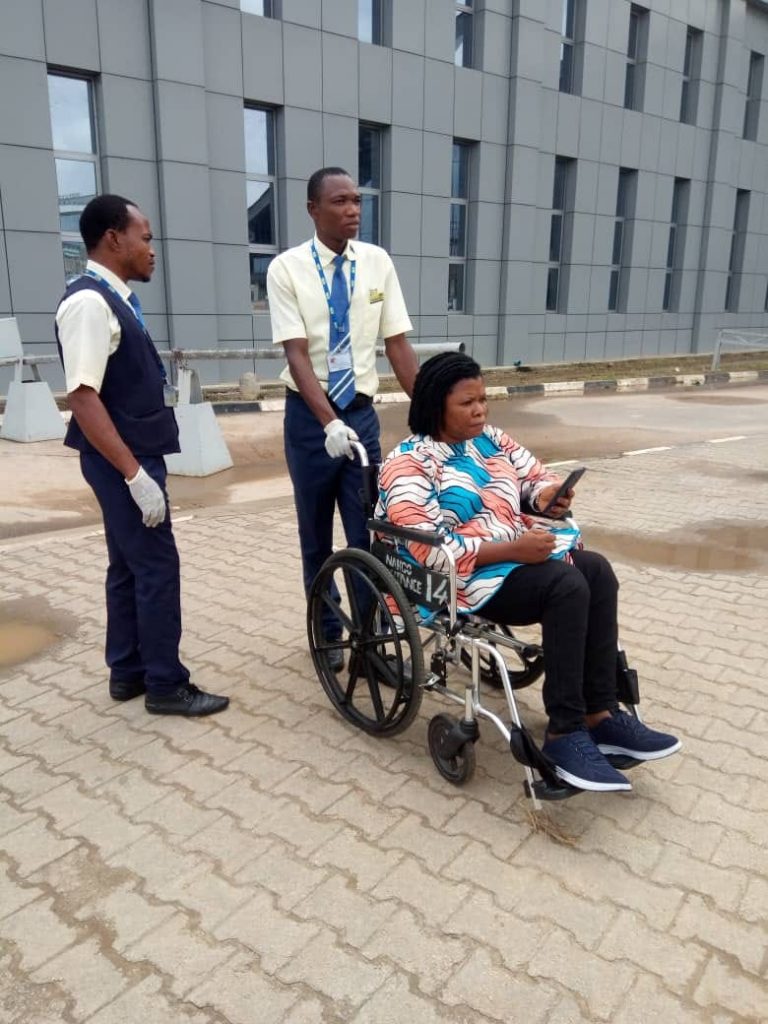
After spending days at a program organised by African Peer Review Mechanism in Johannesburg, South Africa and return to find herself grounded for over 3 hours, the Ethiopian airline could only provide her with a service wheelchair which is to be returned within 24 hours and twitted that they have assisted her which was clearly not a permanent solution.
INN gathered that Grace had to go home with a makeshift wheelchair borrowed her by the Nigerian Aviation handlers.
“Nigerian aviation handling company Have just allowed me to go home with their service wheelchair now for only 24hrs After so much drama, But Ethiopian airline in not saying anything. I was grounded at Abuja airport for over 3hrs” Grace said
At around 5pm, 5 hours after the incident, the Ethiopian airline called in to inform Grace on their effort to replace the missing part though they didn’t say how soon she will get her wheelchair back.
“Thank you my FB family for all the swift action. An official from the @flyethiopian abuja office called around 5pm to inform me on their effort to replace the missing part, he didn’t say how soon I’ll get my chair back. @nahco_aviance is taking the chair they borrowed me back tomorrow. Let the fight to get my mobility aid continue please” , Grace further explained.
The show of shame by the Ethiopian Airline incur the wrath of the disability community in Nigeria and abroad who took to Ms Grace comments section to condemn the ill-treatment meted out to her.
Angrily calling for a conference, Tim-Tinat Gwazah has this to say, “Until we have a press conference to address these abuses of persons with disability by airlines, the generation of persons with disabilities yet unborn will be tweeting the same narratives in 2030. I am ready to work with anyone that is ready to take on the airlines in a press conference….. we will make our demand and if no response we can test the recent discrimination against persons with disabilities prohibition law in the court with these companies”
On his part, Wuni Bitrus says, ” I can only imagine what Grace Jerry passed through and is passing through right now! So her checked in wheelchair from Johannesburg arrived Abuja without one foot rest. How did Ethiopian Airlines expect her to move? That’s her only means of mobility. After hours of being grounded(God knows what she missed), it is the Nigerian Aviation Handling Co that had to #lend her a wheelchair to go home ?? And after 24hours she is going to be without mobility again???? Where is that done? Ethiopian Air should not go unpunished. Nobody should ever have to pass through this!! He declared.(inclusivenews)
My youngest daughter was diagnosed with an Intellectual Disability in 1998. At the time I was not aware of how much hatred existed towards children and adults based solely on IQ score. A quick Internet search of the words retard and retarded turned me into a hate speech advocate
overnight. In 2010, I created Family
Member Inc., a 5013 advocacy organization that works to ensure that all people
living with special needs and disabilities are represented fairly and
accurately in news, entertainment and social media. Our mission is to erase the
negative stereotypes about disability that exist today, starting with language.
We work to educate people that it is not acceptable to use slurs like the
r-word as they only marginalize and make a mockery of the disability community.
At Family Member we believe that words have power and can hurt others. Words
matter. We teach others how to stand up and speak out when they hear negative
language about disability. When you talk about someone with Down Syndrome, or
Cerebral Palsy or Autism, don’t say that they suffer from these disorders. It’s
important to remember that people live with their disability as productive
members of society and need to be portrayed as such.
We have had great success, but still
have much work to do. When we started out Facebook didn’t even list disability
as an option for reporting offensive pages and groups. Now, thanks to Family
Member they do. Facebook used to have groups with these hateful
names; Kill All Retards, I Like Stealing from Blind People, Eating Tards, and
comments on these pages such as “I like hitting retards with brooms.” While
these groups have been removed thanks to reporting by the Family Member
community, we must be vigilant in our efforts to remove the new hate filled
pages that continue to pop up. It’s a bit like playing whack-a-mole. One
hateful group gets removed and two pop up in their place.
In 2010, disability was not on the
ADL’s radar. The groups they listed as targets for cyberbullying
did not include disability. After meeting with representatives from the ADL,
disability is not only included but I sit on the ADL’s Education Committee,
helping to eliminate bullying and hate in our schools.
Family Member has also been
successful in getting hateful websites targeting children with Down Syndrome
removed from the web. Videos on YouTube depicting a man with an Intellectual
Disability being abused at his place of work at a car dealership in California
have also been removed and the employer notified. Questions on Yahoo Answers
like “Is An Abortion Cheaper if the Baby is Retarded?” have been taken down. A
lot of time is spent seeking out the hate and getting it removed. At Family
Member we put out a lot of fires.
In October of 2014, I traveled to
Cincinnati to address the executives at P&G at their annual shareholder
meeting. P&G employs Larry the Cable Guy as their Prilosec spokesperson. A
search of Larry’s videos on YouTube show the comedian mocking kids with special
needs and even imitating how people with Cerebral Palsy walk. In
Larry’s book Git-R-Done, he thinks radio executives have forgotten where they
come from and if it wasn’t for the radio personalities they would “be on the
same level as the retard working the fry machine at Wendy’s.” His Christmas
album includes a song called Donny the Retard. Although P&G
have decided to keep Larry as their spokesperson, we are still waiting to see
if he will apologize to the disability community.
All of the hate targeting children
and adults with disabilities taking place online and in comedy clubs, shouldn’t
just bother the disability community. It actually hurts all of us,
and that’s why we have created a movement to teach people why it’s so important
to speak up and stand up to hate. It’s never easy at first, but words matter.
What we call people is how you treat them. I’d like to think that having a
child with a disability has offered me a front row seat into a world of being
an “other.” I am who I am today because of my child, and hope you
can learn from her also. At Family Member we’re fighting hate and protecting
the most vulnerable among us, and it feels right. Hope you’ll speak up with me.
We are asking for you to speak up
when they see a person with a disability being bullied. We ask that you
speak up when you hear slurs like retard and retarded. We want to engage
the world to not hate and to stop disability hate speech. Words Matter,
just ask someone with an Intellectual Disability.
I had two visually-impaired friends in secondary school and I can honestly say that those friendships changed my life.
I know we now live in a hypersensitive world — where someone can find a simple ‘good morning, how was your night?’ greeting, offensive. But back then, my innocent mind didn’t know that calling someone ‘blind’ could be considered remotely derogatory. But more important than a re-education, seeing my two friends flourish at anything in spite of their disability was inspiring. From that moment on, I grew respect for every person with disability that was able to transcend their circumstance and make something out of their lives; Semah G. Weifur is well on his way to doing the same.
Flavour discovered Semah in Liberia in March 2017 and the highlife superstar has been allowing God use him to change the boy’s life ever since.
Semah was born blind and into poverty. For years, he has been in the care of Monrovia-based NGO, Christian Association of the Blind (CAB). Life hasn’t been kind to him but young Semah hasn’t allowed that kill his spirit. In spite of his circumstances, Semah’s dream is to become a singer. Incredibly, even though he grew up over 2,000 km away from Lagos, he built a love for two of the greatest musicians the continent has ever seen.
Semah idolized Flavour and MasterKraft, the producer responsible for several of the singer’s hits, and was dying to meet them someday.
Late in 2016, veteran Liberian singer, Queen Juli Endee, traveled to Lagos to collaborate with the Nigerian duo on her new single “Atulaylay”; they established a good working relationship. Queen Endee heads a cultural group back home called the Liberian Crusaders for Peace (LCP), they travel around the world promoting peace and Liberian culture. In addition to her music, Queen Endee is a humanitarian and cultural ambassador for her home country. She has been at the forefront of numerous humanitarian initiatives since the end of the first Liberian Civil War. One of her most recent is working with the Christian Association of the Blind (CAB).
Queen Endee met Semah during a peace crusade at CAB; the 11 year old performed one of her songs, “No Shaking”, and left her in awe. During that meeting, Semah told Queen Endee of a life-long desire to meet her co-collaborators, Flavour and MasterKraft, and to also make music with them. While she made no promises, Queen Endee did pray that Semah’s dream would one day come true.
Flavour and MasterKraft visited Monrovia shortly afterwards for a concert and news of Semah’s adoration got back to the 2Nite camp. MasterKraft was the first to visit Semah, and sent Flavour several videos of the boy singing his music. Flavour was touched. Before jetting out of Monrovia, he met up with Semah.
The first meeting happened on March 21st, 2017, at an event to honour the highlife icon. Flavour was conferred with the title of Chief Zanzan of Liberia, in recognition of his ‘immense contribution’ to Africa through music. Semah was in attendance. After being introduced by Queen Endee, the visually-impaired, aspiring singer held the microphone and sang Flavour’s 2016 ode to mothers, “MAMA”. The crowd gathered around to capture the moment. Towards the end, the muscular figure of Flavour unexpectedly crept up behind Semah and cuddled him gently. It was a powerful moment; the two would be inseparable from then on.
Semah grabbed a hold of Flavour’s dreads, his face and his gold chain, anything he could find, perhaps to confirm that it was truly the Nigerian superstar. Flavour would later claim: “I made a new friend Semah G. Weifur. He’s blind and sang my songs better than me.” He might have oversold the performance slightly, nonetheless Flavour saw potential in Semah.
Fast-forward to June, 2017, when the highlife superstar released his fifth studio album, Ijele – The Traveler. It included “Most High”, a gospel duet featuring Semah, as the last track. “Most High” was released as an official single off the album, complete with a music video shot by Clarence Peters. It brought more and more people into the world of Flavour N’Abania and Semah G. Weifur, to learn about their amazing story
One song then became seven, and on March 12th, 2018, Flavour and Semah released a joint gospel EP titled Divine (all songs produced by MasterKraft). For an artist who’s made a career off of lewdness and sexual proclivity, releasing a gospel album in itself is a minor miracle. So, while Flavour might be changing Semah’s life, it’s also fair to say that Semah is having an effect on Flavour’s life as well.
Semah performed alongside his idol at the inaugural “Flavour of Africa” music concert held in Enugu at the end of March 2018. What a difference a year can make. Semah is currently an adopted son to Flavour.
However, Semah still has ways to go before he’d be considered a precocious talent; it’s far too early to declare him a Cobhams Asuquo in-the-making or anything. But for a child who was dealt a difficult set of cards to deal from the day he was born, surely things can only get better from here.
The federal government has been urged not to be soft with Omoyele Sowore and others, who want to take-over government forcefully.
Sowore and others have planned nationwide protest against the government of President Muhammadu Buhari, tagged ‘’#Revolutionow’’.
At a press conference in Abuja, Civil Rights Movement of Nigeria (CRMN), called on the security agencies to effect the arrest of others involved in the protest.
Over the weekend, the Police accused Sowore and the Global Coalition for Security and Democracy in Nigeria of trying to force a regime change in the country.
They said inciting Nigerians, home and abroad, to join a planned ‘revolution’ march against the Government of the Federal Republic of Nigeria on Monday, August 5, amounts to treasonable felony and acts of terrorism.
Sowore, a pro-democracy activist and the presidential candidate of the African Action Congress (AAC) in the last general elections, had been deluding a critical mass of Nigerians, through various platforms, in readiness for #RevolutionNow, a series of planned protests against the government.
However, according to CCRMN’s president, Aaron Dutoye, Mr Sowore had a clear blueprint designed by the major opposition party to overthrow the government, having failed to legitimately do so at the last elections.
To serve as deterrent to others with similar intent of causing havoc, the group, therefore, advised the Department of State Services (DSS) to immediately arraign Sowore for treason.
CRMN further urged the DSS to secure a court order to keep Sowore in its custody once he is arraigned given the gravity of the crime he has committed and the potential instability his release could pose.
‘’We demand that the Department of State Services (DSS) immediately arraigns Omoyele Sowore for treason to serve as deterrent to others with similar intentions, and that includes the foreign agents in Nigeria. The Service must ensure that it secures an order from the court to make him remain in custody once he is arraigned given the gravity of the crime he has committed and the risk his type poses to stability in the country.
‘’Since those goading Sowore to prison are pleading freedom of speech, an arraignment in court will provide him the chance to convince the court that this was the case and where he fails he can be rest assured that his tenancy will be guaranteed at whatever prison he is assigned to.
‘’Those that are threatening to cause mayhem to demand Sowore’s release and those threatening to press ahead with the protests should note that that same fate awaits them because there are specific laws that are being violated’’, the organisation said. (Leadership)
I’ve decided not to renew my Premier League season ticket – there are still far too many obstacles for people like me
We were so far away from other West Ham supporters we didn’t experience the atmosphere or that sense of belonging.’ West Ham’s London stadium. Photograph: REX/Shutterstock
After the summer break, many football fans will be looking forward to the start of the new Premier League season. But for some disabled supporters like me it’s a reminder that there is still a long way to go towards making the sport inclusive.
I love football and held a season ticket at West Ham United from 2016-18. But I didn’t renew it last season and I won’t this year because I don’t believe disabled football fans are treated as they deserve to be.
Under the Equality Act 2010, clubs are required by law to make reasonable adjustments for disabled people. To start with, however, this is ambiguous. What exactly constitutes a reasonable adjustment? It is subjective and can be interpreted differently. Nor does it go far enough. There’s more to inclusion than just ensuring there are enough wheelchair spaces, or publishing an access statement online. The whole match-day experience matters.
Take, for example, providing suitable toilet facilities. More than a quarter of a million people across the UK need fully accessible toilets known as “changing places”. Standard accessible toilets aren’t always suitable because they don’t include a hoist or adult-sized changing bench – and they are usually too small.
Changing places toilets give disabled people greater independence. Yet according to new research by Muscular Dystrophy UK, only 75% of Premier League clubs – West Ham included – have registered one, though some football grounds have provided temporary solutions. Thousands of people with severe disabilities can’t experience the simple pleasure of watching a football match because they are denied a basic human right: the use of a toilet.
Even if there is a suitable toilet, it will often be filthy or out of use. I’ve been to games where facilities haven’t been locked, which inevitably means non-disabled fans end up using them. Installing a universal Radar key, for use only by disabled people, prevents this from happening. Of course, people should take responsibility for their actions and use disabled toilets only if there is a genuine need. But clubs also have a responsibility to ensure their facilities are properly maintained and available.
On more than one occasion, however, I’ve been unable to use a toilet at a match because it had been locked completely without even the Radar key working. Enduring hours of having to hold it in is a horrible experience.
Football is supposed to inspire camaraderie and passion, but some disabled fans are forced to watch the game alone as not all clubs reserve spaces for friends and family to sit alongside them. Sometimes wheelchair users must also sit with supporters of the opposing team. That can be daunting. In that sense I’m lucky because at West Ham’s London stadium I was always able to sit with my partner. But we were so far away from other West Ham supporters that we didn’t experience the same atmosphere or sense of belonging as everyone else. The positioning of this seating was also open to the elements. I struggled with the cold and couldn’t even have a hot drink to warm up because there are no food stalls up in the stands. I would often go without eating or drinking the whole time I was there because it was too difficult to get down to the busy concourse.
The first time I bought a season ticket there was no information about the evacuation procedure for disabled people, nor could I see any signs in the stadium advising on what to do in an emergency. The lack of information panicked me. I couldn’t focus on the game.
All disabled people should have full and equal access to all areas of society. Sport is important to many of us, but reasonable adjustments still aren’t being made for disabled spectators. Far too often our experience of watching games is inferior to that of non-disabled people. I’d love to go to watch my team play this season, but my past experiences have put me off.
Premier League clubs have a lot to learn. They must engage with disabled fans. They must listen to our feedback and, more importantly, they must take it on board and take action.
Vicki Dennis is a disability rights campaigner with Muscular Dystrophy UK’s Trailblazers network
On the 1st and 2nd of August, 2019, Daughters of Charity of St. Vincent De Paul, Province of Nigeria as a strategic partner organization (SPO) of Liliane Fonds organized a two-day training on Advocacy and Lobby for the Daughters of Charity, her implementing Partners Organizations, Persons with Disabilities, Parents of Children with Disabilities and other Relevant Stakeholders with the theme: Ensuring the Inclusion of Persons with disabilities in a changing World through the implementation of the UNCRPD and the SDGs.
Rev. Sister. Fidela Unigwe, the coordinator of the Daughters of Charity Coordination Office for Liliane Fonds Supported Services in her opening remark, welcomed all the participants and the facilitator of the workshop, Mr. David Anyaele, The Executive Director of Centre for Citizens with disabilities (CCD). She recalled the immense contribution of David Anyaele to ensure that Disability Rights Bill is signed into Law. She said that the essence of the workshop was for them to start paying attention on advocacy which is more far reaching in their quest of having a better life for persons with disabilities. After their evaluation, they found out that over the years, they have paid almost all their attention and services towards offering services to children with disabilities, paying their school fees, doing corrective surgery, rehabilitating them etc. These are not enough, it will be better to create an enabling environment for them, get the system to work for them, whereby they will not depend solely on charity to access all the services due for them. It is on this premise that Daughters of Charity is getting all the partners organizations to change their approach to advocacy in their various areas and that’s why the Daughters of Charity also involved the leaders of Joint National Association of Persons with Disabilities(JONAPWD) and other people with disabilities in some states to be part of the workshop. The Partners Organizations will be collaborating with leaders of JONAPWDs and other leaders of People with disabilities in various states to carry out their advocacy. On this advocacy and Lobbying, the focus will be on Inclusive Education just like the We Ring The Bell, the advocacy and lobbying will be on how to get the government to fully implement the National Policy on Inclusive Education.
David Anyaele the facilitator during one of his presentation
The facilitator David Anyaele on first day, took the
participants through SDGs and how it relates to Disability Act, according to
him, the SDGs was designed with full consideration of people with disabilities.
The highlight of the event which also took place on the first day was when he played
a documentary on the struggle led by Centre for Citizens with Disabilities (CCD)
which eventually led to the signing of the Disability Rights Bill into an Act by
President Buhari in January 23rd 2019.
He took the participants through all the sections of Discrimination
Against Persons with Disabilities (Prohibition) Act 2018.
On the second day, he took the participants through the Africa
Charter on Rights of Persons with Disabilities.
A representative of Ministry of Education, Mr. Abel Asuedion took the participants through the National Policy on Inclusive Education and what the Ministry of Education is doing to ensure its implementation. He expressed their gains so far and their challenges which is mainly on budgetary allocation to special needs education.
There was a group work to formulate a plan to drive advocacy
on Inclusive education in Nigeria. Participants are expected to apply these plans
in their various states as soon as possible.
Some leaders of JONAPWD and other leaders of Disability
Community who attended the workshop were Stanley Onyebuchi from Abia State,
Ugochukwu Okeke, SSA on Disability Matters to The Gov. Willie Obiano of Anambra
State, Ann Ojugo from Edo state, Betty Mube Women leader JONAPWD Abuja and Vice
President National Association of Persons with Physical Disabilities (NAPWPD),
Olufunke Ogunronbi from Lagos State, Agbo Chris, The Publisher of The
Qualitative Magazine and Many others from North West, North Central, South West,
South East and South South.
Some important materials like National Policy on Disability, National Policy on Inclusive Education and Discrimination Against Persons with Disabilities (Prohibition) Act 2018 were shared to all participants for them to have a knowledge based to embark on this advocacy on inclusive education.
Socio-Economic Rights
and Accountability Project (SERAP) in their recent townhall meeting on citizens’
participation in the fight against corruption in the police, health, education,
judiciary and electricity sectors, invite Nigerians with disabilities to
participate through the Centre for Citizens with disabilities. SERAP found the
need to involve all Nigerians in the fight against corruption.
Speaking to journalists at the
event held in Abuja on Wednesday, the Executive Director, Adetokunbo Mumuneen,
said the anti-corruption survey report was released this year was aimed at
accessing the level of corruption and the perception of Nigerians.
He said: “The major impediment to the fight against corruption is the fact that the citizens have not come to own the fight. It is when the citizens own the fight we will not start taking practical positive steps from individual perspective that is when we can fight corruption.”
Also speaking at the event,
the Deputy Director, Kolawole Oluwadare said the meeting was to sensitise and
get citizens involved in the fight against corruption.
“Today’s event is a town
hall meeting on the anti-corruption survey report we launched earlier this year
and the findings of the report are interesting. I think it should be
interesting to all Nigerians and anti-corruption agencies. So the town hall is
to sensitise everyone and get citizens involved in the fight against
corruption.
“The report shows that
the people perceived based on experience and perception that police is the most
corrupt agency out of the five sectors we looked at. Again, the survey is part
perception and experience, it is with the experience we have with the people in
this anti-corruption agencies. Power came second, education came third,
judiciary came fourth and health is the last.”
Kolawole explained that the
survey was not an indictment on the agencies rather an opportunity to galvanize
the people in the fight against corruption and people to begin to interrogate
these sectors.