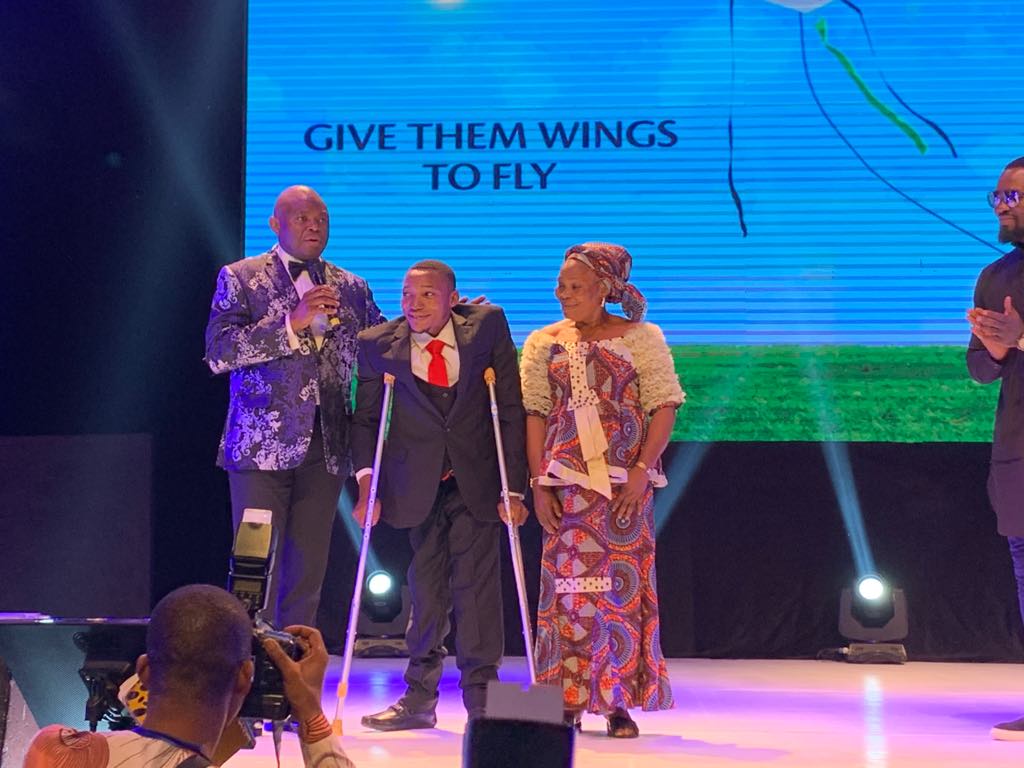
Fidelity Bank PLC last Friday night held its year end customer appreciation party – themed “Give Them Wings” – for the past year and highlights from the event show that it was quite a blissful one.
From guests donning really stunning and glamorous outfits – as the dress theme for the event was ‘glam’ – to same guests grooving to electrifying performances and stage acts.
The event was graced by sensational performers – from really talented and organized dancers to top notch music artistes leading in the music industry – who made good sure that there was a fair share of excitement oozing from their entertainment. There were quite a lot of highlights from Fidelity’s Customer Appreciation party but one remarkable and memorable highlight is that of the ‘greatest teacher in the world’ — Michael Showunmi.
What led to that moment begins with when a heartfelt video of one Michael Showunmi – a physically challenged teacher – made its way to the view of the MD/CEO of Fidelity Bank PLC, Nnamdi Okonkwo after the caption of the video ‘The world’s greatest teacher’ caught his attention. The video documents the inspiring life of Michael, who disregarding his condition makes sure he impacts the lives of young minds with his teachings. Watch the video:
The said heartfelt video, after being watched by Fidelity’s MD/CEO, Nnamdi, moved him to tears and as such, he decided to take action by giving Michael ‘wings’. Michael was led to the stage on Friday night and was introduced to everyone present and in course of this, Nnamdi declared his intention of giving Michael wings by stating that Fidelity bank will be employing him.
Showumi will undergo some training and banking courses & trainings and thereafter become a lecturer at the Fidelity Academy. Showumi addressed the audience as he thanked God, the MD and the bank for giving him wings. W
Pictured above: From Left: MD/CEO of Fidelity Bank, Nnamdi Okonkwo, Michael Showunmi and his mother at the Fidelity Bank Year End Customer Appreciation Party. Which went down at Eko Hotel & Suites, Victoria Island Lagos, on Friday, the 24th of January, 2020. (Information Day Online)
Disability rights advocacy group under the auspices of Association of Lawyers with Disabilities in Nigeria, ALDIN, has paid an advocacy visit to the ECOWAS Community Court of Justice over occupational discrimination against professionals with disabilities, PWDs, while demanding that lawyers with disabilities in West Africa countries be appointed to the bench as judges.
The group made up of legal practitioners with disabilities
made their position known to the President of the ECOWAS Community Court of
Justice, Hon. Justice Edward Amoako Asante, in Abuja on Thursday.
While addressing the ECOWAS Court President, the National President
of ALDIN, Barr Daniel Onwe, frowns at unabated widespread indiscriminate
violations of rights of persons with disabilities contrary to relevant articles
of the African charter on human rights.
Onwe stated that the advocacy visit was necessitated due to
the fact that Persons with disabilities are not put into consideration in the
scheme of activities in the society, particularly, with the inaccessibility of
the justice administration system to the PWDs.
He lamented that public buildings are inaccessible to PWDs
because they are constructed with step flights without consideration to people
with crutches, and people on wheel chairs.
Onwe argued that there are serious legal implications when
public buildings are inaccessible to PWDs as a result of man-made architectural
barriers which violate their fundamental human rights to movement, right to
freedom of association and right to dignity of human person contrary to
articles 12, 10 and 5 respectively of the African charter on human and people’s
rights.
“Our courts of justices are neither just nor fair to
PWDs. Court buildings and environments are very inaccessible to PWDs who come
to court as counsels, litigants or witnesses. When they come to court, they
face untold hardship,” he averred.
The group demanded that elevators and ramps be made
available to PWDs to enable them access the court and its environment either as
layers, litigants or witnesses who need to approach the court to access
justice.
In his response, the president of ECOWAS court of justice, Hon.
Justice Edward Amoako Asante apologized to the group for the difficulty they
faced in gaining access to the court room and other inconsiderate procedure of
the court that do not favour the PWDs as raised in their petition.
On appointment of lawyers with disabilities as judges,
Asante regretted that the impediment on their path to attaining such position
is beyond what he could address with administrative fiat as it is a procedural
matter that requires each member country to nominate three nominees to be
appointed as judges on the bench of the ECOWAS Court of justice.
He however promised to work with other judges and
institutions within the ECOWAS sub-region to put measures in place that will
address all the major concerns of the PWDs in the administration of justice
system in West Africa.
This part of the
project ALDIN started running last year, with the support of the Disability
Rights Fund. And the project is targeted at making the justice administration
system accessible to persons with disabilities.
On Friday, 17th January, 2020 in Abuja, Association of Lawyers with Disabilities (ALDIN) paid an advocacy visit to the President of National Industrial Court of Nigeria, Hon. Justice B.B. Kanyip.
The President of ALDIN,
Barr. Daniel Onwe speaking on behalf of the Association expressed profound
gratitude to the President and judges of the National Industrial Court of Nigeria
for granting them the privilege of the meeting. He congratulated Hon. Justice
Kanyip for his appointment as the President of National Industrial Court of
Nigeria saying that it is well-deserved. He prayed that God will strengthen him
as he discharges his duties as the President of National Industrial Court of
Nigeria.
Speaking further, he introduced
this association as I quote “ALDIN is the umbrella association of Nigerian
lawyers, both at home and in Diaspora, who have one type of disability or other.
Our objective is to champion the cause of persons with disabilities generally,
and in particular, lawyers with disabilities, in the practice of their
profession.
Daniel Onwe explained
that the existence of the organization is necessitated by the fact that persons
with disabilities are usually not put into consideration in the scheme of
affairs in the society hence their interest usually come as an afterthought.
For instance, public buildings are usually constructed with steep flight of
steps, without considering that there are people on wheelchairs and crutches,
those there are blind, deaf and other persons with other disabilities who would
requires peculiar format of communication. Therefore, persons with disabilities
are abandoned to their fate.
Our courts of justice
are not fair to persons with disabilities. Court building and environment are
very inaccessible to persons with disabilities. Persons with disabilities who
come to the courts, either as counsel or litigant are face with untold
hardship, and this could be very demoralizing. Persons on wheelchairs, for
instance, can only access most courts by they either crawling on the floor or
being carried like babies into the courtroom. There are several blind persons
who have defied all odds to become lawyers, but the courts seem to close its
doors to them as the basic assistive facilities to cater for their
peculiarities are conspicuously absent. We have deaf persons who have taken
their destinies in their hand to go to school and trained to become a lawyer.
And then they face a brick wall in the profession, as there are no sign
language interpreters provided to communicate with them in the courts. These practices
are unfair, unjust and unequitable for lawyers with disabilities.
He put it at the door
of the National Industrial Court because the Court has peculiar jurisdiction to
promote equity, fairness and international best practices. It would be
equitable, fair and just to create a level playing field for persons with
disabilities in the buildings, environment, practice and procedures of the
National Industrial Court. Creating level playing field for persons with
disabilities has now become a global trend. And Nigeria cannot afford to be an
exception. National Industrial Court has so much role to play in upholding the
rights of persons with disabilities in Nigeria. It is the court
constitutionally vested with exclusive jurisdiction in matters related to
labour, employment, unfair labour practices, international best practices in
labour, and disputes arising from discrimination.
He submitted that
National Industrial Court in the exercise of this special jurisdiction, should always
be mindful of the undeniable fact that persons with disabilities are always
victims of covert and overt discrimination in the labour market; the labour environment
and practice are most unfair to persons with disabilities. For instance, how
can we explain the case of persons with disabilities, who scales through all
recruitment interviews and test and possess the essential competences for the
job in question, only to be denied employment just for the reason that they are
persons with disabilities? What do we call the situation whereby a lawyer on
wheelchair is faced with practicing in courts with sharp flights of steps, but
without suitable elevators or ramps? How can a lawyer with disability be
crawling in and out court and still fairly compete with other lawyers for patronage?
He went on to repose
confidences on National Industrial Court, telling the President that persons with
disabilities are expectantly looking up to the National Industrial Court for
justice. This visit is to draw the attention of the National Industrial Court
to see the need for them to
rise up to the occasion to address the
plights of lawyers, and other persons with disabilities in the justice administration system in Nigeria. The truth is
that lawyers with disabilities are endangered
species in the legal profession in Nigeria, and in a dire need of urgent intervention.
He informed that this campaign ALDIN is running for accessibility of the
justice administration to persons with disabilities is being supported by the
Disability Rights Fund (DRF), an organization with headquarters in Boston, USA. Also,
he added that an American organization, DRF pushing for accessibility of the
Nigerian justice system to persons with disabilities, should indeed challenge Nigerian institutions.
The group made some specific recommendations
that will be helpful for the National Industrial Court in making provisions for
persons with disabilities:
Accessibility of Buildings/Environment: Elevators and ramps
should be installed at National Industrial Court buildings and environment
across the country, to make them accessible to persons with disabilities. This would
enable persons with disabilities, whether, lawyers, litigants or witness, to
freely and conveniently attend court.
Parking
Lots: There should be
parking lots, near the court, reserved and marked for the use of persons with disabilities at all divisions of the National
Industrial Courts in Nigeria. This
will minimize instances where persons with disabilities would have to walk quite a long distance from their vehicles
to the courtroom.
Appointment
of Lawyers with Disabilities as Judges: There are many lawyers with disabilities, who
are academically, intellectual and otherwise qualified to be judges. We are therefore,
strongly making a case for the appoint of lawyers with disabilities to the
bench of the National Industrial Court. This will send a strong message that
the National Industrial Court is a Court poised to do justice and equity to all, irrespective of circumstance. This will
also be a huge source of inspiration to other persons with disabilities and other disadvantaged persons. We can
assure My Lord that persons with disabilities will give a good account
of themselves on the bench.
Employment
as Judicial Staff: If there are many persons with disabilities
who are qualified to be judges, then it goes without saying that there are much
more of them qualified to be employed as judicial staff. We therefore
urge my Lord to consider the employment of more persons with the
disabilities. This will portray the Court as being non-discriminatory.
5.
Practice Direction: It is
imperative for your Lordship to issue a practice direction for the National Industrial Court to cater for
the peculiarities of counsel and litigants with disabilities. For guidance on this, have attached a draft of our
proposed Practice Direction for My Lords consideration.
It is germane to point
out that the above recommendations are supported by the Discrimination against
Persons with Disabilities (Prohibition) Act, 2018. The said Act, which brings some
innovation to the Nigerian labour
jurisprudence have, inter alia, the follow provisions:
1(1) A person with disability shall not be
discriminated against on the ground of his disability by any person
or institution in any manner or circumstance.
4 A public building shall be constructed with the
necessary accessibility aid
Such as lifts (where necessary), ramps
and other facilities that shall make them accessible to and usable by persons with disabilities.
29
All employers of labour in public organizations shall, as much as possible, have persons with disabilities
constituting at least 5% of their employment.
His
lordship Hon. justice B.B. Kanyip in his response expressed happiness hearing from
the group and commended the group for their good job for articulate all the recommendations
(which were all in line with recently signed disability right Act). He assured
them that to the extent that it lies on them and subject to the availability of
funds, he will grant ALDIN’ requests almost immediately. On the reservation of parking
lots, he assured that it be implemented both at the headquarters and all the judicial
divisions. On appointment of lawyers with disabilities as judges, he said that
the starting point is for lawyers with disabilities to make themselves
available by applying when there is recruitment. He said the proposed Practice Direction, will
be considered for adoption. Furthermore, he advised ALDIN to review the current
National Industrial Court Rules and proposed areas of possible amendment to accommodate
peculiarities of disability. He also requested from ALDIN details of a sign
language interpreter for engagement by the National Industrial Court as the
need arise.
ALDIN will in the coming
weeks be engaging other Courts Heads in Nigeria. This part of the project ALDIN
started running last year, with the support of the Disability Rights Fund. And
the project is targeted at making the justice administration system accessible
to persons with disabilities.
This is to create awareness about the Discrimination against persons with disabilities( Prohibition) Act 2018. We will be publishing it in episodes as it was summarized by Disability Rights Advocacy Centre (DRAC) and published by Alabaraonye Kenneth.
DO YOU KNOW THAT : PART VIII – APPOINTMENT AND DUTIES OF THE EXECUTIVE SECRETARY AND OTHER STAFF.
There shall be an Executive Secretary for the Commission who shall have the qualifications and experience needed to carry out the work of that office. The person must be a person with disability, and shall be responsible to the Council for the carrying out of the work of the Commission.
The Council will employ an adequate number of staff needed to carry out the work of the Commission.
The staff of the Commission are entitled to pension, gratuity, and any other retirement benefit in line with the Pension Reform Act.
The Commission shall submit an annual report of its activities to the office of the Secretary to the Government of the Federation not later than 30th June of each financial year. A copy of its audited accounts and a copy of the annual report shall be sent to the National Assembly. Responsible Bodies: The Governing Council of the Commission.
Hon. Jerry Igbokwe recieving his award from Perm Sec Olusegun Adekunle
Centre for Citizens with Disabilities (CCD) as part of
commemoration of the passage of disability act on Friday, 17th January,
2020 held the first award night to honour those who contributed immensely to
ensure that we have a disability law in Nigeria. The Disability Champion Award
is a rewarding system CCD adopted which would be coming up every year to honour
people who have been contributing in no small measure to the success CCD has
recorded and what CCD is still doing in the area of National Disability Act.
Executive Director, CCD David Anyaele in his remark said that
if not for the contribution of these outstanding individuals, we may not be
celebrating today. The rights of persons with disabilities is vital because it
provides opportunity where persons with disabilities can interact with others
equally. He said that the 18 years struggle before actualizing disability act
in Nigeria is worth celebrating and, in this celebration, we must recognize individuals
who contributed in different ways from the advocacy to passage of the bill to
the advocacy to the signing of the bill into law.
The event witnessed a panel discussion which involved
seasoned disability and human rights advocates, Ezenwa Nwagwu, Barr. Okey Kanu,
Theophilus Odaudu, it was moderated by Kie Obamalu. They discussed the way forward
towards ensuring the implementation of the act.
The Permanent Secretary of SGF Olusegun Adekunle who was a special
guest at the event in his remark reiterated his commitment to assisting the
persons with disabilities towards the establishment of National Disability
Commission but he said that he awaits the implementation strategy document
which can aid his recommendations.
CCD graciously rewarded the following people for their
outstanding contribution towards the passage and enactment of disability with
Disability Champion Award of Excellence 2019.
Hon. Jerry Ugokwe, Member, 5th NASS in
recognition of his effort in sponsoring the Disability Bill at the House of
Representatives in 2004
Omueza Diana Orouvie, a Reporter, News Agency of
Nigeria (NAN) in recognition of her outstanding print reportage on disability
issues in the year 2019.
TVC Breakfast Show, in recognition of their
outstanding visual media coverage of disability issues in the year 2019.
Omo Bazuaye in recognition of his outstanding
reportage on disability issues in the year 2019.
Ruth Tent Natsa in recognition of her outstanding
reportage on disability issues in the year 2019
Dr. Irene Ojiugo Patrick-Ogbogu, Disability
Rights Advocacy Centre (DRAC) in recognition of her outstanding contribution in
the passage of Disability Act 2018
Policy and Legislative Advocacy Center (PLAC) in
recognition of their outstanding support for the passage of Disability Act 2018.
Mr. M.D. Hassan in recognition of his outstanding
technical support to the passage of the Disability Act 2018.
Prof. Chidi Anselm Odinkalu in recognition of his
outstanding advocacy for the passage of Disability Act 2018.
Radio Nigeria in recognition of their
outstanding audio reportage on disability issues in the year 2019.
Mr. Dawodu Sulaiman in recognition of his
outstanding advocacy for the passage of Disability Act 2018.
Centre for Citizens with Disabilities in collaboration with Daughters of Charity of St. Vincent De Paul and Marian Pat Foundation on Friday in Abuja in commemoration of one year of the passage of disability bill into act embarked on roadwalk for an awareness campaign for public to know about the act and to draw the attention of the government towards the non-implementation of Act for the past 12 months.
Executive
Director, CCD, Mr. David Anyaele described the non-implementation of the
Discrimination against Persons with Disabilities (Prohibition) Act signed by
the President, Major General Muhammadu Buhari (rtd.) on January 17, 2019, as a
disservice to about 25 million Nigerians with disabilities.
The group comprising mostly persons with disabilities converged at Unity
Fountain where they took off from stopped first at Ministry of Justice before
heading to Maitama to the office of the Secretary to Government of the
Federation at the three arms zone.
The
group were prevented from accessing the SGF, Boss Mustapha, by security agents
that locked the entrance gates against them.
Undeterred
by this, the group spent over one hour at the gate singing solidarity songs,
dancing and demanding the implementation of the Act, which if a commission is
set up will start addressing issues of discrimination and harmful practices.
After over an hour, the SGF sent
representatives who came and demanded for David Anyaele and four other
representatives to have a meeting with the SGF in his office.
Anyaele stated, “The SGF has refused to
implement the Disability Act which offers protection to 25m Nigerians with
disabilities and which would result in the establishment of the National
Commission for Persons with Disabilities.
After the meeting which was held with the Permanent Secretary of SGF. David Anyaele speaking with the press after the meeting said that the Perm Sec promised to work with the group but he will need implementation strategy document to enable him make appropriate recommendation for the establishment of the disability commission.
“The
Act contains provisions that ensure people with disabilities in Nigeria are
protected against discrimination and harmful treatment. It also ensures
protection at the situation of risk and humanitarian emergencies; right to
health, education, work, and employment.”
The disability advocates unanimously in their message stated that the Act was critical and its implementation is key to the rehabilitation, reintegration and mainstreaming of persons with disabilities into our society.
The Permanent Secretary of Secretary to Government of the Federation
(SGF) Olusegun Adekunle has promised to work with Centre for Citizens with Disabilities
(CCD) and other Organizations of Persons with Disabilities (OPDs) if they forward
to him in couple of days the implementation strategy document which can guide
him to work to see to the establishment of National Disability Commission.
This was revealed to The Qualitative Magazine from a meeting
held between the Executive Director, CCD David Anyaele, other leaders of disability
community and the permanent secretary.
David Anyaele speaking to the press after the meeting which
held as result of the peace demonstration for the commemoration of one year of
the passage of disability bill into law and to remind government about the pending
implementation which establishment of a commission is paramount. He said that after
the team raised section 2 which talks about awareness creation and section 31
which talks about the establishment of a National Disability Commission to oversee
the implementation, the perm sec promised that they will do something but they
will need implementation strategy document from the team in the coming days to
aid their recommendations for the establishment of the commission. Mr. David
said also that the Perm Sec apologized for keeping the group for so long at the
gate. It happened because they were not aware of the reason for the visits.
Earlier, the group was prevented from having access to the
premises of the SGF for over an hour and the group sat at the gate dancing prevented
visitors to the SGF entrance before a team was sent to interact with them and
pleaded that the leadership should follow them to the SGF. They also pleaded for
the group to make way for their visitors which the group willingly obliged to.
Ms Toyosi Giwa, Coordinator of Rule of Law and Anti-Corruption (RoLAC ) programme
Centre for
Citizens with Disabilities (CCD)’s 1st Commemoration of the passage of the Nigeria Disability continued
on Thursday in Abuja, the last day of engagement with stakeholders in which
they engaged the members of diplomatic community themed: learning lessons on
disability rights advocacy in Nigeria with diplomatic communities.
Mr. David Anyaele, Executive Director of Centre for Citizens with Disabilities (CCD) said that since the government, private structure owners, stakeholders, state and non-state actors, Nigerians and the public were not ready to comply with the law, the next action would be naming and shaming. One year since the law was enacted, there is no process or no sign for implementation.
Mr. David Anyaele, Executive Director of Centre for Citizens with Disabilities (CCD)
If the commission is not established, most some sections of the
law will be difficult to enforce, we will call out those sitting on the progress
of persons with disabilities in Nigeria in public and private institutions, and
name and shame them for abusing the rights of Persons With Disabilities (PWDs).
Anyaele said that the act of naming and shaming will make bring
the abusers and violators of the law to public domain and their friends and well-wishers
will ask them questions and it will also bring to the notice of others about the
existence of law.
CCD boss also said that it is only when PWDs are fully benefitting
from the government and they are also included and participate in all
programmes then one can say that Nigeria is being well governed.
Ms Toyosi Giwa, Coordinator of Rule of Law and Anti-Corruption
(RoLAC ) programme, a British Council-managed project when advising the CCD and
OPDs on the way forward said that “the naming and shaming approach was a
laudable initiative that should be brought to life”.
Giwa reiterated that RoLAC would support CCD while urging the
group to intensify its efforts in creating more awareness by exploring the use
of the media.
Mr. Edet Ojo, said that OPDs should explore all avenue to popularize the act. OPDs should use all kind of media to create awareness about the act. He said that social media which is the most popular way people have access to information should be heavily explored by OPDs.
Mr. Edet Ojo
Recall that section 2 of the act provides for awareness creation which the act mandates the ministry of information to carry out but unfortunately, one year down the line, the minster of information Chief Lai Mohammed have not even mentioned National Disability Act in most of his press releases.
Centre for
Citizens with Disabilities (CCD)’s 1st Commemoration of the passage of the Nigeria Disability continued
on Wednesday with the engagement of line ministries and agencies to understand
their roles and responsibilities. Relevant ministries like Ministry of Works, Environment,
Information, Education, Justice, Youth and Sports, etc and Agencies like
National Orientation Agency (NOA) were also at the meeting, Relevant Committees
of National Assembly were also at the meeting/
Executive Director
of CCD, David Anyaele speaking at the event said that the essence of engaging
the line ministries and MDAs is for the Ministries and the MDAs to identify the
provisions of the act which relates to their duties and come up with ways CCD and
OPDs should engage so that the implementation of the act will be successful.
An Official from the National Assembly said that the National
Assembly will ensure that the National Disability Commission is
established by the president in accordance to the provision of the National
Disability Law.
A Clerk of House Committee on Information Jekop Dan-Alih represented
by Mr Yakubu Ayatu-Kadin, Dan-Alih said that the commission was imperative to
the implementation and enforcement of both the transitioning and
non-transitioning provisions of the act. He went on to suggest that CCD should
make effort to meet with all the stakeholders in information to ensure that
awareness is created around the act.
Dr Fatima Waziri-Azi, Rule of Law Advisor in the office of the
vice-president, advised Persons with Disabilities (PWDs) and Organisations of
PWDs (OPDs) to do more lobbying, and advocating engaging those who have the
ears of the president to push for the establishment of the National Disability commission.
Speaking further, if the commission is not established, the act will not be fully
implemented, it will be good of paper.
Mr Yakubu Argungun-Mohammed, Clerk Senate Committee on Youth and
Sport Development, noted that the commission would be placed under the
appropriate committee for the purpose of oversight.
Mr Mustapha Sadiq Clerk House Committee on Human Rights, during
his speech said that whether there was a budgetary provision or not for the
commission, OPDs should push hard to see to the setting up of the commission
and full implementation of the act.
Speaking further, he noted that existence of the commission would
guide stakeholders on ways of collaborating and partnering for the effective
implementation of the act.
He also assured the public that the commission would be properly
placed under an appropriate committee for over sight.
Centre for Citizens with Disabilities (CCD) and other OPDs should
engage stakeholders, pay courtesy visits to relevant agencies, write letters
and make proposals.
If everyone is saying the same thing, the president will have no
choice than to do the needful which is establishment of the commission because
it is the vehicle that will propel the act,’’ she said.
She, however, advised CCD and OPDs not to focus only on the
federal law, but to push for the domestication of the law at state levels.
Waziri-Azi reiterated her commitment to supporting the movement
for the establishment of the commission and the implementation of the law by
offering tangible assistance, granting access, and giving advice.
Mr David
Anyaele, Executive Director of CCD, appealed to President Muhammadu Buhari to justify the
enactment of the law by establishing the commission as prescribed by the law.
This, he said, would reduce the frustration and the burdens on the
lives of Nigerians with disabilities.
He decried that one year had gone since the enacted of the law and
that more would be lost, if nothing was done to bring the law to live.
Odunayo Bolarinde, a representative of the Federal Ministry of
Justice, urged agencies to considerately look at the disability law and its
content from a humanitarian aspect.
He also urged line ministries, departments and agencies to have
recourse to the ministry by giving advice, making recommendations and making
budgetary proposal also to NASS in conjunction with the ministry.
Recallimg that
Discrimination against Persons with Disabilities (Prohibition) Act 2018, also
known as National Disability Act, was passed by the 8th session of the National
Assembly. It was assented to by Buhari on Jan. 17, 2019 and made public on
Jan. 23, 2019.
The section 31 of the act provides for the establishment
of National Commission for Persons with Disabilities to help provide guide
and process in which the act will be implemented to address discrimination and
harmful practices faced by persons with disabilities.
The act also contains provisions that ensure access to public infrastructures, rights to work, right to political participation, right to education, right to first in queues, right to heath, protection against discrimination and harmful treatment, protection at situation of risk and humanitarian emergencies, among others.
Centre for Citizens with Disabilities (CCD)’s 1st Commemoration
of the passage of the Nigeria Disability continued on Tuesday with the
engagement of Civil Society Organizations (CSOs) and different Disability
Cluster Heads with the theme; Learning Lessons on Disability Rights Advocacy in
Nigeria With CSOs /OPDs.
The Executive Director CCD, David Anyaele while speaking at the event said that it took 18 years struggle for Nigeria Disability Act to come into being and it is the commitment of CCD to ensure that the act is implemented therefore it is imperative that CCD keep tab with the relevant stakeholders to ensure the success of the act. This is why this 1st Commemoration was organized so that stakeholders will be engaged to understand the provisions in the act and also to understand their roles and responsibilities to ensure that it is fully implemented. It is also to sensitize stakeholders to take ownership and also to celebrate the success stories of securing this act after 18 years of struggle. It is importance that we document our success stories because if we don’t do that the leaders that will come after us will not understand what was put in to achieve what they are enjoying. Speaking further, he said that inviting CSOs and OPDs is to share experiences with them to know the areas we did well and areas we didn’t do well in order to prepare ourselves for the task ahead which is ensuring that the act is fully implemented.
A documentary on the struggle for the passage of the act which
was led by CCD was screened and Mr. David Anyaele also presented the provisions
in the act.
The participants at the event emphasized that every stakeholder should make effort to have a copy of act read and understand the provisions very well in order to advocate in every given opportunity. They also lamented that majority of Nigerians are yet to know about the act and even those that know about it, don’t know much about the provisions. They suggested that Ministry of information and National Orientation Agency should be made to live up to their responsibilities as it is stipulated in the act. Again, every member of disability community was advised to read and understand the act in order to add their voice to the advocacy because the advocacy is not meant for CCD only.
On lessons learnt on the journey to actualization of the act,
David Anyaele lamented on the way and manner greedy and selfishness hindered
the progress of the disability community in the past that led to 18 years
before the act was actualized. He called for synergy and collaboration among
OPDs because OPDs are fond of doing the same project when there are so many
other areas that they can explore for the community to achieve result faster. He
called on OPDs to read more, apply the knowledge that they are getting from
meetings in order to engage properly whenever the need arises.
Other participants like Barr. Okey Kanu and Theophilus Odaudu spoke on the unity among OPDs because they are of the opinion that if OPDs close ranks, they will achieve more and the fights don’t portray Nigerians with disabilities well in the international community.
CSOs pledged more commitment to disability issues and they
demand that CCD should make the Act easily accessed. CCD boss in responding to
this request, informed that CCD have concluded arrangement to launch an APP soon
that there will be on Goggle Playstore so that one with android phone can easily
access the act, other international laws on disability including policies and
other frameworks on disability.
The participants also agreed that individuals should form advocacy
groups within their locality to ensure that more awareness is created around this
act.
The Qualitative Magazine learnt that CCD engagement with CSOs
is to secure their commitment because it is fact that not much CSOs are
interested in disability issues and if we are to achieve success in the
implementation of act, all critical stakeholders must take ownership.
On Wednesday there will be engagement with the line ministries and government agencies to understand their roles and responsibility as regards to the implementation of National Disability Act.