Usman Aliyu is a deaf tailor from Barking Ladi local government
of Plateau state. He married three wives and with six children.
In this chat with our team in his local government, she spoke about his business as a tailor and his communication challenge as a deaf person.
TQM. Did You have the opportunity to go to School?
Yes, but l did not go far.
I stopped in Secondary School level because of lack of financial
support.
TQM. What are you now doing for a living?
I am a tailor, l owns a tailoring shop here in Barking Ladi
town, and l have five persons that are now learning from me.
TQM. How is the patronage
like from people?
Patronage is good, you know, our line of trade is a seasonal
one. We have peak period, once its
festivity time, but after that, we just manage the little work we have.
TQM. As a deaf person,
how do you communicate with your customers?
With some, we communicate through writing, and with others,
we do it through sign language.
TQM. What about your
children, are they in School?
They are in primary school.
TQM. Who is paying their
school fees?
I am, and l am doing so from my tailoring work.
TQM. Have you
received any assistance from the government or individuals, to increase your
business?
Yes, l receives assistance mostly from politicians, but I
still need more assistance to buy more sewing machines. So many people are
coming to me, seeking to learn the trade from me, but sadly I turn them back
because l lack adequate number of sewing machines to accommodate them.
Christopher Bala Pigiro is a person with physical disability
who have lived in Pankshin all through my life. His father died before he was
born and later, he lost his mother. A kindhearted man took him and cared for him,
he sent him to School from Primary school up to Secondary school level. But the
man didn’t have so much to see him through to the higher education.
Pigiro tried to learn typing, but he could not finish it
because he could not afford the training.
He shared his
challenges and struggles with TQM correspondents Bulus Bala Izang and Joshua
Yenle.
TQM. Are you doing
something for a living?
Nothing much, I keep local chickens in our family house. I also do light labour work like washing of
clothes and separation of grains instead of doing nothing.
TQM. Have you ever
received financial assistance from the government or anybody?
No, I have not received such assistance, but I have received
lots of foodstuffs as assistance from people. I am very grateful for that.
TQM. If someone comes
to you, and he or she say to you, to tell him /her the kind of business you
will like to do, and you will receive financial assistance. What kind of business would you say?
I would like to go into the business of keeping animals,
like goats, sheep and to keep more of the local chickens.
I will also want to learn how to operate computer.
TQM. Have you ever
been discriminated upon, because, of your disability?
No, none I can remember.
TQM. Are you married?
No, I’m not married, I am not working on it, how can I marry?
What will I feed her with?
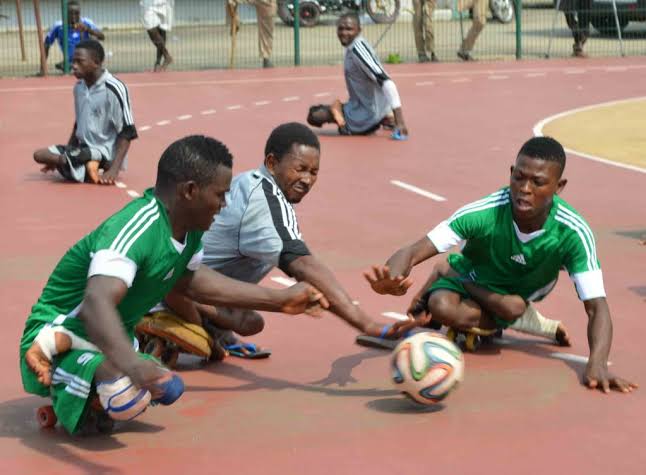
8th Edition of the World Polio Day National Parasoccer Tournament took place at Old Parade Ground, Area 10, Garki, Abuja from Wednesday 21st October to Saturday 24th October 2020.
The tournament which had 8 teams representing 8 states were grouped into two.. The groups were Kano, Nassarawa, Lagos and Sokoto in group A while group B had Bauchi, Katsina, Yobe and Zamfara.
The tournament started with Kano beating Nasarawa 2-0 and Katsina defeated Yobe 3-2.
Action continued on the second day with matchday records such as Kano whooping Sokoto 7-0 and Katsina thrashing Bauchi 4-1.
Nasarawa got over their earlier defeat by Kano and whitewash Lagos 9-0, Yobe got better and thrashed Zamfara 6-2. Lagos on their second game got over their earlier whitewash by Nasarawa and defeated Sokoto 2-0.
Day 3 saw Bauchi and Zamfara played out a 1-1 draw in the early kick off, Nasarawa continued their fine form by whooping Sokoto 6-0. Bauchi in their second game of the day played another 1-1 draw with Yobe. Kano in their usual style thrashed Lagos 6-1 and Katsina got better of Zamfara 3-1.
Kano, Nasarawa, Katsina and Yobe advanced to semi finals having placed first and second in the respective groups, with Kano topping group A with maximum 9 points and Nasarawa placed second in the same group with 6 points, Katsina topped group B with 9 points and Yobe placed second with 4points.
Kano defeated Yobe 4-2 to get the final while Nasarawa set up a crunchy final with Kano with 3-2 win over Katsina.
On 24th October 2020, the losers final between Yobe and Katsina ended in a barren draw and Katsina won 2-1 through penalty shootout.
In the final, Kano retained the trophy they won last year by beating Nasarawa who put up a good fight 1-0.
The tournament team standing in a glance:
Kano-1st Position,
Narasawa-2nd position
Kastina-3rd position
Congratulation to Team Kano State.
The President of the Parasoocer Federation of Nigeria. Misbau Lawal Didi while speaking with the press appealed for sponsors of the tournament especially the subsequent editions and a proposed league for Parasoccer. He called for corporate bodies and NGOs to come and collaborate with the Federation to kickstart a league for Parasoccer which will enhance the development of the game to the good of these polio survivors.
Jessica Lekki Peter is a woman with blindness from Bokkos local
government of Plateau State.
In 1982, she started primary school and when she was in
primary two, she noticed that she could no longer see what is being written on
the black board.
This made her parents to seek medical solution in various
hospitals in Plateau State. At a time, she was taken to Kano where she was
operated upon exactly at her left eye.
After the operation, she started seeing a little with the
eye. She was given some medications and there was improvement on the eye but
mysteriously the drugs got missing and that was how she eventually lost my
sight.
She was made to stay at home for some time but in 1989, her
father had to enroll her in School for the Blind Children in Gindiri, Mangu
local government of Plateau State, on completion, she was enrolled in
Government Secondary School Balbong also in Mangu local government of Plateau
State. She later went to University of Jos. She graduated in 2003 and got
employment with Bokkos local government of Plateau State, as a welfare officer.
TQM. Are you married?
Yes, I am married to a visual impaired person, Mr. Lekki
Peter from Edo State. We meet at the University, he has finished his masters, but
is yet to gain employment. Our marriage is yet to be blessed with Children.
TQM. What is your
relationship like with your in-laws, being a woman with disability, is there
any discrimination?
Well, our relationship is good. We are here in Jos, while
most of my in-laws are in Edo and some are in Abuja. We are not really staying
together for me to determine that. But,
we have been communicating well.
TQM. Are you engaging yourself in any other thing
outside your work as a local government welfare officer?
No
TQM. What is stopping from doing that?
I would have love to but I lack the space and finance stopped
me from engaging in poultry farming that I desire so much.
TQM. Have you ever received
any assistance either from your workplace or somewhere to engage in other
vocations?
I have not received such assistance.
TQM. What did you
observe as a welfare officer, to be the general problem of women with
disabilities?
The problem of women with disabilities are that, they cannot
go to farm and they don’t have money to do business to assist themselves and
their children. Also they are facing the problem of lack of education among
others.
Musa Abdullahi is a person with physical disability and a
farmer from Barkin -ladi local government of Plateau state. He is married and
his marriage is blessed with eight Children.
In this interview, he
shared with our correspondent, Bulus
Baba Izang on how he has managed his farming business inspite of his
disability
TQM. Were you born with disability or how did it
happened?
I was not born with disability. In 1988, a building collapsed on me, with my
two legs badly affected, l was taken to Jos University Teaching Hospital (JUTH)
where l spent two months on admission, l got better, but l was left deformed as
a result, l can now walk with the aid of a walking stick.
TQM. Were you able to
go to School?
Before the incident happened, l was in class five in primary school. But after the incident, l could not continue with my education because of the distance between our home and the school. With my status as a person with disability, there is no way l could walk long distances.
ADVERTISEMENT
TQM. What are you now
doing for a living?
I am a farmer and l also keep some cattle. When I was a boy, before the incident of the
collapsed building. I was practicing farming and cattle keeping.
TQM. You are a person with disability, how do you
do your farming?
I pay people to do the activities for me, from the
cultivation of the land, to harvesting, likewise, l pay people to care of the
cattle for me.
TQM. What are some of
the challenges you face in hiring people to carry out these work for you?
Number one challenge is lack of funds, sometimes, l will
want to do some aspect of farming activity, but l do not have money at hand, l will
have to wait, but the crops will not wait for me. Sometimes, l gets to do it late or not even
doing it at all. This affects the yield
of the crops.
My second challenge is that, since the workers are hired
hands, they don’t do the work as l would want it to be.
TQM. Have you received
any support from the government or individuals towards your business?
No. I have not.
TQM. What will be
your request to the government and other individuals in that regard?
My request is that government and other individuals should
help me with farm inputs or money so that l can expand my business, even if it
is in the form of loan, l will be happy.
This is very sad news today. A woman with disability, who might be at the age of 23 going, cries for a husband. According to niijaweb.ng the woman said that the men in Ghana are refusing to come near to her (Proposing to her). This is one of the sad news to have seen. Well, this is a true life story.
Because she is not the only woman who has come out to confess. She is not getting any guy to marry her just because one of her legs has been cut off. Hmm, very sad right?
TQM’s opinion, Marriage is good and important and it is good for one to get married no matter what. We pray she gets one but it is better she focus in building herself and career,if she will marry, it will come naturally but marriage doesn’t not define success. Please girls with disabillities should be proud of themselves and carry their shoulder high. Focus more on making a mark in life. If man comes good but if he doesn’t still good. Afterall, there are many successful women with and without disabillities out there who didn’t marry.
Paul Daniel acquired his disability as a result of gunshot
injury on his leg when Fulani herdsmen attackers attacked his community in Bokkos
local government of Plateau State.
He became a crutches user when he could not get his limbs to
walk properly again.
This young man lost his mother early and his father left in
1997 and nobody knows his where about till date.
In this interview, he shared with Bulus Baba Izang our correspondent, what transpired after the attack and what is needed for his rehabilitation and survival.
TQM. Were you taken
to the Hospital after the attack?
I was taken to hospital; they did their best for me. But
because, l didn’t have anybody to assist me in paying the medical bills, l was
discharged without the full treatment.
TQM. Did you let Bokkos local government authority
to know about your situation?
No, I don’t know how to contact them.
Do you still have
hope of walking again if treated?
I feel that if I get proper treatment or the full treatment
that the hospital ought to have given me.
TQM. Do you know how
much you need for the treatment?
Yes, l was told, l need about two hundred and fifty thousand
to three hundred thousand naira for the Treatment.
TQM. After the Treatment,
would you be fully well on your feet as you were before the gunshot?
I don’t think so, but l hopes to be better than l am now.
TQM. Did you have
formal education?
Yes, I stopped at SS three.
But could not write my SSCE because l does not have money for the
registration.
TQM. Who was paying your School fees?
I sponsored myself through the proceeds I made as a farm
labourer.
TQM. Are you married?
Yes, l am married with four Children.
TQM. Are they
children in School?
Two are in public School, the fees are not much.
TQM. Are you now able to engaged yourself in any
commercial activity?
I repair phones.
TQM. What is your appeal now?
My appeal is that l need help to able to pay for my medical
bills, so that l would be treated from this bullet wound.
TQM. Thank you for
your time and we wish you good luck, hoping that this publication will bring
assistance your way.
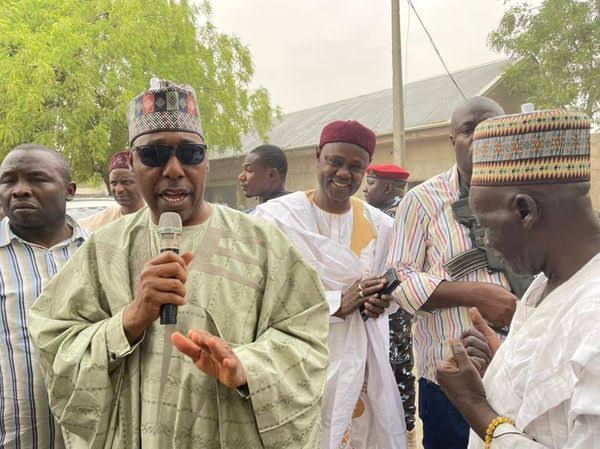
Over 4000 blind people to recieve second tranche of 30,000 each, as motive to end street begging in Maiduguri Governor Borno Professor Babagana Umara Zulum on Wednesday through the Ministry of Youths, Sports and Social development began the verification of beneficiaries who are to be paid 30,000 as soft loans and support to the blind people, who are begging in the streets of Maiduguri It could be recalled that earlier after Governor Zulum assumed office as Governor of Borno, Zulum supported over 18,000 people with disabilities with monthly stipend to make them self reliance and to take them off the street as beggars. The sum of 30,000 was directly paid to their banks after series of registration and details enrollment to banks. The ministry today began the verification of beneficiaries and their bank details ahead of payment. A director of the ministry made this known to the press at the venue of the verification.
Persons with disabilities in the riverine areas are to adhere to government safety measures, even as floodwaters continue to submerge some areas in the state according to a top Government functionary.
Government had issued a directive to people living in flood-prone areas of the state to move to dry land and the Holding Centres for safety.
The Special Adviser to Anambra State Governor on Disability Matters, Mr Chuks Ezewuzie re-emphasised this while exchanging views with newsmen in his office at the Dora Akunyili Women Development Centre, Awka.
He said persons with disabilities were the mainly vulnerable in terms of disaster management and control because of their conditions.
“Our people are mainly adversely affected when faced with this kind of natural disasters and are hereby advised to heed to guidelines, precautions and provisions provided by Anambra State Government in the management of the disaster.
“My office is making every effort to see that persons with disabilities, especially those at flooded areas are safe.
“This has been the number one desire of Gov. Willie Obiano for the disable community in the state.
“I urge those of you living in riverine areas to shun travelling or moving along the coastal lines.
“I also urge you to always listen to radio or look out for flood-related news online to keep abreast of government directives as well as provisions for all the displaced camping sites set up by the state Government.’’
In June, this year, the National Emergency Management Agency (NEMA) sounded an alarm following warnings by Nigeria Metrological Agency (NiMET) that communities at the banks of River Niger and River Benue shall be affected by flood between August and October.
The Agency listed 10 states of the Federation likely to be flooded to include Anambra, Delta, Edo, Rivers, Bayelsa, Kogi, Kwara, Niger, Kebbi and Adamawa states.
Already in Anambra the flooding had reached areas like Anambra East and West, Ayamelum, Ogbaru, Awka North, Ihiala, Onitsha North and South Local Government Areas.
Sarah Emmanuel Pangang is a woman with blindness from
Pankshin local government of Plateau State. She is the wife of Emmanuel
Pangang, a blind man we shared his interview last week. She was not born blind,
I acquired her primary education with her sight intact, she started having
problem with her sight when she was in form three in the Secondary school. It
all started for her inability to see what was at board and when she read her
books, there would be tears all over her eyes. This prompted her parents to
seek medical attention. It led to her
withdrawal from school for some time but when she got better, she went back to
school.
In her form four, going to form five, which was the final
year in Secondary school, her eyes problem got worse, as a result, she stopped
schooling. Not that she was completely blind but she could no longer see what
was on the board and could not read her books any more.
Years later, her father suggested that she should be
enrolled in Vocational Training School for the Blind, Zawan, which she started in
the year 1991 and completed in the year 1992.
In 1994, she got married to one of her teachers at the
Vocational training school for the Blind Zawan who is also a person with visual
impairment.
Sometimes ago, she got pregnant but she gave birth a still
baby, since then she has not conceived up till today.
Our correspondent, Bulus Baba Izang was in her house and they discussed how she carrying out her daily activities knowing fully well that her husband is also a blind person and they did not have any child.
TQM. Are you engaged
in any commercial activity?
I was doing something, when I finished from The Vocational
training school for the Blind Zawan, I applied for employment both in the state
and local governments, without success, while I was waiting for the employment,
that never came, l was having a table in the front of my house where I was selling
provision items, but due to financial difficulty, I could not continue with that
business.
TQM. If you would
have financial support, would you go back to that business or you would do
something else?
l would like to continue with my business, if I have money,
I may even add poultry farm to it.
TQM. Both you and your husband are persons with
visual impairment, how have life been with you?
Life have not been easy, especially, now that my husband is retired,
his pension is the only source of income now. We thank God for His provision.
TQM. Do you have
someone, who is helping you with domestic work?
We once have children who were staying with us, but they are
now married. For now, we don’t. I do all the house work that needs to be done,
I do the cooking, washing, and other things.
TQM. I see you
wearing COCIN Church women fellowship uniform, Is there a story behind it?
I am a member of the COCIN women fellowship group. In fact, I used to be a very active member, I
even was one-time treasurer of the fellowship in a local Church in Zawan, in
Jos South local government of Plateau state. Before we moved here to Pankshin
at the retirement of my husband.
TQM. A person with visual impairment, A Treasurer
of women fellowship? How did you do it?
Yes, (smile) I was,
and I did it successful with the help of God.
TQM. With this, you are
telling us that in all aspect of life, a person with Disability can have any
role and play it successful!
Yes, we persons with disabilities can do any work by the grace of God.
ADVERTISEMENT
TQM. You said, you
used to be an active member, Are you not an active member of the women
fellowship now?
Here in Pankshin, the Church is on the other side of the
high way road, with busy and high speed moving vehicles. We need assistance to
cross the road. And the children that assist us are at School at the time the
fellowship is going on. This really affected my participation in the women
fellowship.
TQM. What advice would you have for girls and
young women with Disabilities regarding married life?
Girls should learn to keep and be known with one lover when
they are ready, that is how it should be, but today, it’s common to see a girl
with about ten lovers, if she is not serious in a relationship, who will take
her serious?
And to young married women, the watch words are, be patient,
faithful and submissive to your husbands, while putting God first in all that
you do.