
Wednesday, December 31, 2025
Home Blog Page 427

Armed With Passion, Million Naira Loan, Blind Graduate Produces Past Questions For Students Amid National Failing Grades

0

By IFEDAYO OGUNYEMI

Despite losing his sight about eleven years ago, Timilehin Olonisaye, a graduate of the University of Nigeria, Nsukka, defied all odds to produce a set of past questions in order to help the country reduce the failure recorded in O’level and JAMB examinations nationwide. IFEDAYO OGUNYEMI reports:

A young man exited the compact office structure inside the large, expansive compound located at Orogun, about 3km North-West of the premier University of Ibadan (UI). He asked whom the reporter sought. “I’m here to see Timilehin,” this reporter said.

“Bro Timilehin, someone is here to see you,” he said as he turned to the office structure.

“Who is that?” Timilehin Olonisaye, a young physically-challenged man in his late twenties said in Yoruba. He was jolted by the sound of the response from this reporter whom he had made an acquaintance over the phone earlier.

“Good afternoon Mr Ifedayo, you’re welcome to our office. You can sit down here,” he cheerfully replied as he vacated the sofa-like seat where he sat before the reporter’s entry.

Without support or assistance from his cane, he made his way into the space between the two brown-coloured wooden tables inside the office. John Ajayi, Olonisaye’s friend and assistant whom I sat across excused himself to attend to some of the students inside the tutorial classes about twenty steps from where we sat.

Olonisaye made his way unaided to the seat left by Ajayi as he gulped the remaining contents of the orange-flavoured soft drink in his hand.
Stationed on the plastic table beside where I sat were four editions of the FAT Success UTME Reloaded past questions Olonisaye and other scholars co-produced for students in preparation for the promotional and certificate examinations such as West African Secondary School Certificate Examination (WAEC), National Examination Council (NECO) and Joint Admission and Matriculation Board (JAMB) which millions of Nigerians have continued to fail every year.

In 2019, 74% representing 8,790 students out of 11,892 students failed WASSCE. This figure shows that 3,102 candidates who sat for the examination (representing 26.08%) obtained credit and above in a minimum of five subjects including English Language and Mathematics. A similar trend happened in 2018, 2017 as well as in other qualification exams which form part of the prerequisites for admission into tertiary institutions in Nigeria.

Beyond these numbers, some students and parents have resorted to devious means including enrolling at special centres where they believe certain persons would help them or their children and wards cheat the system in order to make the cut off those who passed.

Many of these failures have been attributed to the short and sometimes inadequate preparation of the students for the examination, use of unqualified teachers in secondary schools, the decline in literacy level and the failure of students to attentively attend to requirements of the subjects they take. These lapses, as well as others, were what prompted Olonisaye to co-opt others to set up the tutorial centre and produce these UTME past questions.

students

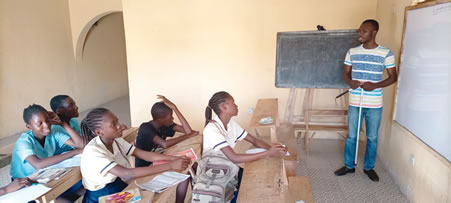
Doing this afforded Olonisaye the opportunity to properly prepare secondary school students for these examinations. In the first attempt at promotional examination after setting up the tutorial centre more than a year ago, 80% of the students got more than the national cut-off mark of 200 for JAMB examination.

In his love to further impart knowledge in the young lads, the visually-impaired man in his late twenties recently secured a loan under the collaboration between Bank of Industry (BoI) and Youth Entrepreneur Development Programme (YEDP) to invest in the center and to improve on its successes.

With funds accrued from the loan and from family members and friends, he also published a unique past questions and answers that cover WAEC, NECO, GCE and JAMB examinations from 1978 to 2020 in subjects such as Use of English, Biology, Physics, Chemistry and Government which he personally compiled despite being visually-impaired. He is among the 1.2 million physically challenged persons living in Nigeria according to the World Bank – some of whom (including Olonisaye) were disengaged from the N-Power programme alongside able-bodied persons in 2020.

Five versions of the publication have so far been distributed and marketed in not less than ten states in the country – Lagos, Akwa-Ibom, Edo, Ondo, Ekiti, Kwara, Ogun, Oyo, Enugu and Anambra – in a bid to save more Nigerian students from the pangs and agonies of failing examinations into tertiary schools.

When asked about the rationale for establishing the center, Olonisaye said: “I had that dream of owning an educational center before, but I didn’t think it would be this fast. I founded this because of the lapses I discovered during my engagement in the N-Power programme in a public secondary school in Ibadan where I taught for two years.

“We don’t really have much issues getting students to the center, there is nothing attached because I’m a visually-impaired person. It is what they have tested and trusted, it’s about our own performance, are we delivering value? Yes! Are we impacting knowledge? Yes, we do with capable teachers, specialised tutors. The only challenge we have is some basic facilities we lack.

“We’ve had students that scored 298, 301, 288, 250 and more. Generally, our students recorded about 80% success in JAMB. Students are already enrolling here for WAEC coaching because they are the ones who believe in what we offer. We don’t only have JAMB and WAEC classes; we have preparative classes in morning and afternoon for JSS 1-3 and SSS 1-3.

“Though we have a very conducive environment for classes, the rent has been a challenge. We have been getting loans and little support from family and friends to invest in the project, if not, we would have closed down because this business is challenging and we still need to pay the tutors and teachers. Infrastructure has been one of the issues we have been facing. We only have two computer systems for our JAMB classes and there are still a lot of things we still believe we need and we are still struggling to get.”

Speaking further on the reasons why FAT Success UTME Reloaded is different from other similar publications, the graduate of political science from the University of Nigeria Nsukka (UNN) said: “The project is a departure from the conventional norm; a new approach to answering questions for students. What made it special was that we collated all questions in those subjects from 1978 to 2020 based on topics in accordance with SSSCE and JAMB syllabuses. It is a question bank for teachers and students. When they are doing a particular topic in Biology for example, just go into the book and solve all the questions on that topic before you move to the next.

“The user will be able to identify the weaknesses and strengths in that particular topic. It reduces confusion for students because it also has detailed explanations for each of the answers. It is a paradigm shift. Most schools we’ve approached are yet to take it because they are waiting for approval from the federal government but they see it as a unique innovation they know will help teachers to know which topic to concentrate more on when preparing for exams.”

Olonisaye who got blind as a teenager about eleven years ago and went on to obtain a Masters degree in political science at UI said compiling the government past questions was not an easy task but his background in government and political science proved useful.

“I have been taking this subject for years; I took it in public secondary schools too. I have developed materials for my students for this particular subject and when the idea for the project came, there were no best hands to handle government other than mine. It was rigorous compiling the questions based on topics, deviating from the conventional norm which is usually based on a year-on-year basis. It took me more than a year; I researched and compiled them every day because we needed to explain the answers even after arriving at them,” he said.

While taking this reporter on a tour of the six-room centre, Olonisaye added that, for the second edition of the publication, the team is also looking forward to producing past questions on Christian Religious Studies, Mathematics, Literature-in-English, Economics and Accounting.

Leadership Newspaper


IFA commends Sokoto govt for domesticating Disability law

0

By Bidon Mibzar, Abuja

The Executive Director of the Inclusive Friends Association (IFA), Grace Jerry has lauded the Sokoto State Government and State House of Assembly for domesticating and passing into law the Discrimination Against Persons with Disabilities Prohibition Act.

Miss Jerry who in a Congratulatory message, signed by the Communication/Program Officer, IFA, Mr. Stephen Idoko, on Friday in Abuja commended the Sokoto State House of Assembly for ensuring that the PWD’s protection law comes to stay in it’s state and revealed that the action will enable the protection of rights and privileges of Persons With Dissabilities (PWDs).

While congratulating the PWD Community there, the IFA boss reiterated that the consistent advocacy of organizations of persons with Disabilities (OPDs) to promote and improve the lives of persons with disabilities in Nigeria should be loudly commended.

She commended the present administration under the leadership of President Muhamadu Buhari for its role in ensuring that PWDs and PWD organizations are protected and given the enabling environment to work.

“Since President Muhammadu Buhari signed the Discrimination Against Persons with Disabilities Prohibition Act in 2019, Inclusive Friends Association (IFA) through her Access Nigeria and Participate Today Campaign funded by National Democratic Institute and National Endowment for Democracy has continually engaged the National Assembly in Abuja, INEC, Political Parties as well as security and key government agencies with strategic evidence-based advocacy; this therefore, has ensured increased participation of PWDs in electoral processes, especially the 2019 general elections which recorded higher turnout of voters with disabilities”, she said.

145 Women with Disabilities benefits from FG’s Cash Grant for Rural Women in Anambra State

0

By Chidimma Ajemba.


Not less than 145 women with disabilities in Anambra benefited from the recent Rural Women Cash Grant made available by the Federal Government through Ministry of Humanitarian Affairs, Disaster Management and Social Development.

The intervention program which was flag off at the Dora Akunyili Women Development Center Awka saw Minister of Humanitarian Affairs, Disaster Management and Social Development Haji Safiya Umar Farouk, ably represented by her Permanent Secretary, Bashir Nura Alkali, the governor of Anambra State, Governor Willie Obiano, represented by the commissioner for Children and Women Affairs Lady Ndidi Mezie and other notable personals in attendance.

Six women with disabilities, each drawn from the 21 local government areas of the state were handed over the sum of Twenty Thousand Naira as a social intervention to caution the effect of Covid-19 on the masses.

Speaking on behalf of the Office of the Governor on Disability Matters and Joint National Association of Persons With Disabilities, Comrade Ugochukwu Ernest Okeke appreciated the Federal Government for bringing out such intervention program.

“I must commend the federal government for giving out this grant to not just women but women in the rural area who are still trying to survive amist Covid-19 pandemic, the government of Anambra, most especially the commissioner for Women and Children Affairs Lady Mezue for creating an enabling ground for this program to take place.”

” I must also commend and appreciate the office of the Governor on Disability Matters for providing the services of sign language interpreters all through the time the program lasted to ease communication gap for the Deaf Community”
He also thanked the local government coordinators of Jonapwd for coming up with list of these indigent women even within the short notice.
Speaking to one of beneficiary Mrs Esther Ezeriora with a physical disability, expressed her joy and thank the federal government and the organizers for the kind gesture.
Another beneficiary Miss Ngozi Enuma, a blind said the fund will go a long way as Covid-19 has crumbled the economy and thank the federal government for initiating such program.
Esther Agụ a deaf also a beneficiary, in high spirit thanked the federal government, the organizers and most importantly Office of the governor on Disability Matters for giving her the opportunity to benefit and also providing the services of sign language interpreters during the program.
This program saw about 2800 women from Anambra benefiting from the federal government grant program, aimed at empowering and alleviating their plights even as Covid-19 lingers.

Disability Commission offers to work with Applicants with Disabilities in achieving 5% employment opportunity of PWDs

0

TQM report,

Association of Workers and Applicants With Disability has been urged to join hands with the Executive Secretary of National Commission of Persons with disabilities, Mr. James Lalu to achieve their mandate.

This advice was given to the group when they barricade the office of the Minister of Humanitarian Affairs, Disaster Management and Social Development, Haijah Sadiya Farouq to ask her question on the state of things in the commission and why the commission have not taken off fully.

The head of technical to Executive Secretary, Barrister Yusuf Iyodo encountered the group and he advised them that their activities would be more coordinated when they join hands with the commission. He told them that he understand that their association have mandates and the mode of operation but President Muhammadu Buhari has created the Commission which is saddled with the responsibilities of taking care all matters related to disability and every other organizations of persons with disabilities should channel their matter through the commission

So, he suggested that it would be better for the group to meet with the ES of the Commission and have all their questions answered instead of seeing the Minister. He offered to fix a meeting between the group and the ES order to facilitate a good working relationship between with group and the Commission for a more coordinated and common front.

Watch the video

TQM learnt that the group accepted to meet with the ES on Friday to discuss issue of 5% employment opportunity of persons with disabilities which the group is canvassing for.

CCD, YIAGA, Others List 10 Demands That Must Be Captured In New Electoral Act

0

By Matthew Ogune, Abuja

Centre for Citizens with Disabilities (CCD), YIAGA Africa and other Civil Society Organisations (CSOs) has called on the National Assembly to ensure that citizens demands are well captured in the proposed Electoral Amendment Bill.

Recall, that the National Assembly through its Joint-Committee on INEC and Electoral Matters had called a public hearing on the Bill for ‘An Act to Repeal the Electoral Act No 6, 2010 (As Amended) and Enact the Independent National Electoral Commission Act 2020’ on 9th December 2020.

The public hearing provided citizens with a platform to outline their demands and make inputs into the Electoral Act Amendment Bill.

The public hearing was another testament to the 9th National Assembly’s commitments towards reforming the nation’s electoral system and process and ensuring that a new citizen-responsive Electoral Act is activated in a considerably good time. 

The group in a joint letter to the lawmakers outlined ten priorities that truly respond to citizens aspirations as a people working to build the nation’s electoral democracy.

In the letter, they urged the National Assembly to strengthen the financial Independence of INEC, make publication of polling unit level results by INEC compulsory as well as protecting the voting rights of the blind and incapacitated Voters.
 
They also demanded that the house considers reduction of the cost of nomination of candidates and promote the inclusion of women, youth, and persons with disabilities in politics.

Other demands include the legitimisation of the use of technology in the electoral process through electronic accreditation of voters, electronic voting and electronic collation and transmission of results, stiffer sanctions for electoral offences, regulation of the conduct of security personnel on essential election duty, early voting for Nigerians on election day and voting rights for Nigerians in Diaspora.
 
According to them, the priority areas are consistent with the tenets of good governance and democratic consolidation and provide Nigerian citizens, especially young people, women and people with disabilities, with the needed confidence in trusting the electoral outcome.

Adding that, adopting the priorities will elevate Nigeria’s standing globally amongst other nations using the instrumentality of the Law to build their electoral democracy and achieve stability and peace. 

“We, therefore, urge you to become a reference point for genuine change, through your support of these citizen’s priorities, by ensuring its reflectiveness in the proposed Electoral Amendment Bill”
 
“Posterity will reckon with you as we work together to reform our Electoral Act for an electoral process that guarantees credible, free and fair elections in Nigeria”
 
“Please be assured of our solidarity and support in our joint quest for the democratic consolidation and development of the Federal Republic of Nigeria.”

TAF advocacy visit: Fidelity Bank to partner Sightsavers on SME program for entrepreneurs with disabilities

0

TQM report,

The Albino Foundation (TAF) on Tuesday, 9th of February, 2021 paid an advocacy visit to the Regional Office (North) of Fidelity Bank Plc.

The National Programme Manager of TAF, Mr. Damian Ivom while stating the agenda of their visit said that their visit is centered on making the bank’s facilities accessible to persons with Disabilities and building the capacity of the bank’s management staff on accessible employment opportunities for persons with disabilities.

The Inclusion Works Project Supervisor of Sightsavers, Mr. Rasak Adekoya in his speech pointed out the skills gap as well as the demand gap in the labour system while drawing reference to the fact that lack of access to education is one of the problems faced by Persons with Disabilities.

He also said that in terms of employment, having done a labour market assessment in Nigeria and discovered that private companies such as the Fidelity bank are not discriminatory in their employment, the problem they face is how to employ PWDs. According to him, some of the employers do not know how to make their recruitment process inclusive, how to ensure their customer service attracts more PWDs since PWDs also contribute to the growth of the economy.

Speaking further, he stated that Sightsavers will work with employers of labour as well as the government to bridge the gap by providing technical disability support to private sector employers such as they have been done in Standard Chartered Bank in Kenya and Uganda and currently going on with the Nigerian branch of Standard Chartered as well as Access bank and has been done in Unilever Plc.

Mr. Rasak in enlightening the staff of Fidelity bank brought to light services Sightsavers renders, ranging from providing disability audit for their buildings, providing disability confidence support to HR, procurement and sustainability teams, to  training them. In providing disability support, the policies, programs, processes and how to make disability inclusive are looked at with no cost involved on the part of the private organization. He brought to their knowledge, the Nigerian Disability Law which states that 5% of the workforce should be PWDs and all public buildings should be accessible to PWDs.

Mrs. Mordi and Mr. Hassan

Speaking further, Mr. Rasak commended the SME program of Fidelity Bank, acknowledging it as one of the best he has seen so far. He therefore used the opportunity to intimate the Mrs Mordi and Mr. Hasan on the Innovation Challenge for Entrepreneurs with Disabilities, a Sightsavers program which has kicked off in Kenya and Uganda. He stated that the program entails people sending in their applications, out of which the top five are selected and supported with the sum of a thousand dollars each by private organizations to start up their businesses. He called on the support of Fidelity bank, seeing that they have an existing program similar to this, to mainstream it into their program.

He went further to disclose that Sightsavers will cover the operational cost while requesting the support of private organizations with the sum of five thousand dollars to be given directly to whoever wins the competition. Mr. Rasak concluded by reminding those present that in terms of training their staff, the HR and management teams on the need for them to understand why inclusivity is needed, Sightsavers will be willing to do at no cost.

The Regional Manager North, Fidelity Bank, Mrs. Mordi stated in her response that Fidelity bank is a responsive organization and has PWDs working with them presently. According to her, disability has not been a disadvantage to applicants as once they had the competence sought for during the interview, they were employed. With regard to assisting the HR with further recruitment process and training, it was agreed that a meeting can be arranged for Sightsavers to liaise with the HR department which is at Lagos to come up with a program which could be of help to PWDs. She went further to express how passionate that Fidelity bank is about SMEs and have supported them through grants while letting Sightsavers know that if they have their criteria of selecting the participants among themselves, the bank will be willing and able to support such persons.


The Executive Director North Directorate of the Bank, Mr Hassan Imam in his response agreed and commended the response of Mrs. Mordi and buttressed on the fact that it is part of the Fidelity bank’s policy to recruit persons with disabilities. He pointed out that they have about two of such persons working with them without segregation of any form; he hoped to expand it to 5% in line with the Disability law. He concluded by talking about their robust SME program which covers all business across the segment of SME, stating that they will be more than willing to partner with Sightsavers. He however requested that more data and information on what they do, how far they have gone be made available to them to enable them know how the SME basket of Fidelity bank can offer their support.

At end, Mr. Rasak expressed his willingness and readiness and he is looking forward to have contact with HR of the bank

TQM report that in the advocacy visit were: Damian Ivom, National Programme Manager of the Albino Foundation; Rasak Adekoya, Inclusion Works Project Supervisor for Sightsavers; Afam Kasim, The Albino Foundation Communication Officer; Ujah Suleiman, International Disability Alliance Project Supervisor.

Uplifting life standard of people with disability, Our Priority- SSG Kano State

0

By Abdullahi kano

The Kano State Government says it  was committed to uplifting the living standard of Persons with Disabilities in the State.

This was reiterated by the permanent secretary office of the Secretary to the State Government, Alhaji Musa Yahaya Bichi today at the two days workshop on Stakeholders engagement meeting with committee for the implementation of Kano State Persons with Disability Law organised by Child Development Grant Program (CGDP) held in Jigawa state.

Representing the SSG Alhaji Usman Alhaji the PS said Governor Abdullahi Umar Gandje signed the 4th of December 2018 and there was an implementation framework that was drafted in collaboration with the SSGs office.

According to him the meeting is aimed at reviewing the implementation framework, develop a road map and action plan for implementation of the law as well as provide recommendations to the State Government.
In her opening remarks, the Program Manager for CGDP , Stella Esedunme explained that, CGDP aims at strengthening and all inclusive social protection systems said there is a red to ensure that PWDs are given opportunities to achieve their full potentials in live wished participants fruitful deliberations.

The Representative of PERL said inclusion is an important aspect of governance across broad even though initially it suffered neglect but in the last few years there has been a lot of awarness. He commended Kano State Government for the opportunity.

There were presentations from Alhaji Rabiu Abdullahi Director Partners SSG’s Office and An overview on the need for inclusion- A case for Disability Specific Law.

KANODAILY

OPDs, CSOs support INEC plan to expand voter access to polling units

0

TQM report,

About 39 Civil Society Organisations (CSOs) and Organizations of Persons With Disabilities OPDs have pledged to support the plan by the Independent National Electoral Commission (INEC) to expand voter access to polling units for elections.

INEC, on Wednesday in Abuja, as part of its engagements and consultations with stakeholders on the need to expand voters access to polling units, met with representatives of the CSOs and OPDs, who pledged support for INEC’s decision to expand voter access to polling units in the country saying it is important.

The meeting which was held virtual and in person participation in strict compliance with COVID-19 Pandemic protocols was attended by representatives of the CSOs, was presided over by the national chairman of INEC, Professor Mahmoud Yakubu, with other national commissioners in attendance.

During the engagement which coincided with the first quarterly meeting with CSOs , OPDs and the Commission for 2021, INEC presented visual evidence on the challenges of voter access to polling units in Nigeria.

Participants therefore resolved that given the current state of voter access to polling units, expanding access to polling units is fundamental and critical to the exercise of the right to vote and to free, fair and credible elections; that it is important and necessary to widely consult and engage in strategic communication with relevant stakeholders to develop consensus and build trust in expanding voter access to polling units; that in expanding access to polling units due attention should be paid to the needs of women, youth, PWDs and other vulnerable groups; that CSOs present in the meet support INEC proposal for the expansion of voter access to polling units and commits to collaborate with the Commission in achieving this objective; that the commission commits to a process that is data driven and will uphold the principles of transparency, accountability, equity and inclusivity in the expansion of voters access to polling units and that there should be further consultations between INEC and the CSOs to ensure successful expansion of voter access to polling units.

These resolution was contained in a document signed by Civil Society Situation Room, The Albino Foundation, Centre for Democracy and Development, Nigerian Women Trust Fund, Yiaga Africa, Centre for Transparency Advocacy and Oja Development Consults.

I started Shayi(tea) business from my little savings to earn a living instead of begging for alms—Yahaya Musa, a young man with disability

0

Abdulrahaman Yahaya Musa is a young man with physical disability from Wase local government of plateau state. He is eighteen years old and from a family of ten children. He became a person with disability at the age of nine years due to a certain sickness.

In his chat with our correspondents, Bulus Bala Izang and Joshua Yenle, he spoke about his education and business.

TQM. Did you have the privileged of been in school?

Yes, l schooled up to the level of secondary school.

TQM. What are the names of the schools you attended?

I attended Kuyam-banna primary school Wase and Government Secondary School Wase for my primary and secondary education respectfully.

TQM. Why could you not continue to higher Institution of learning?

My father who was paying for my education died, and there was no one to help me with school fees.

TQM. Do you face discrimination in your family or in the society?

No.

TQM. What economic activity are you doing?

I am selling shayi (tea) to earn a living instead of begging for alms

TQM. Where did you get the capital to start this tea business?

I started it from my little savings

TQM. Have you gotten financial assistance from somewhere to expand your business?

No, l am still depending on my savings in expanding my business.

TQM. Are you running your business in a rented place?

No, I am not in a rented place, I am not even in a shop. I am doing my business outside on the veranda of our house. For now I am making do with what I have.

TQM. What do you do, when it rains?

I pack my things in one place and wait for the rain to stop.

TQM. If you have a chance to place a request for assistance to the government, what would your request be?

I would love to be assisted with finance to rent a shop for my tea business and some money to increase the business. I would also want a scholarship be in higher Institution, while still doing my business.

TQM. Thank you, we wish you the best from TQM.

Thank you.

I have done a lot of jobs to keep myself in school, so I hope to be employed when I graduate later this year—Bashir, a deaf undergraduate hopes

0

Muhammad Bashir is a Deaf from Wase local government area of plateau state, he was not born with deafness, it came as a result of meningitis when he was about nine years, then he was in primary school.

Our correspondents, Bulus Izang and Joshua Yenle met with him at Wase local government area as part of our project Connecting Our Voices to The World supported by Oxfam Voice and he spoke about his education and how he wish government to give him job following the NCE certificate that he is pursuing.

TQM. Were you able to continue with your education after losing your hearing?

Yes.

TQM. What are the names of the schools you attended?

TQM. I attended Nomadic Primary School Wasen-tofa, from there l went to Relevant Technology here in Wase and then to Muhammadu Abdullahi Wase Memorial Islamic Senior secondary school Wase. And now I am doing my NCE in veterinary.

TQM. Who is paying for your education?

I have been paying for my education, since, after my primary school.

TQM. What do you do to get the money to pay for your education?

During my secondary school days, l was a motorcycle mechanic, but now because of my schedule, l am into farming to provide for my needs.

TQM. What about your parents?

My parents are alive, but they are poor, that is why, l am struggling alone to better my life.

TQM. In doing these business, have received any financial assistance from the government.

No.

TQM. Have you applied for it?

No.

TQM. Do your family members or members of your community discriminate against you, because of your disability?

No.

TQM. What is your marital status?

I am still single.

TQM. What kind of assistance would you like to received from the government and other person in the society?

I would like the government to provide me with fertilizer and to grant me employment after my NCE program, which by God’s grace, l will be completing this year.

TQM. Thank you Muhammadu for granting us this interview.

You are welcome.